


Key actors — tap for context

Baiba Braže
Latvian foreign minister, former NATO Assistant Secretary General for Public Diplomacy.
Why here: She is pushing for Latvia to end its remaining economic ties to Russia by the end of 2026 and is calling on other EU states to do the same.
More info →
Viktors Valainis
Latvian minister of economics.
Why here: He defends the ban as a “policy of complete rejection” of the aggressor’s goods, not as an economic measure.
More info →
Saeima
Latvia’s unicameral parliament, with one hundred members.
Why here: It voted through the ban on 23 July in an expedited procedure as an amendment to the law on assistance to Ukrainian civilians.
More info →
Lotyšsko
A Baltic state with 1.86 million inhabitants, a member of the EU and NATO, bordering Russia and Belarus to the east.
Why here: Since 2022, it has introduced a series of its own import restrictions beyond EU sanctions; imports from both countries have since fallen by 91 percent.
More info →
Bielorusko
Russia’s ally, which borders Latvia to the southeast.
Why here: The ban applies to its goods in the same way as to Russian goods.
More info →What Exactly Is Being Banned and Until When
The government in Riga approved the implementing regulation on 25 August, with effect from 1 September. The ban itself, however, is not a government decision — parliament adopted it already on 23 July in an expedited procedure, as an amendment to the law on assistance to Ukrainian civilians. The government was left to add the precise list of customs items. Chytomo ↗The measure has two deadlines built into it that were not mentioned in the agency report. It is to apply only until 1 July 2027. And every year the government must assess what effect the ban has had on public security and the public interest, and submit this to parliament by 1 March. These are safeguards that are not always a given: the state has itself set a date by which it must justify that the measure works. Chytomo ↗
The Ministry of Foreign Affairs lists three reasons in this order: protecting the country’s security interests, reducing Russia’s and Belarus’s export revenues, and limiting the entry of Russian propaganda materials. In response to the objection that the ban will restrict supply, it adds one sentence: “These goods are not unique, sufficient alternatives are available in other markets.” Lotyšské ministerstvo zahraničných vecí ↗
Economically, It Is Almost Zero
Imports of the affected categories from Russia and Belarus were worth 12.5 million euros last year. That is 6.5 percent of what still comes to Latvia from these two countries — and 0.05 percent of Latvia’s total imports. Euronews ↗That share is so small because the main work was done by previous rounds. Since 2022, Latvia has gone beyond EU sanctions and banned imports of energy, agricultural products, fish and food from Russia and Belarus. The value of imports from both countries has since fallen by 91 percent, from 2.13 billion euros to 193 million. Lotyšské ministerstvo zahraničných vecí ↗ LRT ↗
So if the measure does not primarily carry economic weight, what remains is what the ministry lists as the first and third reasons. The law speaks of categories of goods that can be used to spread propaganda and disinformation — so it is an assessment of a channel, not a publicly substantiated assessment of specific books or authors. Minister of Economics Viktors Valainis presented it as a political goal: according to him, it is meant to be a “policy of complete rejection of goods from the aggressor state.” Foreign Minister Baiba Braže, for her part, is pushing for the country to end all remaining economic ties to Russia by the end of 2026, and is calling on other EU member states to follow Latvia. Euronews ↗
The First Step Did Not Ask About Origin, but About Language
The import ban is the second intervention in the same shelf. The first came on 1 January 2026, when Latvia raised the value added tax on books and periodicals in Russian from the reduced five-percent rate to the standard 21 percent. The reduced rate remained for printed and electronic publications in a preferential list of languages — Latvian, Latgalian, Livonian and the languages of EU and OECD member states are included in it. The proposal was submitted by the Ministry of Culture with the reasoning that Latvian is the only state language and that supporting it is a priority of cultural policy. Chytomo ↗The two instruments each measure something different, and therefore they do not overlap in the way it might appear at first glance. The ban asks about origin: a book printed in Russia will not cross the border regardless of what language it is in — including Latvian classics printed in a Russian printing house. The tax asks about language: a Russian-language book printed in Germany will pass, but at a rate of 21 percent. The higher rate, however, does not affect only Russian — publications in Belarusian and Romani are also outside the preferential list. Eurac Research ↗
The opposition spoke out against the tax in parliament. Deputies from the parties Latvija pirmajā vietā and Stabilitātei! proposed restoring the reduced rate for Russian-language books. Seventeen deputies voted in favour, 60 against. Chytomo ↗
The legal aftermath is playing out outside parliament. According to an analysis by the Eurac Research institute, lawyer Alexey Dimitrov noticed that he had paid a higher tax for the same title in Russian than for the Latvian edition, filed a formal complaint, and is seeking both a tax refund and compensation. He indicated that he is prepared to take the dispute as far as the EU courts. He argues two things: the principle of fiscal neutrality, according to which similar and mutually competing goods should not be treated differently because of a characteristic unrelated to their economic function, and the prohibition of language discrimination in the Charter of Fundamental Rights of the EU together with the Framework Convention for the Protection of National Minorities. Eurac Research ↗
The Limits of This View
The text is based on a press release from the Latvian Ministry of Foreign Affairs, on an ELTA agency report via Lithuania’s LRT, and on two media outlets that are not neutral on the subject. Chytomo is a Ukrainian medium about the book market and follows Russian books from the position of a country at war. Eurac Research is an institute for minority rights — a critical view of a language-differentiated tax is its mandate, not a surprise. I cited both sides precisely for that reason.What is not in the text: the reaction of Latvian booksellers and publishers, the size of the Russian-language book market in the country, and anything that would show whether the ban actually works against propaganda. The last of these is something the government is only supposed to assess annually — an obligation it placed into the law itself.
And one number that needs to be kept in mind with every measure of this type. At the beginning of 2026, Latvia had approximately 1.845 million inhabitants, and Latvians made up 63.8 percent of them. The second-largest group is Russians, whose share has long remained close to a quarter and continues to decline slightly. In a country with this kind of structure, a measure aimed at “Russian propaganda” is inevitably also read through a minority and language context — and that is exactly the register in which the dispute over the tax on books is being conducted. Oficiālās statistikas portāls ↗
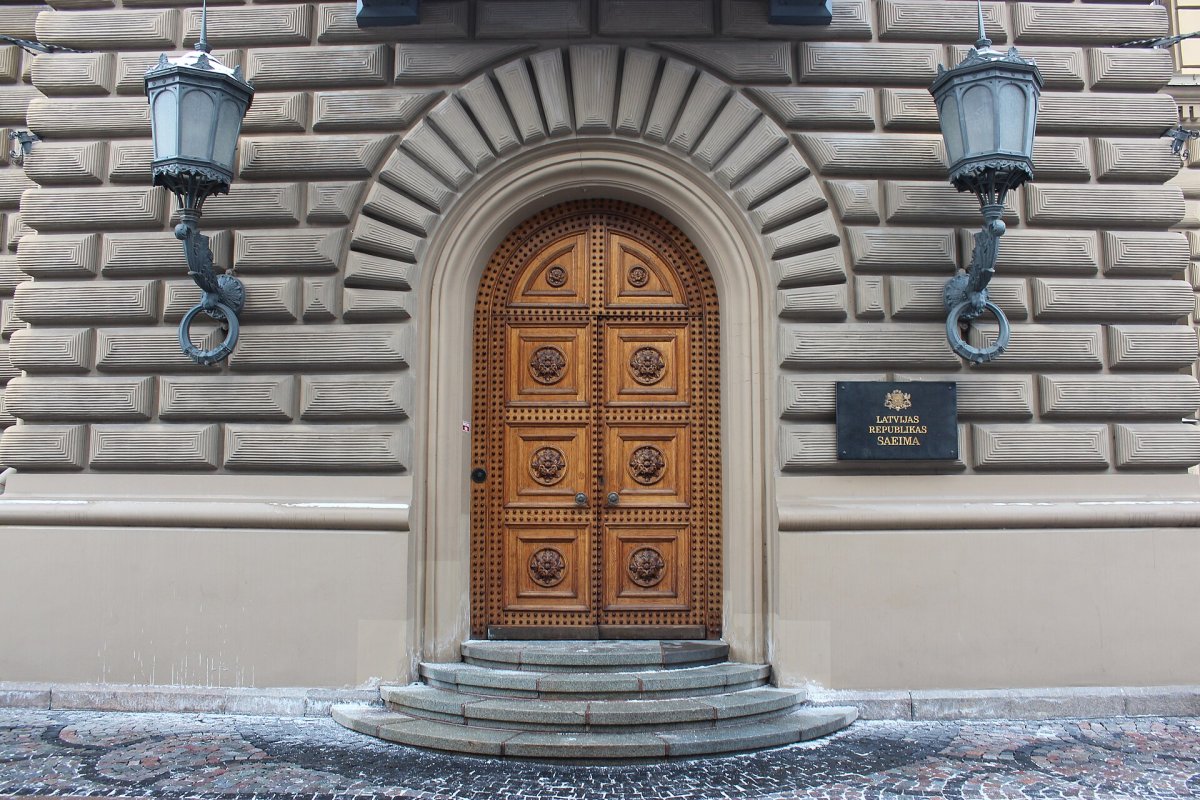
Illustrative photo: the main entrance to the Saeima building in Riga. Author Uhooep, Wikimedia Commons, CC BY-SA 4.0.
What hotinfo Is Watching
The first annual report on the effect of the ban, which the government is to submit to parliament by 1 March 2027.Whether the ban will end after 1 July 2027, or whether parliament will extend it.
How lawyer Alexey Dimitrov’s complaint against the language-tiered tax on books will turn out — and whether the dispute will reach the EU courts.
Whether any other EU member state will adopt the Latvian model after Minister Braže’s call.
Whether Latvia will really end its remaining economic ties to Russia by the end of 2026, as it has set out to do.