
Key actors — tap for context

Kristrún Frostadóttir
Prime minister of Iceland and leader of the Social Democratic Alliance, which called the referendum.
Why here: She said overnight that she hoped the result would “not divide the nation or leave behind wounds that will not heal".
More info →
Þorgerður Katrín Gunnarsdóttir
Iceland’s foreign minister and, since 2017, leader of the pro-EU Viðreisn party.
Why here: During the campaign she received threats that the police are investigating.
More info →Hafsteinn Birgir Einarsson
Icelandic political scientist and author of the predictive model that recalculates partial results into a nationwide estimate.
Why here: His model showed why Reykjavík’s results, despite a “yes" majority, still meant bad news for supporters of the talks.
Ólafur Þ. Harðarson
Icelandic political scientist and long-time analyst of voting behaviour.
Why here: He pointed out that the strongest predictor of voting is party affiliation, not age or place of residence.

Eiríkur Bergmann
Professor of political science at Bifröst University, specialist in European integration.
Why here: He formulated the “no" camp’s argument: Iceland is already three quarters inside the Union and at the same time proud of its sovereignty.
More info →
Lilja Alfreðsdóttir
Leader of the agrarian Progressive Party and former foreign minister.
Why here: At the “no" camp’s election party she claimed young voters had voted against the talks.
More info →Marta Kos
Slovenian European Commissioner for Enlargement.
Why here: She described the Icelandic vote as a clear test of how attractive the Union still is.

Reykjavík
Capital of Iceland, divided into two constituencies.
Why here: So far the only constituencies fully counted, and “yes" won in both.
More info →
Vestmannaeyjar
Archipelago off Iceland’s southern coast and one of the country’s fishing centres.
Why here: A French report from there showed why the EU’s common fisheries policy is unacceptable to fishermen.
More info →
Samfylkingin
Icelandic Social Democratic Party, the strongest party in the governing coalition.
Why here: According to political scientists, its voters supported “yes" at a rate of 90 to 100 percent.
More info →Viðreisn
Icelandic liberal and openly pro-European party that split from the Independence Party in 2016.
Why here: It emerged from a dispute over relations with the EU, and its voters were among the strongest supporters of “yes".
More info →
Sjálfstæðisflokkurinn
Iceland’s Independence Party, traditionally the country’s strongest right-wing and Eurosceptic force.
Why here: About 87 percent of its voters backed rejecting the talks.
More info →Miðflokkurinn
Icelandic right-wing populist Centre Party.
Why here: Its voters were the referendum’s most unified bloc, with about 95 percent for “no".
More info →
Framsóknarflokkurinn
Icelandic agrarian Progressive Party with a traditional base in the countryside and fishing communities.
Why here: Its representatives said overnight that young voters voted against the talks.
More info →Gallup
American polling company that publishes Iceland’s regular Þjóðarpúls mood survey.
Why here: It captured a shift among young voters between June and August.
Maskína
Icelandic polling agency.
Why here: Its last pre-election poll showed a gap of four-tenths of a percentage point between the two camps.
European Economic Area
Treaty that opens the EU single market to non-member states and of which Iceland is a member.
Why here: The “no" camp’s main argument: Iceland already has what matters most that membership would bring.
Two constituencies have been counted so far, and “yes" won in both
Iceland has six constituencies. They do not decide the referendum, because the result is based on the nationwide total of votes, but votes are counted by constituency, and that gives a map of the divide. RÚV ↗In both Reykjavík constituencies, which were the first to be fully counted, “yes" prevailed. In the capital’s northern constituency it was backed by 22,266 voters, or 57.5 percent of valid ballots, while 16,448 people voted against. In the southern Reykjavík constituency, 20,738 voters supported it, or 54.5 percent, and 17,317 were against. Turnout there reached 80.7 and 81 percent. Vísir ↗
The remaining four constituencies leaned the other way in the running totals, and some by a wide margin. In the Southern constituency, which should not be confused with southern Reykjavík and includes the fishing islands of Vestmannaeyjar, 60.8 percent voted against. In the Northwest constituency, the first figures showed 60.8 percent for “no", and in the Northeast the share of rejection votes rose from an initial 56 to 59 percent. Vísir ↗
During the night, the Southwest constituency, known in Iceland as the Kraginn, the collar around the capital, looked decisive. It is the most populous, and its first numbers were exactly tied, 9,900 votes on each side. In the next count it tilted toward “no" by 51.5 to 48.5 percent. According to political scientist Hafsteinn Birgir Einarsson, that was where it was decided whether “yes" still had a chance. “The Southwest constituency is really the unanswered question, but a lot would have to happen for us to see any result other than the nation saying no," he said overnight. RÚV ↗
Why “yes" weakened through the night
More important than the individual numbers is how they moved. In five of the six constituencies, that is, everywhere where a second batch of figures arrived by morning, the later results were worse for “yes" than the first ones. In Reykjavík North, the share fell from an initial 59.4 through 59.0 to a final 57.5 percent. In Reykjavík South it went from 55.9 through 55.5 to 54.5. In the Southern constituency, support for the talks shrank from 40.2 to 39.2 percent. Vísir ↗- The trend has its first exception, and it came at the end of the night. Final figures from the Southern constituency gave “yes" 13,473 votes (39.5 percent) and “no" 20,597 (60.5 percent). Compared with the previous batch, “yes" improved there from 39.2 to 39.5 percent, and RÚV described it as the first time during the evening that the “yes" camp improved within a constituency between two batches. In every other batch in every constituency up to that point, “no" had gained ground. Final figures from the Northwest constituency gave “yes" 7,060 (37.1 percent) and “no" 11,953 (62.9 percent), the strongest rejection of all constituencies. RÚV ↗
Hafsteinn Birgir Einarsson prepared a predictive model before the election that recalculates partial results into a nationwide estimate. According to him, “yes" would have had to win 63 percent in Reykjavík North just to reach a nationwide tie. It got 57.5. Even the first figures from that constituency were below his expectation, and after they were published he dryly commented: “These were not good numbers for yes." RÚV ↗
That also explains why European newsrooms reported something different overnight. Swiss SRF said the first partial results pointed to a narrow “yes". SRF ↗ Germany’s FAZ wrote about a narrow majority for the Union. FAZ ↗ Norway’s NRK, after 140,000 votes had been counted, was still headlining that “yes" was ahead. NRK ↗
Those headlines were not wrong at the time they were published. But they were misleading, and for a structural reason that RÚV had been pointing out throughout: Reykjavík had a much higher share of votes counted than the rest of the country, and Reykjavík is also the most pro-European part of Iceland. The running nationwide total therefore favoured “yes" until the rural constituencies began to come in. Anyone who sees a night-time headline about the pro-Union camp leading in the morning is reading an artefact of the count order. RÚV ↗
In polls, young voters swung by 23 points in two months
The most surprising polling figure of the whole campaign is not about geography but age. In Gallup’s June Þjóðarpúls, 63 percent of people aged 18 to 29 said they would probably vote “yes", and 37 percent “no". By the end of August the ratio had flipped almost exactly: 40 percent for “yes" and 60 percent for “no". Support for “yes" in this group therefore fell by 23 percentage points in two months, and because there are two camps, the net gap between them shifted by 46 points. This is happening in the group that a Western European reader would automatically expect to be on the pro-European side. RÚV ↗Hafsteinn Birgir Einarsson explains this by saying that people harden their political positions with age, while young people are still forming theirs, which is why campaigns focus on them more heavily. “It of course suggests that the no movement managed something in the last stretch," he added. Italian daily Il Sole 24 Ore frames it similarly, citing Morgunblaðið and saying that the youngest age group in the polls declared an intention to vote against more strongly than other age groups. Il Sole 24 Ore ↗
One thing calls for caution. These are polls of stated intent, not data from the vote count, because the referendum is secret and the age breakdown cannot be recovered from the result. When Progressive Party leader Lilja Alfreðsdóttir and her party colleague Magnea Gná Jóhannsdóttir said at the “no" camp’s election party overnight that “it is completely clear that young people are saying no", they were relying on those polls, not on counted ballots. They were also referring to polls about joining the Union, even though the referendum asked only about resuming talks. Vísir ↗
Party loyalty was the strongest predictor
Political scientist Ólafur Þ. Harðarson had warned before the vote that the strongest predictor is neither age nor place of residence, but which party a person votes for in parliamentary elections. Among voters of the governing Samfylkingin and the liberal Viðreisn, the share planning to support “yes" was between 90 and 100 percent. Among voters of the right-wing populist Miðflokkurinn, about 95 percent planned to vote against, and among the conservative Sjálfstæðisflokkurinn about 87 percent. RÚV ↗Maskína’s last pre-election poll put “yes" at 50.4 percent and “no" at 49.6 percent, a gap well within the margin of error. The polls also swung in the final week: according to a survey from the start of the week, 51.3 percent were in favour of resuming talks, while a survey published the day before the vote found 51.6 percent against. RÚV ↗
Turnout was exceptional by Icelandic standards. In the two Reykjavík constituencies that had been counted, it reached 80.7 and 81 percent, and nationwide, according to the running information, it appeared close to the 2024 parliamentary election, when turnout was 80.2 percent. By comparison, in the three referendums held in the history of the Icelandic republic before this one, turnout ranged between 49 and 75 percent. RÚV ↗
What the day looked like on the island is captured in an Euronews report from the polling stations. It was published on Saturday afternoon, before the first results, and runs seventy seconds.
- Brussels reacted calmly, and political scientists confirmed the party line. The European Commission said it respects the choice of the Icelandic people. ANSA ↗ After the result was published, European Council President Antonio Costa spoke with the prime minister and, according to his spokeswoman, repeated that Iceland remains one of the Union’s closest partners, above all through the European Economic Area agreement. RÚV ↗ Icelandic political scientists meanwhile confirmed what the section on party loyalty above describes: voters lined up behind their parties. International political scientist Vilborg Ása Guðjónsdóttir adds that Iceland has no economic need to join the Union, which is usually the main motive for candidate countries, and that she also sees no direct security argument. RÚV ↗
How foreign coverage explains it: quota kings and cod wars
Foreign newsrooms explain Iceland’s “no" primarily through fish, and they have reason to do so. Marine products make up almost 40 percent of Iceland’s goods exports. BFM TV ↗Swedish Svenska Dagbladet went furthest and wrote about the influence the fishing lobby had on the campaign. It uses the Icelandic term kvótakóngar for them, meaning quota kings or quota barons, and adds that the word oligarchs appears more and more often in public debate. According to the paper, they fear Brussels would want to let more countries into their fishing waters and start arguing over what the Swedes called Iceland’s oil. Svenska Dagbladet ↗
French BFM TV brought a report from Vestmannaeyjar, where the answer has long been settled. Trawler captain Jón Atli Gunnarsson recalls that “our predecessors fought to obtain this 200-mile zone around Iceland". He refers to the cod wars, a series of confrontations with Britain between 1958 and 1976, during which Iceland gradually expanded its exclusive fishing zone and the British Royal Navy was deployed against Icelandic vessels. Sverrir Haraldsson of the processing company VSV translates that into the present: with membership, Iceland would stop being the master of setting its own annual quotas. BFM TV ↗
Austrian Der Standard framed the whole question in its headline as a battle of two fears: will the fishing lobby beat the fear of Trump? Der Standard ↗ Croatia’s N1 asked whether fishing will decide the country’s European future. N1 ↗
Trump as a bogeyman and the place where the interpretation intensifies
The second half of foreign coverage belongs to Donald Trump. French L'Obs puts the bogeyman directly in the headline and describes the Icelandic public as divided. L'Obs ↗ Montenegro’s Vijesti frames the vote as taking place in the shadow of Trump’s threats to Greenland and notes that Iceland is only 290 kilometres from that Danish autonomous territory. According to the paper, part of the pro-talks camp believes the Union would protect the country if Trump ever made similar threats to Reykjavík. Vijesti ↗This is where precision matters, because the interpretation gets stronger from one newsroom to the next. Svenska Dagbladet in its second article attributes the calling of the referendum to Trump’s remarks, in which, according to the paper, he confused Iceland with Greenland when talking about annexation. Svenska Dagbladet ↗ We did not find such a strong causal claim in other sources, and caution is warranted on attribution: the referendum was part of the government programme, so at most it is defensible to speak of acceleration. Other outlets describe a weaker and documentable version: Trump’s statements about US control over Greenland changed the mood in Iceland at the beginning of the year.
Italian Il Sole 24 Ore offers a domestic counterargument to that. Political scientist Eiríkur Bergmann of Bifröst University points out that Iceland is a member of the European Economic Area and the Schengen area, so it is “already three quarters inside the European Union", while also being “vehemently proud of its sovereignty". That is exactly where the “no" camp’s argument lives: why join when we already have the essentials? Supporters of the talks countered with two points. Opening chapters does not yet mean membership; that would be decided in a second referendum only after the negotiations were finished, and only the talks would show what concrete conditions Brussels was willing to offer Iceland. EU Commissioner Marta Kos spoke in this context about creative solutions for fisheries. Il Sole 24 Ore ↗
What we still do not know
- According to Brussels, Iceland’s application to the Union remains valid - the referendum did not cancel it. That means Iceland is not formally going back to square one: the 2009 application is still on the table, and the decision to resume talks is political, not procedural. At the same time, the island has opened a debate about the need for clearer rules for future referendums, from turnout thresholds to the binding force of the result. The central bank governor added a warning while it remains unclear what will happen to the application next. This is the last update in this text; follow-up developments around Iceland’s application are covered in separate articles. Morgunblaðið ↗, RÚV ↗
At the time this text was published, the result was not official. Counting continued after 4 a.m. local time, only the two Reykjavík constituencies had been fully counted, and final figures were still missing from the four remaining constituencies. Vísir ↗
- The government accepted the result and will not enter talks. At an afternoon press conference in Harpa, this was confirmed by the leaders of all three governing parties. Foreign minister Þorgerður Katrín Gunnarsdóttir will convene the parliamentary foreign affairs committee on Monday, where they will also discuss whether the 2009 application will be formally withdrawn. Kristrún Frostadóttir rejected the idea that this is a step backward and noted that the difference between city and countryside was expected: “It was always clear it would be uphill against the countryside." She added that if the country wants to keep referendums as a tool, it must also be able to bear their results. RÚV ↗ From the opposition, Lilja Alfreðsdóttir called the result “a heavy blow for the government" and at the same time a victory for young voters. RÚV ↗
- Final result: Iceland rejected the talks. After all six constituencies were counted, “yes" has 105,399 votes (47.2 percent) and “no" 118,040 (52.8 percent), a margin of 12,641 votes, or 5.7 percentage points. The Southwest constituency ended 47.0 to 53.0 in favour of “no", so the breakdown in the body of the article holds in final form: “yes" won in only two constituencies out of six, and both are in Reykjavík. The last figures were delayed because the vote tally in Kópavogur did not add up and had to be recounted. Turnout ultimately reached 82.5 percent, higher than it appeared during the night - surpassing the 2024 parliamentary election and the highest in any Icelandic election since April 2009, when it was 85.1 percent. In total, 225,031 people voted, of whom 1,592 ballots were blank or invalid. RÚV ↗
- Five of the six constituencies have been counted and “no" leads by 9,578 votes. Final figures from the Northeast constituency gave “yes" 10,002 (38.8 percent) and “no" 15,822 (61.2 percent). Nationwide, among counted votes, “yes" has 89,459 and “no" 99,037, or 47.5 to 52.5 percent. Only the Southwest constituency remains, with about 32,000 votes still to be counted according to RÚV - and the “yes" camp would need around 65 percent of them to move into the lead. The penultimate batch from there had already given 48.5 to 51.5 in favour of “no". Icelandic media are already describing the result as a rejection of the talks. RÚV ↗ Vísir ↗
- Four of the six constituencies have been counted. Final figures from the Southern and Northwest constituencies have been added to the two Reykjavík constituencies. The last two are still missing: the Southwest constituency, where the penultimate batch gave “yes" 48.5 and “no" 51.5 percent, and the Northeast constituency, where it was 41.0 to 59.0. The nationwide total has not yet been published. RÚV ↗
One thing remains especially open. About 23 percent of voters on the list cast their ballots early outside the regular polling station, which according to RÚV may account for as much as thirty percent of all ballots cast, and these are counted last. How support is split in them has not yet been examined. The trend throughout the night was one-way and pointed toward “no", so a very strong reversal would be needed. RÚV ↗
It is also important to state precisely what was being voted on. The question was whether Iceland should resume accession talks that the government suspended in 2013 and told Brussels in 2015 it no longer wanted the country to be treated as a candidate for, not whether it should join the Union. The negotiations cover 35 chapters, and a separate referendum on actual membership would only take place after they were completed. The vote is advisory as well. The government said it would respect the result, but it is not legally bound to do so. Il Sole 24 Ore ↗
According to political scientists, it is unlikely that Kristrún Frostadóttir’s government would fall if the result is “no". The prime minister said overnight that she hoped the vote would “not divide the nation or leave behind wounds that will not heal", and conceded that rural concerns about agriculture, fisheries and mineral resources would need to be taken into account. RÚV ↗
For the Union, the result carries its own weight. Before the vote, Enlargement Commissioner Marta Kos said the Icelandic referendum is a kind of measure of how attractive the European Union still is. RÚV ↗
What hotinfo is watching
- The breakdown of early votes between the yes and no camps was published.
- Post-referendum analysis confirmed or refuted a swing among young voters against the pre-vote polling.
- The Landskjörstjórn published the official final referendum results including the national vote total.→ Za rokovania s EÚ hlasoval na Islande len Reykjavík. Prieskumy ukázali obrat ml…Konečné výsledky zo všetkých šiestich obvodov: áno 105 399 (47,2 %), nie 118 040 (52,8 %), rozdiel 12 641 hlasov. Účasť 82,5 %, najvyššia od apríla 2009. Doložené vlnou 3 v tomto článku.
- Kristrún Frostadóttir's government announced its next steps towards Brussels after the referendum result.→ Za rokovania s EÚ hlasoval na Islande len Reykjavík. Prieskumy ukázali obrat ml…Vláda na tlačovej konferencii v Harpe potvrdila, že výsledok rešpektuje a do prístupových rokovaní nepôjde. Ministerka zahraničia Þorgerður Katrín Gunnarsdóttir zvoláva na pondelok zahraničný výbor, kde sa bude riešiť aj formálne stiahnutie prihlášky z roku 2009.
- The European Commission commented officially on the Icelandic referendum result.→ Za rokovania s EÚ hlasoval na Islande len Reykjavík. Prieskumy ukázali obrat ml…Európska komisia vyhlásila, že rešpektuje voľbu islandského ľudu (ANSA). Predseda Európskej rady Antonio Costa sa spojil s premiérkou a zopakoval, že Island ostáva jedným z najbližších partnerov Únie cez zmluvu o EHP.
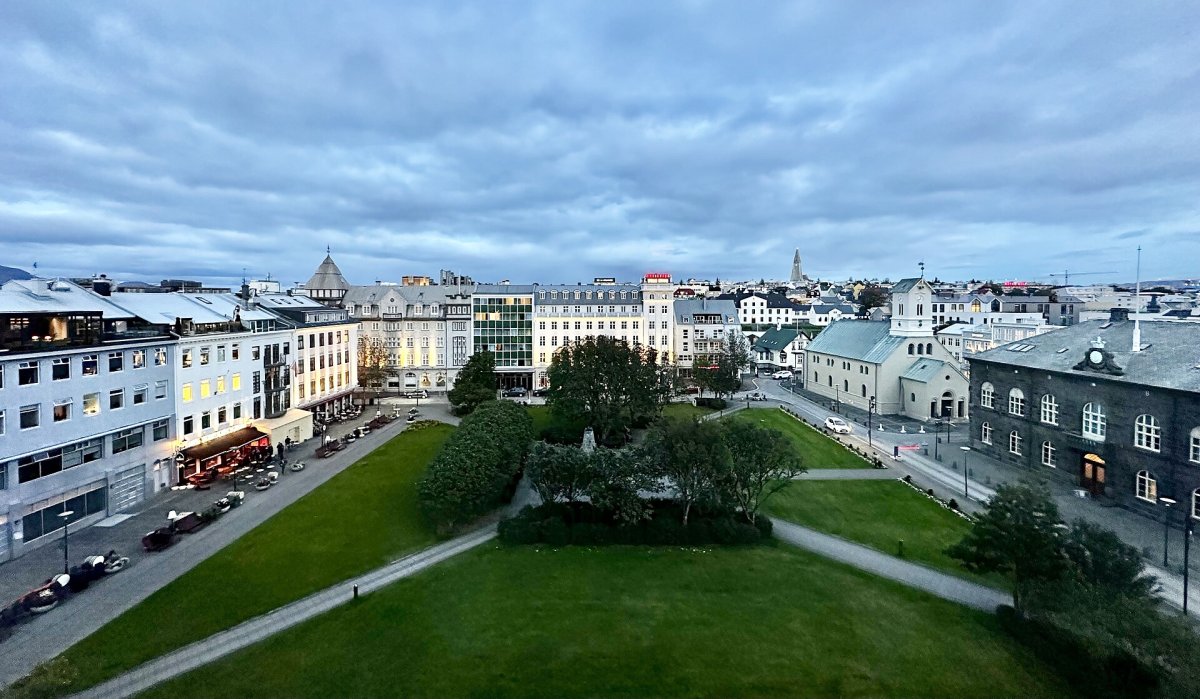
Illustrative photo: Austurvöllur square in central Reykjavík, with the Alþingi, Iceland’s parliament, on the right. By APK, Wikimedia Commons, license CC BY-SA 4.0. The image has been resized.