






Key actors — tap for context

Troy Meink
US Secretary of the Air Force, who has led the department since 2025 and also oversees the Space Force.
Why here: His sentence at the conference in National Harbor is the first public admission that the US has weapons in orbit.
More info →US Space Force
The sixth branch of the US armed forces, established in 2019 during the first Trump administration.
Why here: The systems Meink spoke about fall under it — and it was the Space Force that refused to say what they are.
Guo Jiakun
Spokesperson for the Chinese Ministry of Foreign Affairs.
Why here: Called on Washington to stop preparing for war in space.

Dmitry Peskov
Longtime spokesperson for the Kremlin.
Why here: Responded with a call for the complete demilitarization of space — something Russia itself does not practice.
More info →Outer Space Treaty
International treaty from 1967, the foundation of space law, ratified by more than a hundred states.
Why here: Its Article IV is the reason no ban on conventional weapons in orbit exists.
More info →
Ursula von der Leyen
President of the European Commission.
Why here: Four days before the American admission, she announced the European Space Shield in Paris.
More info →
Andrius Kubilius
European Commissioner for Defence and Space, former Lithuanian prime minister.
Why here: Named anti-satellite weapons among the threats the shield is meant to address.
More info →
Boris Pistorius
German Minister of Defence.
Why here: His department plans to invest €35 billion in space security by 2030 — the largest European commitment in this area.
More info →They admitted having a weapon, but not what kind
Meink spoke on September 14 at the annual Air and Space Forces Association conference in National Harbor near Washington. In his address he used a formulation that is new in the American military lexicon: "Troy Meink · 2026-09-14">This is why the United States now has on-orbit space control weapons capable of defending the joint force against hostile adversary action." Breaking Defense ↗What matters is what came next. The Air Force Department refused to say whether those weapons are kinetic or non-kinetic — that is, whether they shoot something down or blind and disable an adversary's satellite. It also did not disclose the timing of deployment. Meink justified this by saying that details would not serve deterrence. Air & Space Forces Magazine ↗
The difference between those two possibilities is not a technical footnote. A kinetic strike on a satellite creates a debris cloud that, in low Earth orbit, endangers everything else, including civilian satellites and the space station crew. Radio jamming, by contrast, is usually reversible and leaves nothing behind — though even a non-kinetic strike can be permanent if a laser damages a satellite's sensors. Washington has left the world uncertain about which of the two it has in orbit — and that is probably the point. The Washington Post ↗
The 1967 treaty has no ban on conventional weapons
Slovak and Czech media reported this story on Tuesday in dozens of versions, and almost all of them share the same structure: the Americans admitted it, Russia and China protest. What is missing is the thing that determines how the admission should be read — the legal framework.The 1967 Outer Space Treaty, in its Article IV, obliges states not to place in Earth orbit objects carrying nuclear weapons or other weapons of mass destruction. A stricter regime applies to the Moon and other celestial bodies: there the treaty bans military bases, installations and fortifications, the testing of any weapons, and military maneuvers. Military personnel for research and peaceful purposes, however, is explicitly permitted. Arms Control Association ↗
In other words: a conventional weapon in orbit is not banned. Space law expert Laetitia Cesari called this a regulatory vacuum — the 1967 text simply does not address conventional weapons in space. RTÉ ↗
This does not mean that the specific system complies with the whole of space law — the treaty imposes other obligations too, and Washington has not said what system is involved. What the admission actually changes is American restraint: these capabilities went undiscussed publicly for years, and now they came out in a single sentence at a conference.
Moscow and Beijing protest against what they themselves are doing
China's Ministry of Foreign Affairs responded through spokesperson Guo Jiakun. He called on the American side to stop expanding its military presence in space and to preserve global strategic stability through concrete actions. According to wire transcripts of the briefing, Beijing also warned against preparing for war in space and against turning it into a battlefield. The Irish Times ↗Kremlin spokesperson Dmitry Peskov said Russia is counting on broad international agreement on the complete demilitarization of space. Le Figaro ↗
Both statements, however, contradict the two countries' own programs. The Russian satellite Kosmos 2553, launched in February 2022, is described by American assessments as a testing platform for technologies related to a nuclear anti-satellite program — not as a warhead carrier. Ground-based measurements detected instability around it as early as November 2024, with later observations suggesting it has partially stabilized. China's Shijian-17, according to American military statements, has a robotic arm and has maneuvered in close proximity to geostationary satellites, demonstrably Chinese ones. American officials warn that the same technology could also be used to grab a foreign satellite. Secure World Foundation ↗
Unlike Washington, however, neither Moscow nor Beijing has admitted any of this.
Europe has a shield on paper and a new constellation only from 2029
For a European reader, one timing coincidence stands out. Four days before Meink's remarks, on September 10, European Commission President Ursula von der Leyen and Commissioner for Defence and Space Andrius Kubilius presented the European Space Shield at the international space summit in Paris, and reiterated the proposed budget envelope of €131 billion for defence, security and space for 2028–2034. Neither the shield nor that sum is new — they have featured in EU documents since 2025, and the envelope is still only a proposal, not an approved budget. Among the threats the shield is meant to address, Kubilius listed signal jamming and spoofing, suspicious approaches to satellites, anti-satellite weapons, missiles, robots and lasers. SpaceNews ↗The difference between the two announcements lies in both timing and nature. According to Meink, the American systems are already in orbit. Europe does have military satellites — France operates the Syracuse communications system, Britain has Skynet — but no European country has admitted to having weapons in orbit. The IRIS² constellation, which is meant to have 348 satellites and its first launches only in 2029, is a communications project, not a weapons one. The largest national commitment belongs to Germany, and it is not new: Boris Pistorius's defense department plans to invest €35 billion in space security between 2026 and 2030. Thales Alenia Space ↗
Central Europe's involvement so far takes a different form than weapons of its own. On Tuesday, September 15, as Meink's sentence traveled around the world, the Pardubice-based company ERA announced a partnership with the American firm HawkEye 360, which collects radio-frequency signals from satellites. The Czech company will process its data as an international partner for automated radar products. ERA has three decades of passive radiolocation experience behind it, with installations in more than seventy countries. PR Newswire ↗
That is a fairly accurate picture of Europe's position: a processor of data within an American architecture, not an owner of weapons in orbit.
Limits of this account
We know very little. Meink did not say how many systems are in orbit, since when they have been there, or what exactly they do — and without that it is impossible to judge whether this is a turning point or the disclosure of something that has been there for years. Claims about the Russian and Chinese programs come from American assessments and from observations by independent analysts, not from any admission by Moscow or Beijing. Kosmos 2553 remains a disputed case to this day, one that Russia denies.It also holds that "first admission" is not the same as "first deployment." American ground-based jammers targeting satellite communications have been publicly known for years, and programs involving close approaches to foreign satellites have been written about since 2014. What is new is the word, not necessarily the capability.
What hotinfo is tracking
- The Air Force or Space Force specified whether the deployed systems are kinetic or non-kinetic.
- The issue reached the UN Committee on the Peaceful Uses of Outer Space or the Conference on Disarmament in Geneva.
- Following the US acknowledgement, the European Commission changed the timeline of the European Space Shield or IRIS².
- Another country acknowledged having its own weapons in orbit.
- The ERA–HawkEye 360 collaboration translated into contracts for Czech or Slovak defence.
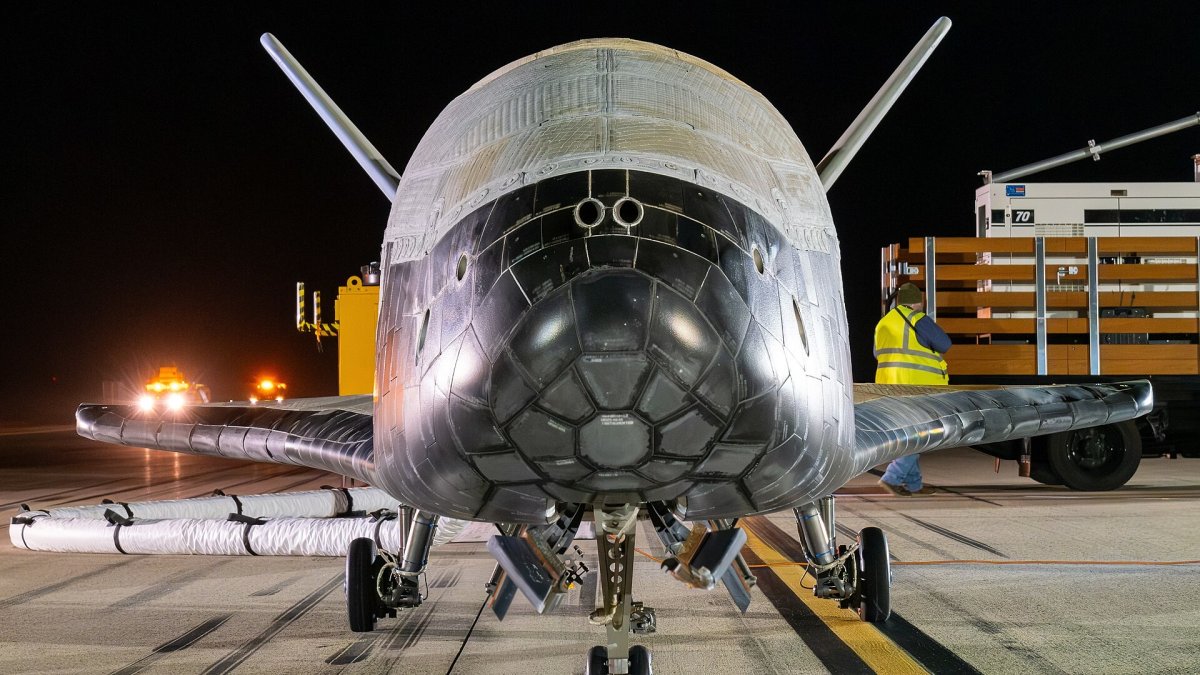
*Illustrative photo: the X-37B space plane of the US Space Force after landing at Vandenberg base in March 2025. It is not confirmed that Meink was referring specifically to the X-37B — the Pentagon did not name the system. Wikimedia Commons. Author: U.S. Space Force/Alexander Veloz. Public domain.*