


Key actors — tap for context

Joint Expeditionary Force
Military grouping of ten Northern European countries led by Britain, focused on waters around the British Isles and toward the Arctic Circle.
Why here: Ireland is negotiating entry into its broader branch JEF+, for now as an observer.
More info →
Helen McEntee
Irish Minister for Foreign Affairs and Trade and also Minister for Defence for Fine Gael, the first woman in both positions.
Why here: Leads the ministry that is to prepare the entry, and this week hosts defence ministers of the EU in Wicklow.
More info →
Kaja Kallas
High Representative of the EU for Foreign Affairs and Security Policy, former Estonian Prime Minister.
Why here: In Wicklow defended low Irish defence spending by saying Ireland has "much better neighbours".
More info →
Donnchadh Ó Laoghaire
Dáil member for Sinn Féin and party spokesperson for defence.
Why here: Leads opposition to scrapping the safeguard that ties foreign missions to a UN mandate.
More info →
Juraj Blanár
Slovak Minister for Foreign Affairs for Smer.
Why here: Is one of the ministers who travelled to the Gymnich talks in Ireland.
More info →
Wicklow
Irish county east of Dublin in the province of Leinster, where the Irish presidency hosts informal talks of EU ministers.
Why here: Location where defence ministers and foreign affairs ministers of the EU met this week.
More info →Ireland will not go to the core of the coalition
The Joint Expeditionary Force grouping was established as a British initiative and today consists of Britain, Denmark, Estonia, Finland, Iceland, Latvia, Lithuania, the Netherlands, Norway, and Sweden. Its task is to protect waters around the British Isles and northward toward the Arctic Circle, thus limiting Russia's ability to move freely in them. It fits into the British Operation Bastion, which means more intensive patrols of the Atlantic and a network of underwater listening stations. The Journal ↗According to the server, Dublin is not heading into the combat core of the grouping, but into a wider circle designated as JEF+, initially in the position of an observer. The rationale is practical. The Irish Navy has eight vessels, of which only about four are realistically deployed, they are not armed for combat, and they oversee a sea area many times larger than the area of Ireland itself. Instead of building its own fleet, Ireland wants to connect to the already existing British maritime surveillance infrastructure and use it against hybrid threats, for example, drone incursions. Military sources told the server openly: capacities are so limited that it will mainly be about providing information and intelligence data. Security Ireland ↗
Irish waters are a hub of transatlantic cables
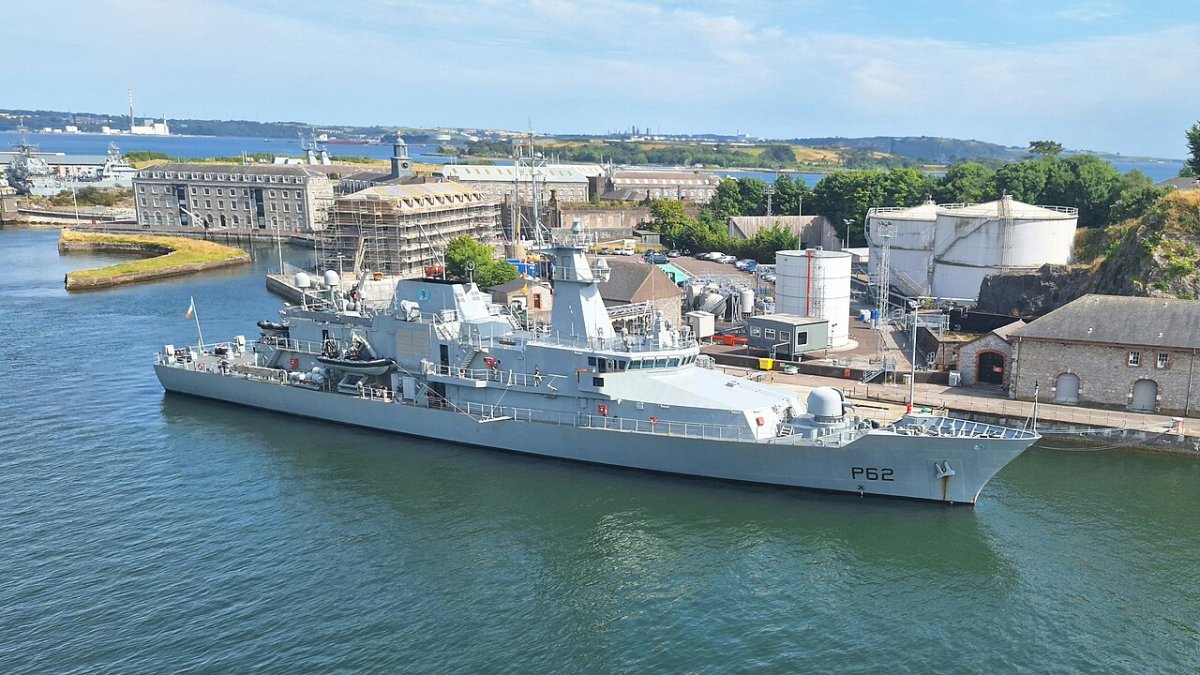
The reason why the topic opened now lies on the seabed. A substantial portion of transatlantic data cables pass through Ireland's exclusive economic zone or waters near it, plus gas pipelines and electrical connections to Britain. This is infrastructure that the country cannot guard alone.What this looks like in practice was shown by an incident on the night of November 14-15, 2024. The Russian ship Yantar, which Moscow describes as a research vessel and Western intelligence services as a tool for mapping the seabed, entered Ireland's economic zone and patrolled the section where eight data cables between Ireland and Britain lie, three gas pipelines, and two electrical connections. The Irish ship LÉ James Joyce tracked it and escorted it out of the zone in the morning. Irish Examiner ↗
In February, the Irish government responded with its first national maritime security strategy, which stated that without broader international ties, the country would not be able to guard its waters. Defence Minister Helen McEntee then said that the state should not be afraid to cooperate with Britain on security issues. The Journal ↗
Neutrality being rewritten
Negotiations with London come at a time when the Irish government is changing the rule that has defined its military restraint for decades. The so-called triple lock still today requires a UN mandate, government consent, and for deployment of more than twelve soldiers, also consent from the Dáil, the lower house of the Irish parliament. The first condition has given missions dependent on the Security Council a de facto brake from permanent members including Russia and China. This year's government defence bill proposal abolishes the UN mandate requirement and raises the threshold requiring parliamentary vote from twelve soldiers to fifty. The proposal passed the first reading in the Dáil and the government wants to push it through by year's end, but its second reading has been postponed to a later date. The Irish Times ↗The opposition rejects this. Sinn Féin defence spokesperson Donnchadh Ó Laoghaire called the intention an unprecedented attack on Irish neutrality and pointed to a detail that is essential in the JEF debate: cooperation can be done bilaterally, with Britain or with France, while all member states of the Joint Expeditionary Force are also NATO members. Ireland would thus find itself in a grouping where it is the only one outside the alliance. Moreover, not just Sinn Féin opposes scrapping the safeguard, other opposition parties also reject it, and some of them are calling for such a change to be decided by referendum. Sinn Féin ↗
Read also: Swiss will vote on banning their own sanctions. In the campaign for neutrality, Moscow appears
Slovak and Czech media write about Ireland, but about something else
Right here it becomes clear how differently the same country is read from outside and from within. Slovak and Czech media have written about a dozen articles about Ireland in the last two days. Among them are reports that Foreign Minister Juraj Blanár travelled to the Gymnich, that his Czech colleague Petr Macinka is flying to Ireland after the V4 talks with Japan, and a series of texts about a copy of the Prague Infant Jesus that Prague gave to Irish county Kerry for the presidency. TERAZ.sk ↗About what is the main domestic topic of Irish media on the same day—namely, negotiations about entry into the British naval grouping—nothing appeared in Slovak or Czech reporting that HotInfo monitors. Yet the neutrality of one of the few unaligned countries in the union is changing precisely in the week and at the place where our ministers are physically present.
The difference in framing was also heard directly in Wicklow. When foreign journalists pressed EU High Representative Kaja Kallas on why Ireland spends 0.2 percent of gross domestic product on defence, roughly 0.3 percent of gross national income, when twenty-three of twenty-seven member states have already reached or exceeded two percent, she replied that Ireland is a neutral country and has "much better neighbours". McEntee countered with budget growth of 43 percent over four years and purchases of military radars and anti-drone technology. Irish Examiner ↗
Limits of this perspective
The information about negotiations currently stands on a single source. The Journal is an established Dublin news server, but its text relies on unnamed government and military sources and formulations like "it is understood that the government tasked the ministry". Neither the Irish cabinet nor the British side has officially confirmed this yet, and until they do, this is a well-founded intention, not a done deal.Precise reading is also demanded by the step itself. JEF+ is not NATO and does not establish a mutual defence obligation. Ireland is heading into it as an observer and not as a combat force, which with four usable ships couldn't happen anyway. Whoever would make an alliance entry out of this jumps the gun as much as whoever would claim that nothing is changing.
Illustrative photo: Irish patrol ship LÉ James Joyce (P62) at the naval base Haulbowline, July 2024. This very ship tracked the Russian vessel Yantar in Irish waters just a few months later. Author Gloriouswarship, Wikimedia Commons, CC0.
What hotinfo is monitoring
- The Irish government officially confirmed or denied that it tasked the defence ministry with preparing to join JEF+.
- The government defence bill removing the UN mandate requirement passed second reading in the Dáil.
- Ireland obtained formal observer status in JEF+.
- The defence ministry published what specific data and intelligence products it is to receive from taking part.
- Sinn Féin or another opposition party forced a parliamentary debate on neutrality or tabled a counter-proposal.