


Key actors — tap for context

Operation Atalanta
A European Union naval operation off the Horn of Africa, launched in 2008 to protect merchant ships and World Food Programme convoys from Somali pirates.
Why here: It tracks hijacked ships, warns shipping companies, and coordinates the response of warships from several countries.
More info →International Maritime Bureau
A specialized division of the International Chamber of Commerce founded in 1981. Its Piracy Reporting Centre operates in Kuala Lumpur and publishes regular reports on attacks.
Why here: Its semi-annual report is the source of both figures, which seemingly contradict each other.
More info →
Puntland
An autonomous region in northeastern Somalia with its own government and security forces.
Why here: Hijacked ships are anchored off its coast, and its authorities have denied the government's version of the Lutuf's release.
More info →
Gulf of Aden
A sea gulf between Yemen and Somalia, which connects to the Red Sea in the northwest via the Bab-el-Mandeb Strait and to the Arabian Sea in the east.
Why here: The area through which the route to the Suez Canal runs and where the attacks are concentrated.
More info →
Al-Shabaab
A Somali Islamist movement linked to al-Qaeda that has been fighting the Somali government since 2006 and controls part of the countryside.
Why here: Analysts cited by the Guardian link it to smuggling networks and to contacts with Yemen's Houthis.
More info →
Starlink
A satellite internet service operated by SpaceX that provides connectivity through a network of thousands of satellites in low orbit.
Why here: According to Somali officials, pirates use it to track targets and to communicate between ships.
More info →Two Figures From the Same Report
The International Maritime Bureau published its semi-annual report on July 9. For the first six months of the year, it records 38 piracy attacks and robberies at sea. By comparison, there were 90 in the same period last year, and sixty in 2024. Of this year's incidents, 27 ships were boarded, five were hijacked, attackers fired on three ships, and three attacks remained attempts. The Bureau's director, Michael Howlett, called it an encouraging figure that reflects sustained efforts. Medzinárodná obchodná komora ↗But the same report also contains a figure about people. Over the half-year, pirates captured 67 sailors, threatened two, and injured one. And this is precisely where the picture reverses: according to the Bureau, Somali pirates are responsible for 94 percent of captured crew members. Medzinárodná obchodná komora ↗
These two figures measure two different things. The number of incidents indicates how many times someone boarded a vessel — in the vast majority of cases, this meant boarding without capturing the crew. The Somali model is different: the entire ship, crew included, is hijacked, towed toward the coast, and held for months while a ransom is awaited. That is why a handful of Somali hijackings outweigh dozens of boardings elsewhere in the hostage statistics.
Four Ships Off the Northern Coast
What this looks like in practice was described by Operation Atalanta, the European Union's naval mission off the Horn of Africa. In a report from July 29, it listed four hijacked ships that were then anchored off the northern coast of Somalia. EUNAVFOR Atalanta ↗The Palau-flagged tanker HONOUR 25 was hijacked on April 21, with 17 people on board, mostly Pakistanis, carrying petroleum products to Mogadishu. The Saint Kitts and Nevis-flagged cargo ship SWARD was boarded on April 26, with a crew of 15, mostly Syrians, carrying fertilizer to Mombasa. The Togo-flagged tanker EUREKA was hijacked on May 2, with twelve people on board, eight of them Egyptians. The Tanzanian-flagged tanker ASANA was hijacked on July 17 about 65 nautical miles southwest of Mukalla, Yemen, with 22 people on board, half of them Indians. EUNAVFOR Atalanta ↗
Regarding their location, Atalanta added that "the four pirated vessels are anchored in the Northern coast of Somalia, inside territorial waters and very close to the coast". This matters, because a foreign warship cannot intervene in territorial waters without Somalia's consent. EUNAVFOR Atalanta ↗
Since then, the numbers have continued to grow. On September 9, Horseed Media reported that pirate groups are holding six merchant ships and more than ninety sailors. That figure is based on an earlier report that predated the release of the ship Lutuf in late August. According to the same source, the kidnappers are demanding ten million dollars for the eight Egyptians held since May. Horseed Media ↗
A Hijacked Ship as a Tool for the Next Hijacking
The Guardian, which wrote about the return of piracy on Tuesday, provided a detail that shows how the attacks are chained together. The British newspaper spoke with local officials, who described how pirate groups use ships they have already captured to carry out further raids. The Guardian ↗Since the end of April, the Guardian has counted eight hijackings by Somali pirates, two of them within a two-week span in August. Specifically: the Cameroon-flagged cargo ship Lutuf was boarded on August 17 about three nautical miles off the coast near the fishing town of Maraya. It was approached by none other than the SWARD — the same cement-carrying ship that pirates hijacked in April and have since turned into a mother ship. Eight armed men transferred from it to the Lutuf and overpowered its armed security detail. The Guardian ↗
The Lutuf was carrying equipment for the Turkish military base in Mogadishu. According to the specialist outlet Maritime Executive, it was a ship built in 1995 with a deadweight of 1,400 tons and a crew of ten — six Indians, one Turk, one Georgian, and two Serbian security personnel. Maritime Executive ↗
How the Lutuf Was Freed Depends on Who You Ask
The ship was freed in late August, but the accounts diverge, and it is worth distinguishing between them.Somalia's Ministry of Defence announced a joint operation with Turkey that lasted ten days, in which fourteen pirates were killed and four of their boats destroyed. According to Al Jazeera, the ministry stated that "sustained pressure from the forces ultimately compelled the remaining pirates to abandon the vessel". It gave no further details about the fate of the crew or its own losses. Al Jazeera ↗
Turkey's Ministry of Defence confirmed the number of pirates killed, and according to Maritime Executive, Ankara refused to pay a ransom. According to unconfirmed reports, the kidnappers initially demanded ten million dollars and later lowered the sum to two million. Maritime Executive ↗
Local officials, including Mohamed Mubarak, who heads Puntland's security coordination office, told the Guardian, however, that a ransom of 2.5 million dollars was in fact paid. And they warned that it is precisely such payments that encourage further hijackings. The Guardian ↗
Which version is closer to the truth cannot yet be determined from public sources. However, the Guardian noted an indirect signal in Galkayo, a commercial hub in central Somalia: residents say that after the Lutuf case, significantly more money began circulating in the local economy, consumption of the stimulant khat rose, and expensive off-road vehicles appeared on the roads. During the previous wave of piracy, such money accompanied coastal towns for years. The Guardian ↗
What Made the Return of Piracy Possible
The sources describe a convergence of several causes — international conflicts, domestic factors, and the growing capabilities of the pirates themselves.The first is the redeployment of warships elsewhere. Matthew Reisener, senior national security advisor at the think tank Center for Maritime Strategy, wrote on July 16 that Iranian operations in the Strait of Hormuz and attacks by Yemen's Houthis in the Red Sea allow piracy to "to once again thrive". He wrote: "Not only have the global navies that once combatted piracy off the Horn of Africa diverted their resources to counter the threats against ships in these critical waterways, but these conflicts have also drawn maritime traffic closer to Somalia’s coastline, creating openings for opportunistic pirates to target commercial ships". The Guardian ↗
The second is the shift in shipping routes. In his July analysis, Reisener stated that approximately 70 percent of the traffic that used to pass through the Red Sea before the Houthi attacks has been rerouted around the Cape of Good Hope. The Guardian ↗
Added to this is the domestic backdrop. The Guardian notes that the attention of both Somali and foreign authorities is focused on weapons smuggling into Yemen by networks that, according to observers, act on Iran's behalf, and that analysts, according to the paper, suggest part of these networks is increasingly linking up with the Somali Islamist movement al-Shabaab, which is once again expanding the territory under its control and seeking contacts with Yemen's Houthis. This is an assessment by analysts, not a finding by investigators. The Guardian ↗
The third is technology. According to Somali officials cited by the Guardian, pirate groups use SpaceX's Starlink satellite internet to search for targets and to communicate quickly among themselves. Neither of the available sources presents technical evidence or independent verification for this, so it remains a claim by officials rather than a proven fact. In this context, the specialist outlet Lloyd's List speaks of a "more capable and adaptive" Somali threat that exposes weaknesses in shipping companies' protective measures to date. The Guardian ↗ Horseed Media ↗
The Somali parliament responded on Wednesday. The upper chamber passed, by 29 votes with none against, a new law against piracy and hijacking that replaces legislation from 1975 and introduces sentences ranging from five to twenty years. According to the Ministry of Justice, this is "a pivotal step towards strengthening maritime security, protecting important trade routes". The law still needs the signature of President Hassan Sheikh Mohamud. Horseed Media ↗
Why Watch This From Here, Too
The operation currently tracking these ships is European. Atalanta has been operating under European Union command since 2008; its operational headquarters have been based in Rota, Spain, since 2019, and Slovakia is one of the member states that contributes to its joint costs. Its reports are today the main public source of information on how many people are being held captive off the Somali coast.That this is not merely observation was demonstrated by a case on July 1. According to the report, the ship MV Golden Arsenal, about 110 nautical miles northeast of Bosaso, was attacked by armed men with rifles and rocket launchers; the crew locked themselves in a safe room, and, via Atalanta's coordination center, the South Korean navy, the Indian frigate INS Trikand, and the Combined Maritime Forces responded. The Indian unit searched the ship and confirmed that none of the attackers remained on board. No one was injured. EUNAVFOR Atalanta ↗
The second reason is cost. The route through the Suez Canal is the shortest path for goods from Asia to Europe, and the detour around Africa extends it by weeks. If the risk off the Somali coast is added to the risk in the Red Sea, the space in which ships can sail safely narrows — and higher insurance and shipping costs could be passed on to the prices of imported goods.
And the third is precedent. British academics Anja Shortland and Federico Varese, who studied Somali piracy in 2014, wrote in May that further developments depend on how the current hijackings end. "Pirates rely on ransoms for reinvestment and to attract young men into their no-win-no-fee contracts. Fast and generous payments … may free the captive ships. But they will lead to escalating risks for everyone else." At the same time, they doubt that anyone today would repeat the 2011–2012 mission, when the world's navies spent more than a billion dollars a year on counter-piracy operations. Their conclusion is that although piracy plays out at sea, it can only be solved on land. The Guardian ↗
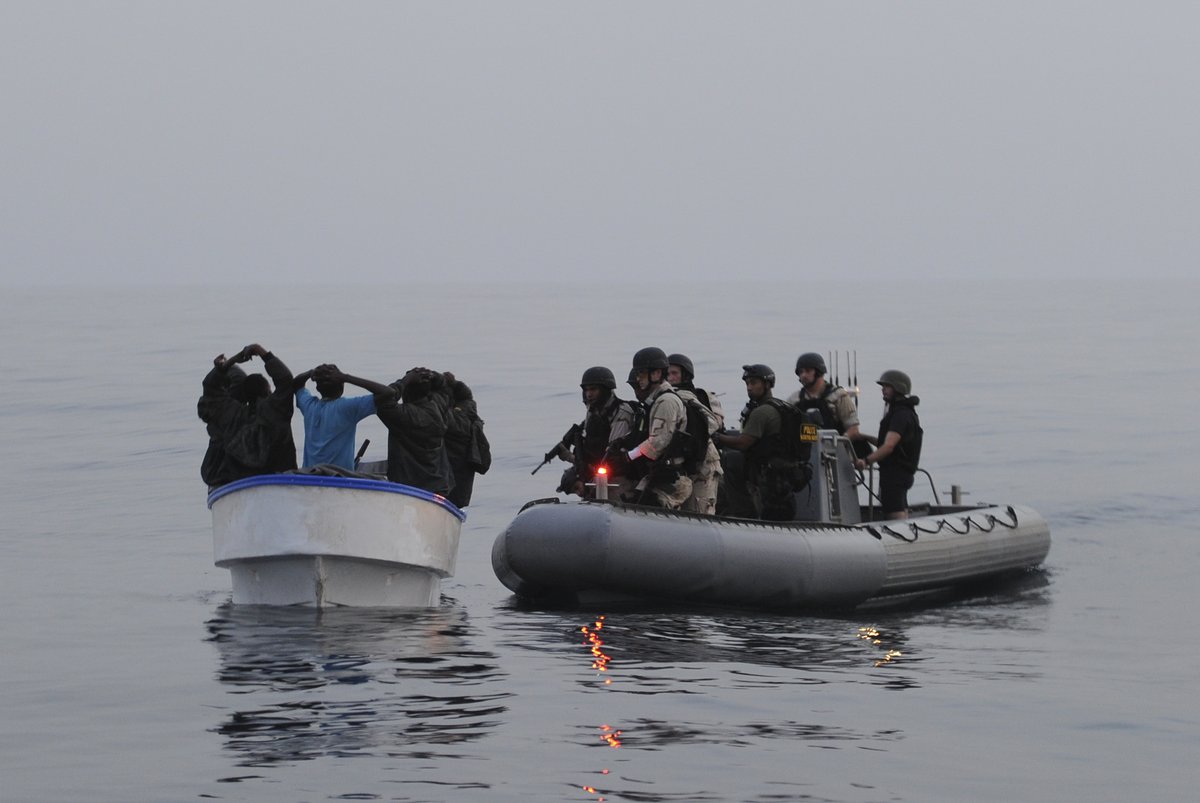
Illustrative photo: a boarding team from the U.S. missile cruiser USS Anzio inspects a suspicious skiff in the Gulf of Aden, July 2011. Photo: Bryan Weyers / U.S. Navy, public domain