


Over the following five days, all three Baltic states joined the issue one after another. On Monday the Lithuanian minister of agriculture expanded the checks and the State Security Department announced the expulsion of 22 Belarusians, on Tuesday the Lithuanian prime minister spoke up, and on Wednesday the Estonian prime minister and the head of Latvia's Food and Veterinary Service. Together it adds up to a picture of a single conflict waged through trade documents, port cranes and satellite navigation.
Key actors — tap for context

Kristen Michal
Estonian prime minister, chairman of the liberal Reform Party, in office since 2024.
Why here: Declared that the export of Russian grain through Estonian ports is unacceptable, even though his own customs officers report zero transit.
More info →
Mindaugas Sinkevičius
Lithuanian prime minister, a social democrat and former minister of economy.
Why here: Announced that shipments through Klaipėda will not pass uninspected, and discussed it by phone with his Latvian counterpart.
More info →Kęstutis Mažeika
Lithuanian minister of agriculture.
Why here: Asked the food and veterinary service to verify the origin of all grain from Russia and Belarus regardless of its declared use.
More info →Māris Balodis
Director general of Latvia's Food and Veterinary Service (PVD), which inspects food and feed.
Why here: Explained the mechanics of isotope testing of grain and also why the result comes only after the ship has sailed.

Baiba Braže
Latvian foreign minister for the New Unity party, previously NATO assistant secretary general for public diplomacy.
Why here: At the Terehova border crossing she described the instrumentalisation of migrants as an organised hybrid threat to the whole of Europe.
More info →
Tom Berendsen
Dutch minister of foreign affairs.
Why here: Came with Braže to the Latvian-Russian border and supported funding of the eastern border from the Union budget.
More info →
Gitanas Nausėda
Lithuanian president, an economist, in office since 2019.
Why here: His national security adviser is the only person in this story who claims that the threat from Belarus is not growing.
More info →
Deividas Matulionis
Lithuanian diplomat and chief national security adviser to President Nausėda.
Why here: Said that the Lithuanian services do not see an increased threat from Belarus, thereby casting doubt on the overall picture of an escalating danger.
More info →
Sviatlana Cichanouská
Belarusian opposition leader living in exile in Lithuania, a candidate in the 2020 election.
Why here: Claims that new military infrastructure is being built in Belarus, which Lithuanian intelligence does not confirm.
More info →
Raivo Vare
Estonian logistics expert, businessman and former minister of transport.
Why here: Explained why the Baltic ports are attractive to Russia, even though no grain flows through them so far.
More info →Pavel Prokopenko
Spokesman for the Estonian Tax and Customs Board (MTA).
Why here: Said that since the start of the full-scale invasion not a single grain of Russian cereal has passed through Estonia.
Jānis Karlsbergs
Chairman of the board of the Latvian Transatlantic Organisation, a non-governmental association focused on security.
Why here: Called the threats against Latvian arms companies a psychological operation.

Klaipėda
Lithuania's most important port city and its only seaport.
Why here: This is exactly where samples were taken from the disputed grain shipment.
More info →
Muuga
Estonia's largest cargo port, east of Tallinn, with a grain terminal dating from 1986.
Why here: It is precisely its capacity that Estonian experts cite as the reason why it could be of interest for Russian exports.
More info →
Kaliningrad
A Russian exclave between Poland and Lithuania, separated from the rest of Russia by Union territory.
Why here: According to the Lithuanian authorities, the suspicious shipment passed through it.
More info →Terehova
A border crossing on the Latvian-Russian border in Latgale, one of the main entry points into the Union from the east.
Why here: Latvian and Dutch diplomats came here to look at the application of sanctions in practice.
Galileo
The European Union's global satellite navigation system, the European counterpart of the American GPS.
Why here: Precise receivers for its agricultural use were to be developed by a company with hidden ties to the Russian and Belarusian arms industry.
More info →
European Public Prosecutor's Office
An independent Union body prosecuting crimes against its financial interests.
Why here: It led the investigation into a company that fraudulently obtained almost half a million euros from the European space programme.
More info →
DEFRA
The British Department for Environment, Food and Rural Affairs.
Why here: Its laboratory created, together with Ukrainians, an isotope map that makes it possible to determine the origin of grain.
More info →Global Citizens Against War 1984
A pro-Russian group that claims responsibility for acts of sabotage in Europe.
Why here: It is threatening two Latvian companies unless they stop supplying Ukraine by 7 October.
Grain Verification Scheme
An inspection scheme of Lithuania, Ukraine and the United Kingdom from May 2025 with mandatory testing of feed grain.
Why here: It applies only to feed grain in customs warehouses, not to all transit.

Latvijas Radio
Latvia's public service radio broadcaster.
Why here: It carried an interview in which the head of the PVD described a sample's journey through three countries.
More info →How it can be proved which field the grain grew in
How it is actually proved which field grain grew in was explained by the director general of Latvia's Food and Veterinary Service, Māris Balodis, in an interview for Latvijas Radio. His agency wants to obtain the right to inspect transit cargo in Latvian ports, something it has not done so far because the European Union does not require it. LSM ↗The method is isotope analysis and trace element analysis. "We will have the right to take samples of grains to determine their possible geographical origin through isotope and trace element analysis." "There is an isotope map of a specific country available, which allows us to determine whether products, in this case grains, come from a specific region," Balodis said. The Ukrainian isotope map for grain was created by the British DEFRA laboratory together with Ukrainian colleagues.
In practice this means a journey across three countries. "We will take samples, analyze them in France, France will send them to England, and then we will receive an answer whether grains that match the Ukrainian profile have been detected," Balodis described the procedure. One inspection is to cost 900 to 1,000 euros and will be paid by the owners of the cargo, and in advance. Whoever refuses the advance payment will not cross the Latvian border; whoever pays it may continue on their way.
And here is the core of the problem. According to Balodis, roughly a month passes from the taking of the sample to the result, even longer than the two to three weeks the Lithuanians expect for the sample from Klaipėda. The specific shipment will long since be somewhere else by then. But the agency will know who transported it and where it came from. "This will be a reason for making other decisions in the future at the European Union level," Balodis says. The inspection is therefore not meant to stop the ship it is checking, but to obtain evidence against the next ones.
Estonia says not a single grain has passed through its ports
The Estonian side, however, says there is nothing to catch. Pavel Prokopenko, spokesman for the Tax and Customs Board, said that since the beginning of the full-scale invasion no grain has been imported into Estonia from Russia, nor has any transited through the country. Grain of Russian origin is moreover subject to high tariffs on import into the Union, so it is not economically worthwhile for an importer. ERR ↗Prime Minister Kristen Michal nevertheless considers it an issue. "Estonia's position is clear: We do not consider it acceptable for Russia to use Estonian ports to export its grain. Russia bears sole responsibility for the security situation in the Black Sea, which has seriously disrupted both Ukrainian and Russian grain exports. It would be cynical if Russia were simultaneously able to reroute its grain exports through Baltic ports," he wrote for ERR.
So why are three governments dealing with something that, according to Estonian customs officers, is not happening? There are two reasons. The first is the change of route. Since Ukrainian attacks have largely halted Russian shipments across the Black Sea, Russia has, according to ERR, increased grain transit across the Baltic Sea. So far this involves its own ports, but that is precisely why the Baltic governments are watching whether the flow shifts to them. The second reason is capacity. Logistics expert Raivo Vare told ERR that Estonia has capacity for five and a half million tonnes of grain, Latvia two to three million and Lithuania similarly. The grain terminal in Muuga east of Tallinn has deep-water berths where large grain carriers can dock, something the shallower-draught Lithuanian and Latvian ports cannot handle. In his view the Baltic ports are logistically better positioned than the Russian ones for markets across the Atlantic and in East Africa.
Lithuanian Prime Minister Mindaugas Sinkevičius therefore said in Klaipėda that shipments would not pass through the port there "uncontrolled" and that he had spoken by phone with his Latvian counterpart about the matter. "The issue concerns not just Lithuania as a state; in this case, we are talking about three states - Latvia, Estonia and Lithuania," he added. LRT ↗
Lithuania says the 2025 scheme has a hole
A control mechanism has in fact existed for more than a year. Since May 2025, Lithuania, Ukraine and the United Kingdom have been running the so-called Grain Verification Scheme, under which feed grain stored in customs warehouses is subject to mandatory laboratory testing.The Lithuanian Ministry of Agriculture, however, warned that changes in the monitored flows suggest circumvention. According to the ministry, some shipments may be moving through simplified direct transit procedures or are declared as food-grade grain, to which the checks do not apply. Agriculture Minister Kęstutis Mažeika therefore formally asked the service to verify the origin of all grain from Russia and Belarus regardless of the declared use. "We must do everything to ensure that our country's infrastructure is not used for the transit of stolen Ukrainian grain," he said. LRT ↗
Satellites for tractors and threats to arms makers
That agriculture is not a marginal topic in this conflict was also shown by a second Lithuanian case from the same week. The State Security Department (VSD) announced on Monday that it had declared 22 Belarusian citizens working for a technology company a threat to national security. They lost their residence permits, were expelled and received a five-year ban on entering the Schengen area. LRT ↗The company took part in a project of the European Union Agency for the Space Programme and was supposed to develop high-precision satellite navigation receivers for Galileo, intended for guiding agricultural machinery and for precision agriculture. An investigation by the European Public Prosecutor's Office and the Lithuanian financial crime service found that the company had concealed ties to the Russian and Belarusian military industry. The project had a budget of more than one million euros, of which the agency financed more than 745,000, and the company actually received 447,272 euros. Last week the Vilnius Regional Court convicted two Belarusian citizens of fraud.
On the Latvian side there was a third case. A pro-Russian group signing itself as Global Citizens Against War 1984 sent threats to the governments of Latvia, Poland and Portugal, demanding a halt to arms supplies to Ukraine. It told two Latvian defence industry companies, Unitruck and Eraser, that it would stop their activities by any means if they did not cease supplying Ukraine by 7 October. LSM ↗
The Latvian Constitution Protection Bureau said, according to Latvijas Radio, that the aim is to sow fear and uncertainty, to bolster the group's own image and thereby indirectly slow down aid to Ukraine. The bureau refrained from further comment on the grounds that it would itself amplify the effect of the message. Jānis Karlsbergs, chairman of the board of the Latvian Transatlantic Organisation, called it a psychological operation in a radio programme and recalled that there had already been a fire at Latvia's Museum of the Occupation and that IKEA stores had burned in Poland.
The border, migrants and the Dutch minister
The fourth event took place on the same Wednesday at the Latvian-Russian border in Terehova, where Foreign Minister Baiba Braže arrived together with Dutch Foreign Minister Tom Berendsen. Braže described the instrumentalisation of migrants by Belarus and Russia as an organised hybrid threat to the whole of Europe and called for the Union, alongside the large sanctions packages, to regularly adopt targeted restrictions against companies and supply channels that help Russia produce missiles and drones. Diena ↗Both ministers agreed that the Union's next multiannual budget needs to earmark money for eastern border infrastructure. Braže also thanked the Netherlands for its willingness to host the Special Tribunal for the Crime of Aggression against Ukraine and praised its contribution to the region's defence, from the German-Dutch corps responsible for NATO ground forces in Latvia and Estonia to airspace patrols.
Read also: Dutch transport workers went on strike over disability benefits. Trains stood still for 24 hours and the government kept quiet about having already withdrawn the cuts
The limits of this view
All four stories come from Baltic public service media and from the Latvian daily Diena, that is, from countries that see themselves as the front line. That is a legitimate lens, but it is a lens, not a neutral view from outside. None of the four events has so far been picked up by Slovak or Czech media.More importantly, even within the Baltics themselves there is no consensus on the level of threat. Deividas Matulionis, chief national security adviser to Lithuanian President Gitanas Nausėda, said on 4 September that Lithuanian services do not see an increased threat from the Belarusian side. "I specifically made additional inquiries today, and our services have no such information. As of today, we do not see an increased threat from the Belarusian side," he said, adding that while Russian military facilities do exist in Belarus, intelligence has not detected any new manoeuvre units that would directly threaten Lithuania, Latvia or Poland. He was responding to claims by Belarusian opposition leader Sviatlana Tsikhanouskaya that new military infrastructure is being built in Belarus. LRT ↗
The grain question itself also remains open. The suspicion from Klaipėda has not been confirmed so far and Estonian customs data speak of zero transit. Without the result of the isotope analysis it is premature to claim that stolen Ukrainian grain is flowing through Baltic ports. So far the only thing demonstrated is that three governments have decided to look down this route before anything is proven.
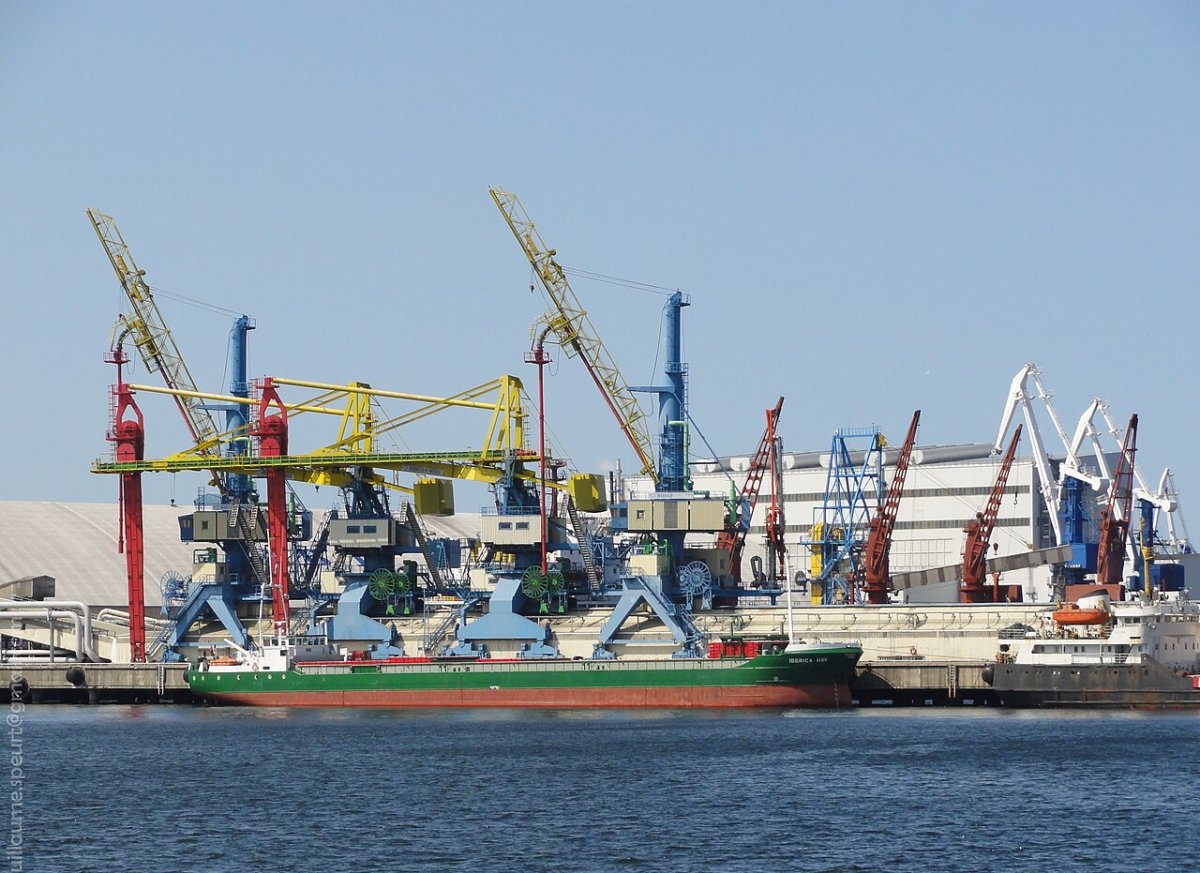
Ilustračná fotka: transhipment cranes and a cargo ship at Estonia's Muuga port near Tallinn in an archive photograph. Author Guillaume Speurt, Wikimedia Commons, licence CC BY-SA 2.0. The image has been downscaled.
What hotinfo is watching
- Laboratórium potvrdilo alebo vyvrátilo ukrajinský pôvod zásielky obilia zadržanej v Klaipėde.
- Lotyšská vláda rozhodla o právomoci Potravinovej a veterinárnej služby kontrolovať tranzitné náklady v prístavoch.
- Tri pobaltské vlády predstavili spoločný postup proti tranzitu ruského a bieloruského obilia.
- Uplynul 7. október, dokedy dostali lotyšské firmy Unitruck a Eraser ultimátum od skupiny Global Citizens Against War 1984.
- Európska únia zaviedla kontrolu pôvodu tranzitného obilia ako spoločné pravidlo namiesto národných opatrení.