





Key actors — tap for context

Teresa Ribera
Executive Vice-President of the European Commission for a Clean, Just and Competitive Transition, formerly Spain’s minister for ecological transition.
Why here: She presented the proposal and defends it by arguing that the Commission is not ordering cities to do anything.
More info →
Dan Jørgensen
Danish Social Democrat, Commissioner for Energy and Housing. The housing portfolio was created in 2024 for the first time in the Union’s history.
Why here: He defends the proposal by saying that cities will no longer have to fear lawsuits because of it.
More info →
Ursula von der Leyen
President of the European Commission since 2019, formerly Germany’s defence minister.
Why here: She described affordable housing as a promise she made a year ago.
More info →
European Commission
The executive body of the European Union, with the exclusive right to propose most European laws.
Why here: It submitted the Affordable Housing Act, which the member states and MEPs are now deciding on.
More info →Airbnb
An American platform for arranging short-term accommodation, founded in San Francisco in 2008.
Why here: It criticises the proposal, saying it will not add a single apartment, and calls for a focus on construction.
More info →
Barcelona
The capital of Catalonia and one of Europe’s most visited destinations.
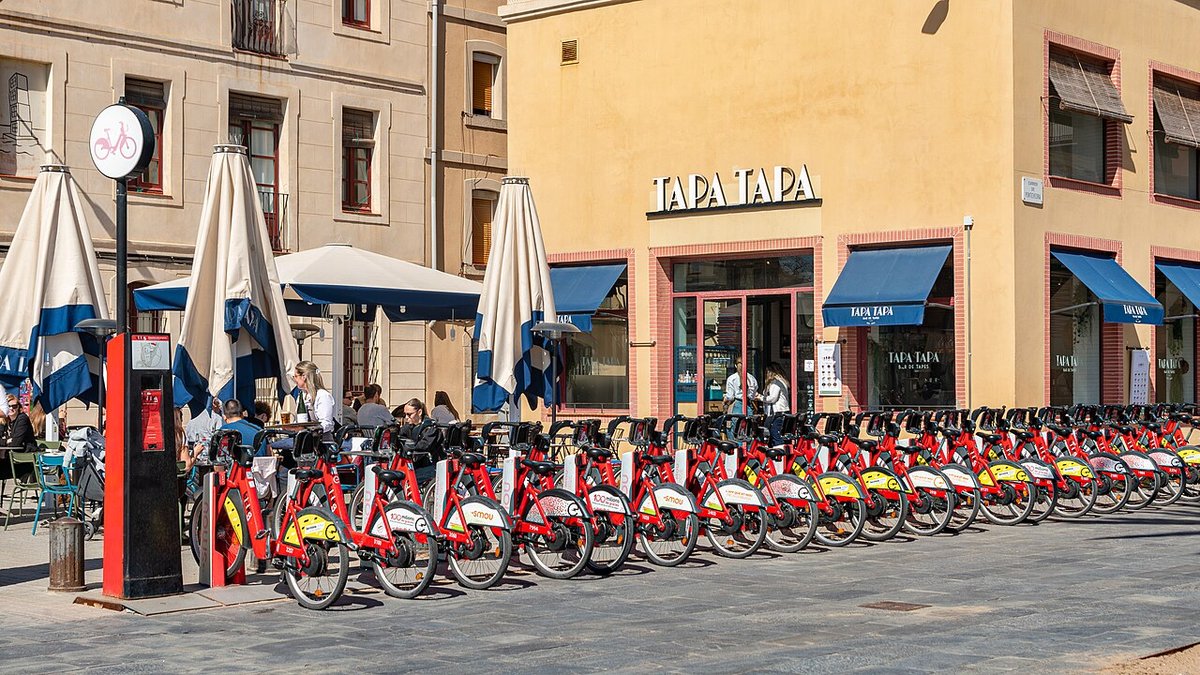
Why here: The city decided not to renew the licences of any tourist apartments from November 2028; the owners’ association is invoking the Brussels proposal against this.
More info →Confedilizia
An Italian association of property owners, one of Europe’s oldest property-owner lobby groups.
Why here: It called the Commission’s methodology an unacceptable intrusion into the powers of the member states.
What the Commission actually proposed
The proposal is called the Affordable Housing Act, and alongside it the Commission also submitted a recommendation to support housing supply. The regulation neither bans short-term rentals nor sets a rent cap, and it does not give cities powers they did not previously have. It introduces a common methodology under which an authority assesses whether an area is under housing pressure, as well as a framework within which it can then defend its intervention. European Commission ↗At its core is a single ratio. Under Article 6 of the proposal, the price of an average-sized dwelling in a given area must reach at least eight times the annual disposable income per person. The ratio must have increased over the last ten years of available data, and no easing is expected without intervention during the following three years either; the authority assesses this from population trends and housing supply and demand. If the ratio reaches ten times the annual income, the ten-year trend no longer has to be documented. Draft regulation, Art. 6 ↗
Another condition is evidence of an impact. Under Article 9, an authority may restrict short-term rentals for housing-affordability reasons only if it proves that they significantly worsened housing availability or affordability for at least the three years preceding adoption of the measure. The intervention may last no more than five years and may be extended after a review if the conditions persist. The proposal does not concern people who occasionally rent out their own primary residence. SME ↗
There is also a condition that will be important for Central Europe. Article 10 includes among the proportionality criteria the fact that the authority in the area genuinely applies and enforces the European regulation on collecting short-term-rental data: it maintains a register, verifies registration numbers and can order listings without them to be taken down. A city without such a system will not meet the condition. Draft regulation, Art. 10 ↗
The figures the Commission used to support this are substantial. Property prices in the Union have risen by 60 per cent since 2013 and rents by 20 per cent; activity on major platforms increased by 93 per cent between 2018 and 2024, and in central Madrid, according to Brussels, there are roughly 40 short-term rentals for every 100 homes rented long-term. SITA ↗ Housing Commissioner Dan Jørgensen added, according to NZZ, the growth in average rents over ten years: 59 per cent in Berlin, 75 in Madrid and 103 in Lisbon. He summed it up by saying that “normal people with normal jobs often can no longer live where they work”. Neue Zürcher Zeitung ↗
A formula that can be turned around
Barcelona’s tourist-apartment association Apartur read the new text before it was published. At midday on 8 September, it claimed that the planned European instrument cast doubt on the plan to abolish tourist apartments in the city. Europa Press ↗The background is this: in November 2023, the Catalan government adopted a decree that abolished the indefinite validity of tourist-apartment licences in municipalities with a serious housing crisis. On its basis, Barcelona City Hall announced in June 2024 that from November 2028 it would renew the licences of none of the city’s 10,101 legal tourist apartments. Catalan News ↗ On the day the proposal was published, Apartur chairman Enrique Alcántara said, according to El Mundo, that the Catalan decree “does not meet the criteria required by the European Union”, and that the attempt to abolish ten thousand licences automatically and without a prior proportionality analysis was “arbitrariness that collides head-on with Community law”. El Mundo ↗
For now, it has no direct legal basis. Article 14 of the proposal says that the regulation will not apply to measures adopted before it enters into force, and both the Barcelona decision and the Catalan decree are older. The same sentence, however, adds that an authority may review older measures under the new framework. The proposal itself therefore cannot be taken to mean that Barcelona’s plan is unlawful. Apartur is using it as an argument for the city council to reassess the plan under the criteria proposed by the Commission. Draft regulation, Art. 14 ↗
In Italy, the governing right opposed the proposal. For the League and the Brothers of Italy, Brussels is “attacking private property”, even though the proposal bans nothing. Giorgio Spaziani Testa, president of the property-owners’ association Confedilizia, called the methodology for measuring housing pressure an overcomplicated calculation “that is not even worth dwelling on”, and the entire framework “an unacceptable intrusion by the Union into an area that must remain with the member states”. The association of short-term-rental managers AIGAB also said that 510,000 listings with the national identification code CIN, which landlords in Italy are required to display, were registered in August, and that the sector comprises around 45,000 companies employing 150,000 people. Il Fatto Quotidiano ↗
How it is read in Zurich
Neue Zürcher Zeitung called the ratio a miracle formula and added a detail that disappears in summary reports. At the Brussels press conference, Ribera and Jørgensen repeatedly rejected the impression that the instrument undermined subsidiarity—the principle that the Union should not intervene where states and cities can manage on their own. When asked why the Union was entering the field at all, they referred to the single market: in their view, a patchwork of local rules and legal uncertainty restricts it. Neue Zürcher Zeitung ↗The legal basis is therefore not housing hardship but the functioning of the single market, and from there a direct line leads to the evidentiary requirements. This is not an entirely new obligation. In 2020, the Court of Justice of the European Union ruled in the Cali Apartments case that a member state may require authorisation for short-term rentals if it justifies this by an overriding reason in the public interest, relies on clear and non-discriminatory criteria, limits it to areas under particular pressure and proves that the same result cannot be achieved through a less restrictive measure. Court of Justice of the EU ↗ At the time, this was an assessment under the Services Directive. The new proposal expressly excludes that directive for restrictions on short-term rentals and replaces it with its own test. What is new, then, is not the proportionality requirement but the common figure used to determine which areas are under pressure.
Jørgensen presented this as an advantage for local governments, saying they would no longer “have to fear that someone will drag them before a court”. AFP ↗ The proposal nevertheless expressly preserves judicial protection: Article 11 gives affected persons the right to challenge the authority’s assessment itself. The decision whether to intervene at all remains with states, regions and local authorities. “We are not imposing obligations,” Ribera stressed. Il Fatto Quotidiano ↗
The dispute over one number
The industry relies on statistics. According to figures cited by Airbnb, short-term rentals account for 1.2 per cent of the Union’s housing stock, while the Commission says they may account for as much as one-fifth of homes in the most popular destinations. From the first figure, the technology lobby CCIA concluded that “in the vast majority of cities, the claim that short-term rentals are driving housing pressure will not survive contact with this evidence”. AFP ↗The two figures do not contradict each other. The Europe-wide average describes a dispersed phenomenon, while the local share describes a concentrated one, and the parties disagree over which is relevant for regulation. Pekka Sagner, an economist at the Cologne Institute for Economic Research, summed it up for WDR by saying that the impact of short-term rentals on rents is scientifically demonstrable, but not everywhere. It is demonstrable in international tourist centres, as a 2021 study by American and Portuguese researchers on Lisbon showed. WDR ↗
Airbnb criticised the proposed wording and called for changes. According to George Mavros, its head of relations with EU institutions, it will add “not a single apartment, while creating increased regulatory uncertainty for hosts in European cities”; in his view, the answer is construction, renovation and homes that currently stand empty across Europe. A platform spokesperson added that “the European housing crisis needs structural solutions”. Portfolio ↗ The Commission itself acknowledges in the text that restrictions on short-term rentals cannot, on their own, eliminate the structural causes of the housing shortage.
What it means for Slovakia
Slovakia is one layer below this debate. While Brussels is dealing with how an intervention is defended, Slovakia is only beginning to collect data on who actually rents out accommodation short-term. The Act on the register of short-term accommodation rentals enters into force on 1 January 2027. Slovak Collection of Laws, 133/2026 ↗The Act establishes a register of units providing short-term accommodation-rental services. Each unit will receive a registration number, and the Ministry of Tourism may have an advertisement without one taken down. Anyone offering accommodation by the end of 2026 has until 28 February 2027 to register, and until then the penalty provisions do not apply to them. Fines range from EUR 100 to EUR 1,000 for an offence by a natural person, from EUR 1,000 to EUR 3,000 for an administrative offence by an entrepreneur, and from EUR 3,000 to EUR 30,000 for platforms; for repeated violations, up to twice the upper limit may be imposed. Slovak Collection of Laws, 133/2026 ↗
The register is not a Slovak idea. It implements the European regulation of 11 April 2024 on the collection and sharing of data on short-term accommodation rentals, which has applied since 20 May 2026. EUR-Lex ↗ The Slovak register will therefore start operating roughly eight months after the regulation began to apply.
This is precisely where the two instruments fit together. The 2024 regulation sets out how rental data are collected, and the new proposal makes this one of the proportionality conditions: a city that wants to restrict short-term rentals must genuinely apply and enforce registration. A Slovak city cannot meet that condition before 2027 because the register does not yet exist.
The register alone is not enough for the remaining evidence. It contains neither apartment prices nor residents’ incomes; those must be taken from other statistics, and the city would also have to document the rentals’ three-year impact on housing affordability. The first Slovak restriction on short-term rentals under the European rules is therefore a matter of several years, not months.
Limits of this perspective
This is a view through foreign newsrooms, and their own positioning is part of it. Neue Zürcher Zeitung is a liberal-conservative daily that has long been sceptical of expanding Brussels’ powers, and its framing of the miracle formula reflects that. Il Fatto Quotidiano stands on the opposite side of the Italian dispute from the property lobby it quotes. El Mundo is a right-wing Madrid daily.The more important caveat is factual. This is still only a Commission proposal, and it must be approved by both the Council of the European Union and the European Parliament; according to NZZ, member states are generally sceptical of similar proposals. The form in which the instrument might ultimately apply is therefore open. The eight-times-income threshold is also a ratio, not a list of cities. Which Slovak or Czech settlements would exceed it can only be determined from data calculated according to the methodology set out in the proposal’s annex.
What hotinfo is watching
- Rada Európskej únie zaujala k návrhu spoločnú pozíciu
- Európsky parlament schválil svoju správu k Affordable Housing Act
- Slovenský register krátkodobého prenájmu začal fungovať k 1. januáru 2027
- Barcelonská radnica prehodnotila plán neobnoviť turistické licencie od novembra 2028
- Slovenské mesto oznámilo zámer obmedziť krátkodobé prenájmy podľa nových pravidiel