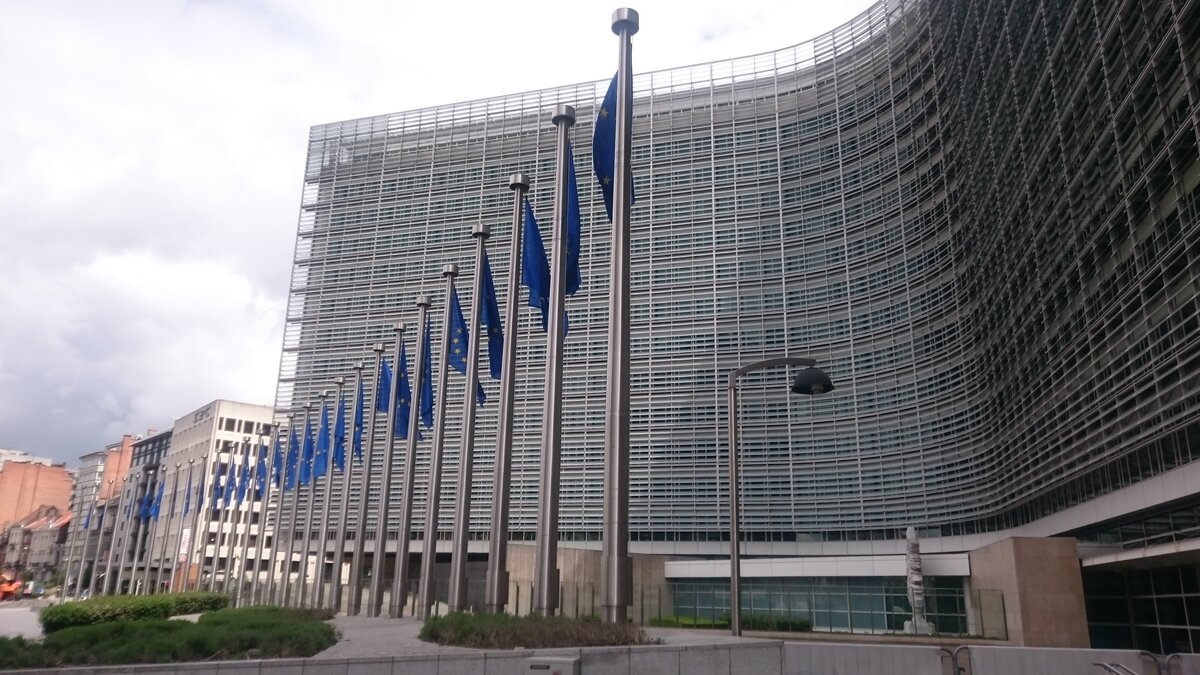



The permitting process, however, did not take place to the usual extent. Brussels did, however, learn of the construction through official channels, directly from the Hungarian authorities, as the European Commission confirmed to the Átlátszó portal. Hungary also informed the Danube Commission and the International Commission for the Protection of the Danube River. What concerns the Commission most is the impact of the Hungarian authorities' complete halt of Danube shipping near Paks on August 25. Austria's Ministry for Innovation, Mobility and Infrastructure confirmed that both the European Commission and the Danube Commission are negotiating directly with the Hungarian authorities. Slovakia is a member of both the European Union and the Danube Commission, and the river also forms part of its border. HVG ↗ Átlátszó ↗ On Thursday it emerged that no formal complaint actually stands behind this: the Austrian ministry confirmed it had not filed an official complaint with the Commission, and Brussels cannot confirm having received one.
Key actors — tap for context

Dunaj
The second-longest river in Europe, flowing through ten countries from Germany to the Black Sea and also forming part of the Slovak-Hungarian border.
Why here: Its water level in Budapest dropped to one centimeter on Tuesday, the lowest value ever recorded in the history of local observations.
More info →Dunajská komisia
An intergovernmental organization based in Budapest that oversees the rules of international shipping on the Danube all the way to the Black Sea. It was established under a 1948 convention, and its members are the Danube riparian states, including Slovakia.
Why here: According to the Austrian ministry, it is negotiating together with the European Commission directly with the Hungarian authorities over the stone weir near Paks.
More info →
Paks
Hungary's only nuclear power plant; its four units cover roughly a third of the country's electricity consumption. It is cooled directly with water from the Danube.
Why here: The stone weir in the riverbed was built because of it; the plant returned to full output on August 26.
More info →Országos Vízügyi Főigazgatóság
Hungary's General Directorate of Water Management, which together with the army is involved in building the weir.
Why here: It denies that any error occurred during construction and says that scouring of the riverbed was already accounted for in the pre-project preparations.
Romulusz Ruszin-Szendi
Hungary's Minister of Defense.
Why here: In a government video, he compared the construction to the folk ballad of the mason Kelemen: what is built by day collapses by night.
Balázs Szendőfi
Hungarian nature documentary filmmaker and ichthyologist.
Why here: He warns that the deepening of the riverbed could have exactly the opposite effect to the weir's purpose, since the water level may drop along with the falling riverbed.

Péter Magyar
Prime Minister of Hungary and leader of the Tisza party, in office since May 2026.
Why here: He rejects the Austrian move and says the weir eliminated an emergency situation.
More info →
Dávid Vitézy
Hungary's Minister of Transport and Investment in Péter Magyar's government, formerly director general of the Budapest Transport Center.
Why here: He and the prime minister received a joint statement on the construction from the Danube riparian countries.
More info →Elektráreň Kelenföld
Budapest's oldest municipal power plant, owned by Budapesti Erőmű, part of the Veolia group. In summer it supplies hot water to nearly 41,000 apartments, and provides heating in winter.
Why here: For the first time in its more than 110-year history, it had to have the riverbed dredged in order to reach the water.
Vodohospodárska výstavba
A Slovak state enterprise that manages the Gabčíkovo waterworks and put out a tender for removing sediment from the Danube.
Why here: The tender was won by the Italian company Nautilus with a bid of €68.7 million excluding VAT.

Tomáš Taraba
Slovakia's deputy prime minister and minister of the environment.
Why here: He defends the tender as proof of economical procurement, saying the winning bid came in more than €68 million under the estimated value.
More info →
Andrej Danko
Chairman of the Slovak National Party.
Why here: He criticizes Taraba for the fact that a foreign company won the Danube contract.
More info →
Štúrovo
A town in southern Slovakia on the bank of the Danube, opposite Hungarian Esztergom.
Why here: The cargo ferry to Esztergom stopped running because of the low water level.
More info →HungaroMet
Hungary's national meteorological service.
Why here: According to its preliminary data, summer 2026 was the driest since measurements began in 1901.

Átlátszó
A Hungarian investigative outlet focused on transparency in public spending.
Why here: From the depths cited in government videos, it derived an estimate of how much the riverbed may have deepened during construction.
More info →The weir that undermined its own riverbed
The weir grew from both banks at once, two stone walls advancing toward each other. Until they joined, the water did not flow over them but was forced through the gap between them, which made it accelerate sharply in the narrowing. That same water then put strain on the structure itself and scoured the riverbed beneath it. Defense Minister Romulusz Ruszin-Szendi explained this in a government video by referring to the folk ballad of the mason Kelemen. The stones, he said, are necessary "because what we build by day collapses by night." Átlátszó ↗The solution was concrete blocks. Near the village of Dunaszentbenedek, the army dropped them from a helicopter straight into the riverbed — 117 blocks in total, two and a half tons each. "We'll go up on board and look down to see whether the current carries the stone to the right spot," Ruszin-Szendi said in a video from late August, adding that water management officials had measured a depth of thirteen meters that morning. Telex ↗
Exactly how deep the riverbed sank is not known. The Átlátszó portal estimated it from the depths mentioned in government videos: at the start of construction in August, the deepest points of this stretch had four to five meters of water, while later videos already spoke of thirteen, and then sixteen to eighteen meters. From this, the portal deduced that the river may have deepened its bed by eight to thirteen meters. This is not, then, the portal's own measurement, but an estimate based on publicly stated figures. Átlátszó ↗
A comparison with the long-term trend gives a sense of scale. Over the past half century, the Danube's riverbed on the Hungarian stretch has deepened by an average of about two meters. If Átlátszó's estimate is accurate, several times that much would have happened at the weir in just two weeks. Átlátszó ↗
Water Managers: We Expected This
The Hungarian General Directorate of Water Management denies that this was an execution error. According to the directorate, the scouring was to be expected due to changes during the implementation phase and the accelerated schedule, especially given the already significantly narrowed flow cross-section. Deepening, it says, could have been anticipated back at the pre-project preparation stage, which is why concrete cubes had long been among the technologies under consideration. The directorate cites as evidence of this planning that the cubes were brought to the site weeks in advance. The Ministry of Defence likewise states that their placement was not the result of a construction error, adding that no further scouring has been observed since the intervention and that the structure is fulfilling its function. Átlátszó ↗Ichthyologist and documentary filmmaker Balázs Szendőfi points to another problem. At Paks, he says, the riverbed is mostly sandy with an admixture of fine gravel, beneath which lies a layer of gravel and marl that has remained undisturbed for centuries. The accelerated current in the narrowed section has begun rapidly washing away the lower layers. "This produces exactly the opposite effect to the goal of building the sill, because deepening the riverbed can also significantly lower the water level, and general deepening of the riverbed is precisely one of the main causes of the Danube's extremely low water levels," he told the outlet. Átlátszó ↗
According to Átlátszó's information, it has meanwhile become questionable whether the sill can be completed according to the original plans at all, or whether it will need to be modified. Neither the Directorate of Water Management nor the Ministry of Defence answered the outlet's question on this point; their statements addressed the quality of the execution. Átlátszó ↗
Budapest's chief landscape architect Sándor Bardóczi took the question further. In his view, the problem is not haste or construction errors, but the possibility that a hastily built sill in the river remains there permanently. Telex ↗
How the Neighbors Actually Found Out
A diplomatic dispute has meanwhile arisen around the construction. According to the daily Világgazdaság, on which HVG draws, the Hungarian government did not complete the usual permitting procedure for the sill, meaning domestic environmental authorities were unable to comment on it either. The second part of the claim — that neither the neighboring countries nor the Union were officially informed — was not confirmed by the European Commission's response to Átlátszó; more on this below. This was made possible by the declaration of a state of emergency and by designating the investment as a priority from the standpoint of the national economy. However, the government decree does not eliminate permitting obligations entirely. It requires a supplementary application for an environmental operating permit, including an assessment of impacts on Natura 2000 sites, by the end of September. HVG ↗ Magyar Közlöny ↗In response to a question from Világgazdaság, the Austrian Ministry for Innovation, Mobility and Infrastructure said that the Danube Commission and the European Commission are holding direct negotiations with the relevant Hungarian authorities over the planned sill. In addition, the Danube countries, within the framework of the EU Strategy for the Danube Region, formulated a joint position, which they submitted to Minister of Transport and Investment Dávid Vitézy as well as to the Prime Minister. The Austrian side did not specify exactly what it contains. The negotiations by themselves do not mean that formal proceedings have been initiated against Hungary. HVG ↗ However, on Wednesday evening it emerged that no formal complaint had been filed. A spokesperson for the European Commission told the MTI agency that it could not yet confirm receipt of an official complaint or notification from Austria, adding that, given the complex nature of the issue, the Commission was consulting with its own departments; more information was expected on Thursday. The Austrian Ministry for Innovation, Mobility and Infrastructure, asked the same question directly, replied that it had not filed an official complaint with the European Commission. It described the Danube's economic significance for both Europe and Austria as beyond question and reiterated that the Danube Commission and the European Commission are in direct contact with the relevant Hungarian authorities. The dispute over the sill is therefore proceeding through negotiations, not through a filed complaint — which also clarifies the claim made by Péter Magyar that Austria had lodged a complaint against Hungary in Brussels. (Portfolio ↗, HVG ↗, Népszava ↗)
As for who informed Brussels, only the Commission itself explained that. It told Átlátszó that it knows about the crisis at Paks and about the construction of the sill directly from the Hungarian authorities: it received an early warning from them, which EU rules require in the event of an imminent crisis in electricity supply, and the Hungarian side presented measures to maintain Paks's output on August 19 at a meeting of the electricity coordination group. According to its response, the Commission is concerned about the impact of the complete closure of navigation on shipping and about its possible long-term consequences. The closure was ordered on August 25 by the Budapest Capital City Government Office "with immediate effect until further notice." It therefore recommended expert consultations to the authorities and affected parties so that navigation during the construction remains safe and predictable. The Vienna-based organization Pro Danube International, which represents companies from Danube shipping, also protested the closure with an open letter, which it also sent to the Commission. Átlátszó believes that it was precisely this letter that Prime Minister Magyar may have interpreted as an Austrian complaint, which he repeated again on September 9. (Átlátszó ↗, Népszava ↗)
Péter Magyar rejects the Austrian move. At a press conference, he compared it to asbestos contamination, arguing that contaminated stones from Austrian mines caused real damage, whereas the sill was a remedy for an emergency situation. He does not consider it a good sign when a friendly neighbor, at such a moment, starts objecting to the construction and potentially initiates international proceedings against Hungary. Index.hu ↗
The River Dropped to One Centimeter
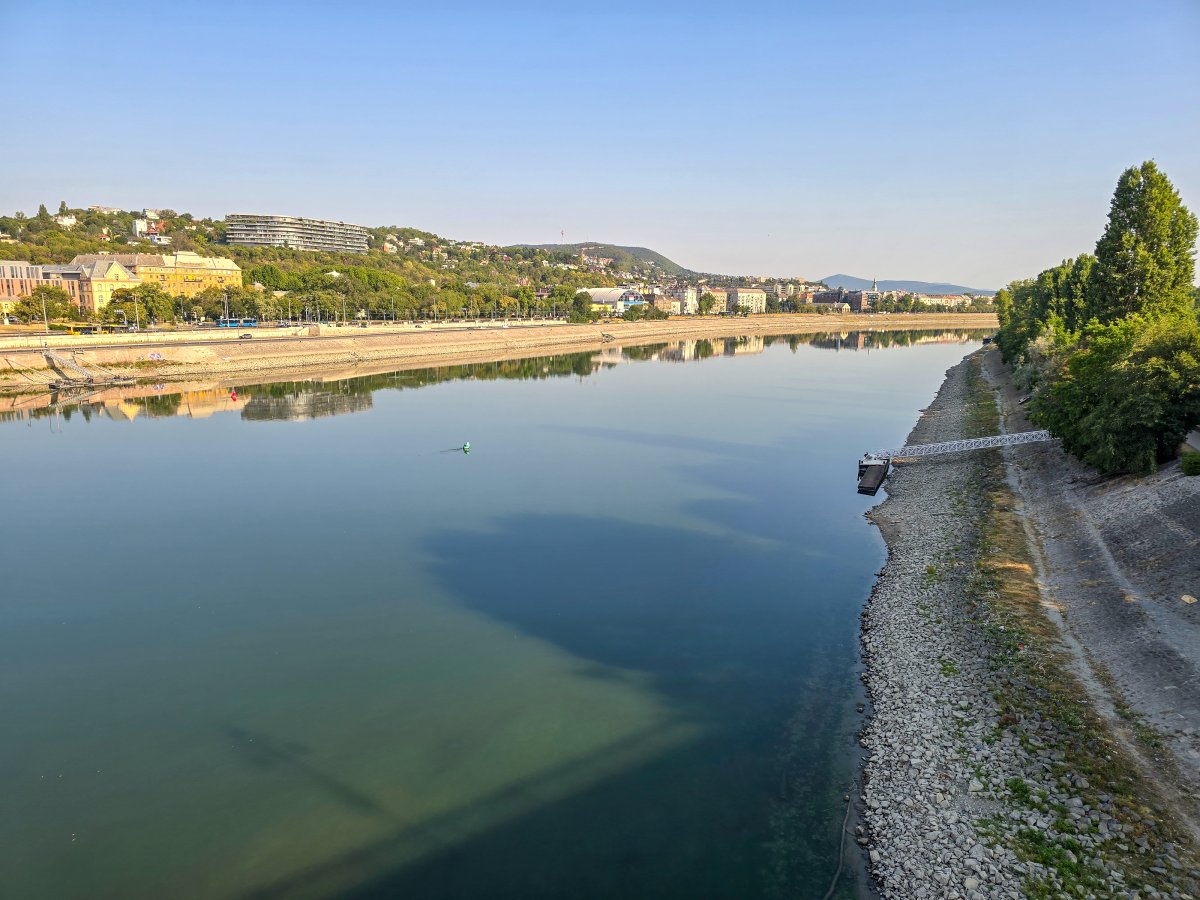
Tuesday's measurement shows the reason behind the entire intervention. The Danube's water level in Budapest dropped to one centimeter, the lowest figure in the history of local observations. The previous record low from 2018 was already broken at the end of July at 27 centimeters, and in August the level fell by nearly another twenty centimeters. Telex ↗The figure needs to be read correctly. Water level is given relative to the zero point of the gauge staff, not relative to the riverbed, so one centimeter does not mean there is a centimeter of water in the Danube. Negative values on the Slovak side are read the same way. nitrak.sk ↗
Drought is behind the decline. According to preliminary data from the Hungarian meteorological service HungaroMet, this year's summer was the driest since measurements began in 1901. Precipitation reached a national average of 74.1 millimeters, or 36 percent of the thirty-year norm, about thirty millimeters lower than in the previously driest summer of 1952. August was also the warmest month recorded in Hungary since the beginning of the 20th century. Telex ↗
The nuclear power plant wasn't the only one
The same Danube a thousand kilometers downstream has shut down both Romanian nuclear reactors. Cernavodă is Romania's only nuclear power plant and has two operating units — both are now out of service. State Secretary at the Ministry of Energy Cristian Bușoi told Digi24 television that a restart is conceivable at the earliest by the end of September, and a more precise estimate will only come after September 15, since it depends on the Danube's water level rising: "The forecasts are cautious. There is some good news from the upper basin, mainly from Austria, where it has been raining recently. There is also a slight rise on the Sava, but so far we don't see that as a rescue solution." Romania is covering the peak-hour shortfall with imports, which Bușoi says should fall well below 2,000 megawatts as wind power output ramps up. So Hungary is placing a stone sill in the riverbed to keep one power plant running — while its downstream neighbor has lost both of its own. (HotNews ↗, Naftemporiki ↗)Ordinary municipal energy also draws on the Danube. The Kelenföld power plant, Budapest's oldest municipal power station, draws water from the Lágymányosi Bay and in summer supplies hot water to nearly 41,000 apartments and 1,800 institutions. When the water level at the plant fell in late July to a point that already threatened operations, its technicians prepared the work in two days and, in the first week of August, dredged a fifty-meter stretch of the bank, deepening the riverbed there by 50 to 100 centimeters. HVG ↗ The company states that in more than 110 years of the plant's history, dredging had never once been necessary. The entire operation cost twenty million forints, roughly 55,000 euros. Index.hu ↗
Something similar happened at the Pécs heating plant and the Mohács fiberboard factory. The low water level threatened sufficient industrial water intake at the 1960s waterworks that supplies them, so water utility workers temporarily installed two pumps on a pontoon and connected them via two fire hoses to the existing pressure pipeline. The regional water utility justified this by saying that after Paks' partial outage, the Pécs heating plant's output had become a matter of national economic interest. Index.hu ↗
Slovakia is dealing with the same riverbed, but for a different reason
The Slovak side of the river is in similarly bad shape. According to a report from September 7, the cargo ferry between Štúrovo and Esztergom was not operating, because the water gauge station near Štúrovo showed a water level of minus 36 centimeters. The Slovak Hydrometeorological Institute already stated in its August analysis that July 2026 brought the lowest average July flow of the Danube in Bratislava in the entire history of observations, at 35.6 percent of the long-term July average for the 1961–2000 reference period. nitrak.sk ↗According to the institute, extreme drought now affects two-thirds of Slovakia's territory. Pravda ↗ At the end of June, when hotinfo last wrote about the water crisis, it was about 37 percent. TASR ↗
Bratislava is also preparing to intervene in the riverbed, but for a different reason than Budapest. The state enterprise Vodohospodárska výstavba evaluated an international tender in early September for removing sediments from the Danube and from the Hrušov reservoir, aimed at improving flood protection for Bratislava and its surroundings and maintaining navigability. The Italian company Nautilus won with a bid of €68.723 million excluding VAT, against an estimated value of €137 million; the work is scheduled to take 96 months, i.e. eight years. So this is not an emergency raising of the water level for a power plant, but long-term sediment cleanup. Ministry of the Environment of the Slovak Republic ↗
The tender result immediately became a coalition dispute. Environment Minister Tomáš Taraba defends it as proof of economical procurement and emphasizes that the winner came in more than €68 million below the estimated value. SNS chairman Andrej Danko criticizes him for letting a foreign firm win such a contract and declared that Taraba is a closed chapter for the party. Denník N interprets this as a struggle over influence on contracts awarded by state water management companies. Pravda ↗ Denník N ↗
When hotinfo last wrote about the Danube at the end of June, the focus wasn't on the water level but on water temperature, which had reduced Paks' output and endangered fish. Also read: Thousands of people without water in both Hungary and Slovakia, Magyar urges people not to water their gardens. Has the Danube dried up? It's more that it overheated In the ten weeks since, the emphasis has shifted from temperature to water volume, and from weather reports to intervention in the riverbed. In the short term the water level should rise — meteorologists reported a front bringing precipitation to the basin for Wednesday — but the sill in the river remains. Telex ↗
What hotinfo is watching
- The European Commission and the Danube Commission concluded their talks with the Hungarian authorities about the stone weir, or published the outcome
- Slovakia, as a member of the Danube Commission, has publicly commented on the structure
- Hungary submitted the additional application for an environmental operating permit, including the Natura 2000 impact assessment
- It became clear whether the weir would be completed according to the original plans, or had to be modified
- Work began on removing sediments from the Danube and the Hrušov reservoir under the eight-year contract