









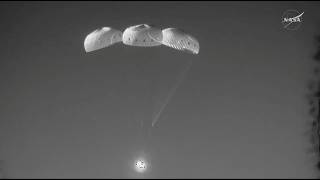

The Orion capsule carrying the Artemis II crew landed on Saturday at 02:07 Central European Time in the Pacific Ocean about 70 kilometers off the coast of San Diego. The descent through the atmosphere took roughly a quarter of an hour and concluded a ten-day mission — the first crewed flight to the Moon since Apollo 17 in 1972. The crew flew around the Moon but did not set foot on its surface — a Moon landing is the goal of the Artemis III mission, planned for 2028. CBS News ↗
"We are stable. Four crew members, all green," commander Reid Wiseman announced shortly after splashdown. Mission control described the landing as a "bullseye." All five airbags inflated correctly and the capsule remained upright. NBC News ↗
The crew consisted of commander Reid Wiseman, pilot Victor Glover, mission specialist Christina Koch (all from NASA), and Jeremy Hansen of the Canadian Space Agency — the first non-American astronaut on a journey to the Moon. During the mission they flew around the Moon and reached a distance of 406,706 kilometers from Earth — one of the greatest distances a human crew has ever reached. In total they traveled 1,117,878 kilometers over 9 days, 1 hour and 32 minutes. Al Jazeera ↗
The most critical phase was reentry into the atmosphere. At 01:53 CEST the capsule hit the atmosphere at an altitude of 122 kilometers at a speed of around 40,000 kilometers per hour. For six minutes the crew experienced a communications blackout as ionized gas around the capsule blocked radio signals. According to Reuters, temperatures on the surface of the heat shield reached approximately 2,760 degrees Celsius. The astronauts experienced g-forces of up to 3.9 G. NASA ↗
The entire course of the reentry is captured in NASA's official broadcast, from separation of the service module through atmospheric entry to splashdown in the ocean:
The heat shield was in fact the biggest source of concern ahead of the mission. During the uncrewed Artemis I mission in 2022, the shield suffered more damage than engineers had expected — the material cracked and broke away in larger pieces than anticipated. Gas pressure building up beneath the surface was unable to escape quickly enough. NASA engineer Charles Camarda publicly warned that the agency "does not fully understand the cause of the failure." CNN ↗
Instead of replacing the shield, NASA changed the reentry trajectory. The originally planned "skip reentry" maneuver, in which the capsule would first bounce off the atmosphere and enter it twice, was replaced with a steeper, more direct entry. This allowed the capsule to pass through the phase of most intense heating more quickly. Commander Wiseman said before the mission: "If we follow the new entry profile, this heat shield will be safe to fly." Al Jazeera ↗
The mission also had another technical issue. A helium leak in the propulsion system of the European service module was ten times larger during the flight than in ground tests. NASA stated that the leak posed no risk to the crew or to the return, but that data from the mission will inform a redesign of the system for future flights. NBC News ↗
After splashdown, U.S. Navy divers attached an inflatable platform to the capsule, on which the astronauts acclimated to Earth's gravity before a helicopter transported them to the recovery ship USS John P. Murtha. NBC News ↗
NASA chief Jared Isaacman told NBC News that he "still doesn't have the words" and that "the kid inside him can't believe what he just watched." He stressed that this was not a one-off achievement: "We are back in the business of sending astronauts to the Moon and safely bringing them home." Canadian astronaut Hansen added after landing: "We live on a fragile planet in the vacuum and emptiness of space. We are very lucky to live on planet Earth." Al Jazeera ↗

Artemis II Returned to Earth: Six Minutes in a Fireball, and Humans Are Back at the Moon After Half a Century
Videos
🔥 You might also like
Technology
Crew-12 crew returns to Earth after eight months
The four-member Crew-12 mission crew returned to Earth on Thursday after approximately eight months aboard the International Space Station (ISS). The Spac...

Technology
Government approves proposal to ban social networks for children under 16; France's constitutional court quashed similar ban two weeks ago
16-year age limit applies from 2027. France's blanket ban struck down Aug 14 for undue interference with freedom of speech; same concerns apply to Slovakia's pr …

Ukraine
Tokyo Rejects Russian Missile Tests Near the Kurils
Japan on Friday, August 21, voiced opposition to Russian missile tests near the disputed Kuril Islands. Moscow announced them shortly after...
Geographic locations




From our newsroom original
All →
Nobelovu cenu za mier získala Navanethem Pillayová, Izrael protestuje

Machadová vyzvala Venezuelu na usporiadanie volieb v roku 2027

Súd zrušil rozkaz, ktorým Šutaj Eštok postavil Čurillu mimo služby
Swedish court convicts two men over concealed Viking-era treasure, acquits third man accused of selling it
Man suspected of attempting to sell uranium-238 for $700,000 detained in Georgia

Amsterdam museum returned ancient vase to Sicily, theft revealed by 1976 wedding photo

Quebec: Separatists Win with 28% of the Vote and No Majority, Promise Referendum Only After Trump

What Europe Is Writing About: AfD Leads a State Parliament, Ex-BND Chief Arrested, Puigdemont May Return