The difference between eighth and third place is the state’s share. And while Bratislava and Prague both explain why they cannot intervene in prices, both point to a component they do not set — and remain silent about the one they do. During the night of 15 September, the underlying cause itself shifted: the Houthis struck Saudi Arabian cities for the first time, Brent then exceeded 107 dollars, and a tanker caught fire in the Strait of Hormuz after hitting a mine. Hospodárske noviny ↗ La Libre ↗ Kleine Zeitung ↗ This changed on the afternoon of 14 September: Andrej Danko and Robert Fico announced over the weekend that they would reduce the excise duty, while the opposition SaS offered specific figures — and those diverge from the Union ceiling precisely where the room for manoeuvre is narrowest.
Key actors — tap for context

Matúš Šutaj Eštok
Slovak politician, interior minister and chairman of Hlas-SD.
Why here: He said Slovak fuels were the eighth-cheapest in the Union and admitted that talks on fiscal instruments were possible.
More info →
Andrej Babiš
Czech prime minister and entrepreneur of Slovak origin, leader of the ANO movement.
Why here: He rejects a reduction in excise duty and margin regulation, blaming refineries and ETS 2 emissions allowances.
More info →
Robert Fico
Prime Minister of the Slovak Republic.
Why here: He announced another government discussion on fuel prices and hosted a V4 summit at Bratislava Castle on 10 September.
More info →
Michal Šimečka
Chairman of the opposition Progressive Slovakia.
Why here: He proposed using Slovnaft’s alleged debts to help people; the company rejected this.
More info →
Lukáš Kovanda
Czech economist, chief economist at Trinity Bank and commentator.
Why here: He drew attention to UBS estimates according to which the refining margins of Orlen and MOL exceeded their long-term normal level several times over.
More info →Ivan Indráček
Chairman of the board of the Czech SČS petrol-station association, known until 2021 as the Union of Independent Oilmen.
Why here: He says high margins are the market’s response to a lack of capacity and sees the solution in reducing the Union’s minimum excise duty.
Petr Lajsek
Analyst at Purple Trading.
Why here: In his view, ETS 2 is not the cause of the current price rise; he recommends releasing reserves and temporarily reducing diesel tax.

Maud Bregeon
Spokeswoman for the French government and minister delegate for energy.
Why here: Asked about a fuel-price cap, she replied that she wished she had a magic wand.
More info →
Marine Le Pen
French far-right politician, chairwoman of the parliamentary group of the National Rally, whose party is led by Jordan Bardella.
Why here: She proposed reducing VAT on motor fuels; the government rejected the proposal.
More info →
Slovnaft
Slovakia’s only refinery, part of the Hungarian MOL group.
Why here: It rejected claims about debts, saying that over three years it had paid one billion euros in taxes and levies.
More info →
Orlen
Polish state-controlled refining and petrochemical group.
Why here: UBS estimates put its gross refining margin at 50 to 55 dollars per barrel.
More info →MOL
Hungarian oil and gas group, owner of Slovnaft.
Why here: According to UBS, its refining margin is approaching 50 dollars per barrel.
More info →
UBS
Switzerland’s largest bank.
Why here: Its latest estimates of refining margins have become an argument in the Czech and Slovak debate on fuel prices.
More info →Miroslav Novák
Chief analyst at the Czech company Citfin.
Why here: He points out that the government cannot force foreign refineries to supply fuel at a price it sets itself.

Philippe Brun
French Socialist MP for the Eure department.
Why here: He called the situation unsustainable and demanded an urgent reduction in fuel taxes.
More info →
Európska komisia
Executive body of the European Union.
Why here: Every week it publishes fuel prices in all member states, both with and without taxes.
More info →The minister’s figure is correct. So is what lies behind it
On 12 September, Šutaj Eštok said that fuel prices were “the eighth-cheapest within the European Union” and that among the Visegrád Four, only Hungary was cheaper. He also admitted that the government was considering intervention: “We are discussing fiscal instruments. Whether that means reducing excise duty or VAT.” STVR ↗The European Commission’s weekly overview, which collects prices from all member states, confirms this. In the figures dated 7 September, Slovak petrol was the eighth-cheapest in the Union. At €1.908, diesel shares eighth place with Croatia, whose price is identical to the tenth of a cent. Within the V4, only Hungary was cheaper in both cases, so the minister was speaking accurately. Weekly Oil Bulletin ↗
The Commission publishes two sets of figures, however — prices including taxes and prices excluding them. The ranking looks quite different in the second set. Before taxes, Slovak petrol is the third-cheapest in the Union; only Malta and Estonia are cheaper. Diesel is the fourth-cheapest before taxes, with Malta, Hungary and Estonia ahead of it. Czechia is eighth for petrol and eleventh for diesel, while Poland is as low as nineteenth for petrol.
Where the euro disappears in a litre
The price of a litre can be broken down into components. Of the €1.774 price of petrol, 51.4 cents is excise duty Finančná správa SR ↗ and 33.2 cents is VAT at a rate of 23 percent. Taxes alone therefore account for 84.6 cents, or 47.7 percent of the price. Added to this is just under 4 cents to maintain emergency oil reserves — money that does not go to the state budget but to the agency managing the reserves. Including it, the mandatory component reaches 88.5 cents, or 49.9 percent. The remaining 88.9 cents cover everything else: the crude oil itself, processing, transport, wholesale costs and the petrol-station margin. For diesel at €1.908, taxes amount to 72.5 cents (38 percent), or 76.4 cents including the charge, equal to 40.1 percent.This breakdown is our calculation, not a Commission figure — in this overview, the Commission publishes prices with and without taxes, not individual components. The total matches its figures to a tenth of a cent, so this is not an estimate. Compared with its neighbours, the result is unequivocal: the full mandatory component accounts for 49.9 percent of the price of Slovak petrol, more than the Union average (47.6 percent) and more than in any of the V4 partners. In Czechia it is 46.7 percent, in Hungary 45.1 and in Poland 42.
Record margins that are not paid by Slovak drivers alone
On 12 September, Trinity Bank chief economist Lukáš Kovanda drew attention to fresh UBS estimates. They put Polish Orlen’s gross refining margin at roughly 50 to 55 dollars per barrel and Hungarian MOL’s close to 50 dollars, while their longer-term norm is around 15 to 20 dollars. Both companies are crucial to the region — Orlen operates refineries in Litvínov and Kralupy, while MOL supplies the Slovak market through Slovnaft and its distribution network. Hospodářské noviny ↗Ivan Indráček, who heads the Czech SČS petrol-station association, also confirms that the margins are extraordinary. He attributes them to a lack of capacity, rather than exploitation of the crisis: “The market is simply worried about a fuel shortage because European refinery capacity is insufficient and deliveries are being disrupted.” In the same article, Deník says that the European petrol margin was above 62 dollars per barrel at the beginning of September, almost matching the record level of 2022. Deník ↗
The Commission’s data add one complication to this picture. Orlen supplies both Poland and Czechia, yet the two countries are at opposite ends of the ranking for prices before taxes: Poland has the highest value of the four and ranks only nineteenth in the Union, while Czechia, where Orlen itself produces fuel through Unipetrol in Litvínov and Kralupy, ranks eighth. If the price were determined by one supplier’s margin, the two countries would have to be closer.
Record margins are therefore a common European phenomenon and do not by themselves explain why prices differ between neighbours. Taxation is not the only answer either — the pre-tax price also depends on what crude a refinery buys, how far it transports it and under what contracts. One thing is certain: tax determines where a country ultimately ends up in the ranking. Slovakia is the third-cheapest in the Union for petrol before tax and eighth afterwards.
The cause untouched by either of those instruments
While European capitals argued about taxes, the front shifted. According to Greece’s Protothema, the Houthis control almost the entire western coast of Yemen and have tightened the noose around the Bab el-Mandeb passage; Saudi Arabia, according to the Houthis’ own claims, responded with more than fifty airstrikes in twenty-four hours. Protothema ↗ Naftemporiki ↗ More important for prices is that the attacks reached Saudi cities for the first time — thirteen people were injured and Riyadh is promising a tough response. Hospodárske noviny ↗The market’s concern was not limited to oil. US diesel has reached a new record of 6.27 dollars per gallon. Naftemporiki ↗ Politico writes that the Houthis’ actions are sending oil higher and leaving Trump with very few options. Protothema ↗
A second strand of risk has emerged in Hormuz. The tanker El Gaia caught fire after colliding with a mine Kleine Zeitung ↗ Die Presse ↗, and Greenpeace reports five oil slicks in the strait. Kleine Zeitung ↗ This is the part of the price that neither excise duty nor margin regulation can change — and it is precisely the part that moved most over the past day.
Prague points to Brussels, analysts to the market
The Czech government rejects intervention in both directions at once. “The Finance Ministry is monitoring the situation. Margins are currently at no more than three crowns; they are not excessive. There is therefore no room for regulation. We will not reduce excise duty,” Prime Minister Andrej Babiš said. In his view, the problem is not petrol stations but refineries: “It is unacceptable for wars to be exploited for disproportionate profits. We will want to address this at European level.” Deník ↗The second Czech argument concerns ETS 2 emissions allowances, whose launch Babiš wants postponed. TASR ↗ The system’s launch has already been postponed once, from 2027 to 2028, and Babiš is seeking another delay. Analysts questioned by ČTK agree that its impact on refineries will be real, but is unrelated to the current price rise — full operation is not due to begin for another two years. “ETS 2 will not be paid directly by drivers, but by fuel suppliers,” explained Petr Lajsek, an analyst at Purple Trading. He considers releasing strategic reserves, stricter monitoring of petrol-station margins and a temporary reduction in excise duty, especially on diesel, more meaningful. Hospodárske noviny ↗
Chief CitFin analyst Miroslav Novák likewise confirms that the government cannot reach the margins: although the state can set a maximum price in an emergency, it “cannot influence global wholesale prices or force foreign refineries to supply the Czech Republic at a price set by the Czech government.” Deník ↗
The ceiling Bratislava does not discuss
If tax is what remains, it is necessary to say how much of it can actually be reduced. Directive 2003/96/EC sets minimum taxation levels for member states: €359 per thousand litres of petrol and €330 per thousand litres of diesel. This does not concern just one tax — the directive defines the minimum as the sum of all indirect taxes apart from VAT. Európska komisia ↗Slovakia’s diesel rate is €368, just €38 above the Union floor. Even if the government taxed diesel at the absolute minimum permitted by EU law, a litre would become less than five cents cheaper, including the effect of VAT. For petrol, the room is considerably larger: the €514 rate is €155 above the minimum, corresponding to roughly nineteen cents per litre.
There is a paradox here. Some analysts are calling for a tax reduction primarily on diesel, yet that is precisely where the room for manoeuvre is almost exhausted. The greater reserve lies with petrol, the fuel that is already the eighth-cheapest in the Union. The Finance Ministry rejects both options, arguing that they would mean “a significant shortfall in state-budget resources amounting to tens or hundreds of millions of euros.” Michal Šimečka, chairman of the opposition Progressive Slovakia, proposed drawing on Slovnaft’s alleged debts; the company rejected this, saying it had paid one billion euros in taxes and levies over three years. STVR ↗
Over the weekend, both coalition leaders came out in favour of intervention. According to SME, Andrej Danko announced price regulation by reducing excise duty so that people would find it worthwhile to refuel at home rather than abroad; Robert Fico said he was also discussing prices with Slovnaft and hinted that the government had only limited influence over global oil prices. SME ↗ On Monday, the opposition SaS announced that it would support any coalition proposal and claimed it would not burden the budget: deputy chairman Marián Viskupič argued that after prices fell, Slovaks from border regions would stop refuelling abroad and foreigners would instead come to Slovakia, recalling that when the government capped fuel prices for a month in March, excise-duty revenue rose by 22 percent. TASR ↗
This is where the figures diverge. SaS chairman Branislav Gröhling expects that reducing excise duty to the Union minimum would make petrol 30 cents cheaper and diesel 16 cents cheaper. The diesel figure cannot come from this tax alone: Slovakia’s rate of €368 per thousand litres is only €38 above the directive’s minimum, or 3.8 cents per litre and less than five including VAT. An INESS analyst gives the same figure, saying petrol could become up to twenty cents cheaper — close to our calculation of nineteen cents, not thirty. Sixteen cents for diesel could be achieved only together with the second measure proposed separately by SaS: a temporary reduction in VAT. SME ↗
Indráček reaches the same conclusion from the opposite direction. In his view, a local solution makes no sense, and a windfall-profit tax would merely transfer money into the budget rather than to drivers. “A sensible solution would be an agreement at European level to reduce the statutory minimum excise duty. Otherwise, there are not many options,” he says. Deník ↗
Seven instruments, one ceiling and none addressing the cause
The debate, which in Bratislava looks like a domestic dispute between the coalition and opposition, is taking place across the Union in the same week and everywhere runs into the same boundary.In France, diesel rose to as much as €2.85 per litre at some stations according to an Ouest-France infographic, and shortages of SP95-E10 petrol appeared. Ouest-France ↗ Socialist MP Philippe Brun is calling for an urgent tax cut BFM TV ↗, while Marine Le Pen is proposing lower VAT and government spokeswoman Maud Bregeon is rejecting a cap, saying she would need a “magic wand” to introduce one. BFM TV ↗
In Germany, calls for a fuel-price cap are growing, but the federal economy minister rejects it. ZDF heute ↗ Italy, which already has a diesel excise-duty discount, is considering adding a targeted €100 voucher. Open ↗ In Portugal, the opposition Socialist Party is demanding an immediate VAT cut rather than waiting until January, Público ↗ while the country’s fire-brigade league says diesel prices are “financially suffocating” it. Observador ↗
Over the weekend, the list expanded south and east. Venko Filipče, chairman of North Macedonia’s opposition SDSM, proposed abolishing fuel excise duty altogether and reducing VAT to five percent, Nezavisen ↗ while Montenegro’s opposition European Alliance called on the government to reduce VAT on fuel. Vijesti ↗ In both cases, these are opposition proposals, not government decisions. Meanwhile in Germany, diesel exceeded €2.60 per litre, HRT ↗ petrol reached a historic high, Tagesspiegel ↗ the petrol-station association warned of a three-euro price n-tv ↗ and Bavarian Premier Markus Söder called for measures to make high prices more bearable. Die Zeit ↗
On 15 September, a seventh instrument was added, and it is the most interesting because it is not one-off. Belgium’s MR is calling for the “reverse cliquet” to be activated: fuel excise duties would automatically fall whenever the price of oil rose sharply, returning around one hundred million euros to drivers. Het Laatste Nieuws ↗ 7sur7 ↗ Instead of a one-time discount, it is therefore a rule that activates itself.
In Germany, the dispute intensified that same day. The petrol-station association warned that a litre could rise to three euros, Welt ↗ Lower Saxony Premier Olaf Lies pressed for a price cap, saying he had been demanding one for months, Die Zeit ↗ the Greens rejected a subsidy with the words “I do not want to give these oil companies a single cent” n-tv ↗ and economists from the IfW institute warned against repeating the refuelling discount. Spiegel ↗
The impact has already appeared elsewhere. In Spain, the statistical office confirmed that fuel had pushed August inflation to 4.3 percent, the highest since February 2023. El País ↗ The Greek government offered new support for electricity and fuel but rejected an excise-duty cut, saying there was no money for it — exactly the opposite of Bratislava’s position. Protothema ↗ In France, fishermen blocked an oil terminal at Fos-sur-Mer and a tense confrontation developed with riot police, BFM TV ↗ while low water levels on the Rhine are also contributing to the rise there: fuel must be transported by tanker trucks and in some regions a litre is approaching €2.50. BFM TV ↗ In Albania, diesel is 2.6 times more expensive than the European average when adjusted for purchasing power. Balkanweb ↗
There are therefore seven different instruments on the table at once — a price cap, VAT, excise duty, a voucher, releasing reserves, margin regulation and an automatic cliquet — and most remain proposals rather than adopted measures. What they have in common is that none addresses the cause. And excise duty, the area where the state can intervene most directly, has its lower limit set by a 2003 directive. The V4 prime ministers met at Bratislava Castle on 10 September; high energy prices were among the main topics and, according to STVR, they agreed to seek a joint solution. No specific common tax or price instrument emerged from the meeting. SITA ↗
Limits of this view
The European Commission’s data are dated 7 September. Tensions around the Strait of Hormuz had already been escalating before that date, but Saudi Arabia’s East-West oil pipeline went out of operation only five days later. Prices have continued to rise since then and the countries’ ranking may have shifted, although the tax rates at issue here have not changed.The scale of the outage is now clearer. The East-West pipeline, through which Saudi Arabia transports oil to the Red Sea while bypassing the Strait of Hormuz, will remain largely out of operation for three to five weeks after the drone attack; according to AP, its capacity is as much as seven million barrels a day, and Riyadh blamed Shiite militias linked to Tehran in Iraq for the attack. iRozhlas ↗ The price of North Sea Brent reached 109 dollars per barrel on the afternoon of 14 September TASR ↗, while diesel at Slovak petrol stations approached €1.91. The Commission data on which this text is based do not yet reflect that movement.
The non-tax component of the price is not the same as the refinery margin. It includes the crude oil itself, processing, transport, wholesale costs and the petrol-station margin. Since the price of oil is global and the same for all countries, differences between member states in this component reflect the processing and trading layer — but they cannot be reduced to a single figure.
The estimates of refining margins do not come from audited company statements, but from a commentary in which the Trinity Bank economist reproduced figures from UBS analysts. They are also figures for the Orlen and MOL groups as a whole, not for Slovnaft alone, so they affect the Slovak market only indirectly.
Finally, the calculation of five and nineteen cents assumes two things: that the state would reduce the tax exactly to the Union minimum and that the entire saving would be passed on at the pump. Neither is a given. Gross margin is not net profit either, as Kovanda himself points out — the refinery pays for energy, operations, maintenance and logistics from it.
What HotInfo is monitoring
- Ministerstvo financií vyčíslilo, o aký výpadok rozpočtu by pri jednotlivých variantoch išlo
- Slovensko alebo Česko oficiálne požiadalo Európsku komisiu o zníženie minimálnych sadzieb spotrebnej dane
- Únia rozhodla o ďalšom odklade systému ETS 2 za rok 2028, o ktorý žiada Praha
- Povinná zložka ceny slovenského benzínu, teda dane spolu s odplatou za núdzové zásoby, klesla pod 49,9 percenta, ktoré sme z údajov Komisie k 7. septembru dopočítali
- Vláda predložila konkrétny návrh na zníženie spotrebnej dane alebo DPH na pohonné látky→ Česká vláda bude opäť regulovať ceny pohonných látok. Na mesiac zníži spotrebnú…Doplnené kontrolou 7.10.2026: Splnené českou vládou; slovenská vláda zaviedla len strop marží (#1565011), nie zníženie dane.
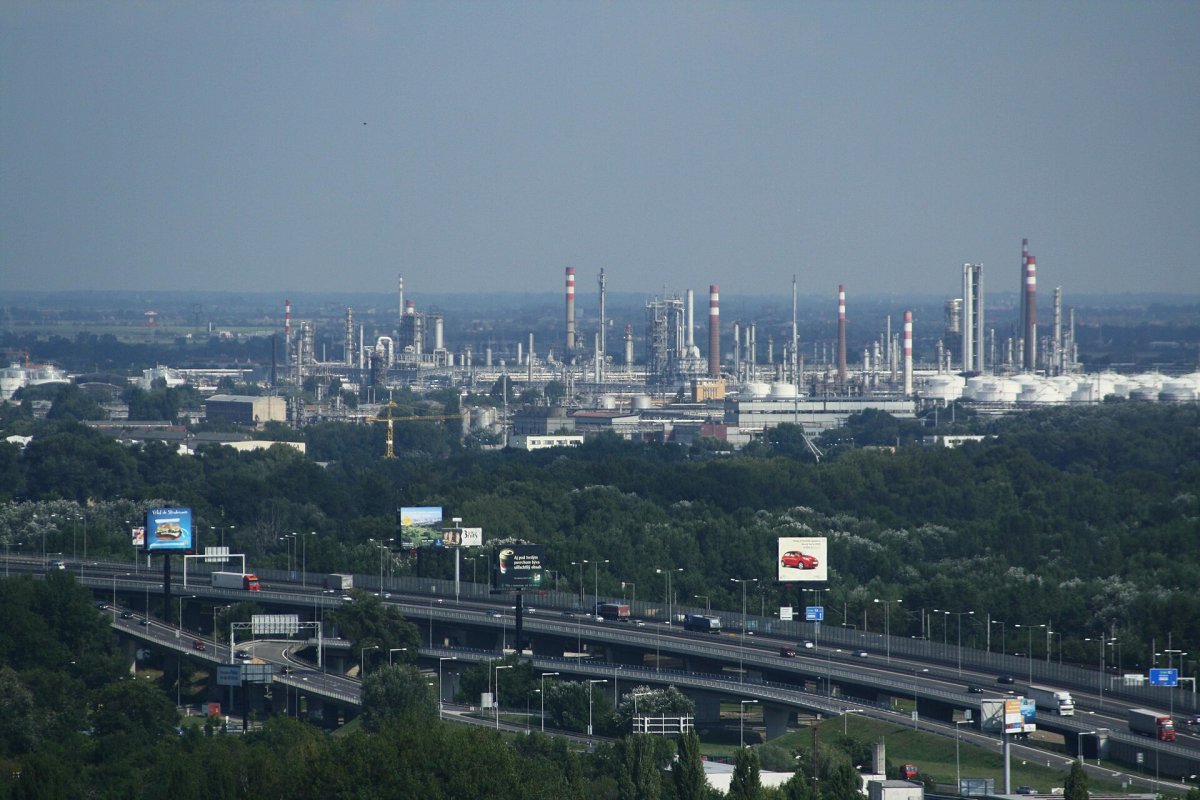
Illustrative photo: Slovnaft refinery, viewed from the Nový most lookout in Bratislava. Author Frettie, Wikimedia Commons, CC BY 3.0.