

The difference between eighth and third place is the state's share. And while both Bratislava and Prague explain why they can't intervene in prices, both point to the component they don't set — and stay silent about the one they do.
Key actors — tap for context

Matúš Šutaj Eštok
Slovak politician, Minister of the Interior and chairman of Hlas-SD.
Why here: Declared that Slovak fuels are the eighth cheapest in the Union and acknowledged negotiations on fiscal instruments.
More info →
Andrej Babiš
Czech Prime Minister and businessman of Slovak origin, leader of the ANO movement.
Why here: Rejects both a cut in excise duty and margin regulation, placing the blame on refineries and ETS 2 emission allowances.
More info →
Robert Fico
Prime Minister of the Slovak Republic.
Why here: Announced further government talks on fuel prices; hosted the V4 summit at Bratislava Castle on September 10.
More info →
Michal Šimečka
Chairman of the opposition party Progressive Slovakia.
Why here: Proposed using Slovnaft's alleged debts to help people; the company rejected this.
More info →
Lukáš Kovanda
Czech economist, chief economist at Trinity Bank and commentator.
Why here: Pointed to UBS estimates showing that the refining margins of Orlen and MOL exceeded the long-term norm several times over.
More info →Ivan Indráček
Chairman of the board of the Czech filling-station association SČS, which was called the Union of Independent Petroleum Dealers until 2021.
Why here: Argues that the high margins are the market's reaction to a shortage of capacity, and sees the solution in lowering the EU minimum excise duty.
Petr Lajsek
Analyst at Purple Trading.
Why here: In his view, ETS 2 is not the cause of the current price rise; he recommends releasing reserves and temporarily cutting the tax on diesel.

Maud Bregeon
Spokesperson for the French government and Minister Delegate for Energy.
Why here: When asked about capping fuel prices, she replied that she would like to have a magic wand.
More info →
Marine Le Pen
French far-right politician, chair of the parliamentary group of the National Rally, a party led by Jordan Bardella.
Why here: Proposed cutting value-added tax on fuel; the government rejected the proposal.
More info →
Slovnaft
The only refinery in Slovakia, part of the Hungarian MOL group.
Why here: Rejected the claims about debts, stating that over three years it paid a billion euros in taxes and levies.
More info →
Orlen
Polish state-controlled refining and petrochemical group.
Why here: According to UBS estimates, its gross refining margin climbed to 50 to 55 dollars per barrel.
More info →MOL
Hungarian oil and gas group, owner of Slovnaft.
Why here: According to UBS, its refining margin is approaching 50 dollars per barrel.
More info →
UBS
The largest Swiss bank.
Why here: Its fresh estimates of refining margins have become an argument in both the Czech and Slovak debates on fuel prices.
More info →Miroslav Novák
Chief analyst at the Czech company Citfin.
Why here: Points out that the government cannot force foreign refineries to supply at a price it sets itself.

Philippe Brun
French Socialist Party member of parliament for the Eure department.
Why here: Called the situation unsustainable and is demanding an urgent cut in fuel taxes.
More info →
Európska komisia
The executive body of the European Union.
Why here: Every week it publishes fuel prices in all member states, both with and without taxes.
More info →The Minister's Figure Checks Out. So Does What's Behind It
Šutaj Eštok said on September 12 that fuel prices are the "eighth cheapest in the European Union" and that among the Visegrád Four countries, only Hungary has lower prices. At the same time, he acknowledged that the government is considering intervention: "We're talking about fiscal instruments. Whether that's cutting the excise duty or the VAT." STVR ↗The European Commission's weekly overview, which collects prices from all member states, confirms this. In the overview for September 7, Slovak petrol was the eighth cheapest in the Union. Diesel at 1.908 euros shares eighth place with Croatia, whose price is identical to within a tenth of a cent. In both cases, only Hungary was cheaper within the V4, so the minister was speaking precisely. Weekly Oil Bulletin ↗
The Commission, however, publishes two sets of figures — prices with taxes and prices without them. In the second, the ranking looks quite different. Without taxes, Slovak petrol is the third cheapest in the Union, cheaper only in Malta and Estonia. Diesel without taxes is the fourth cheapest, behind Malta, Hungary, and Estonia. The Czech Republic ranks eighth for petrol and eleventh for diesel, while Poland ranks as low as nineteenth for petrol.
Where a Euro Gets Lost in a Liter
The price of a liter can be broken down into components. For petrol at 1.774 euros, 51.4 cents is excise duty Finančná správa SR ↗ and 33.2 cents is value-added tax at a rate of 23 percent. Taxes alone thus make up 84.6 cents, which is 47.7 percent of the price. Added to that is just under 4 cents for the fee for maintaining emergency oil reserves, which doesn't go to the state budget but to the agency that manages the reserves. Including it, the mandatory component reaches 88.5 cents, or 49.9 percent. The remaining 88.9 cents covers everything else: the oil itself, its processing, transport, wholesale, and the filling station's margin. For diesel at 1.908 euros, taxes are 72.5 cents (38 percent), and with the fee, 76.4 cents, or 40.1 percent.This breakdown is our own calculation, not a figure from the Commission — in this overview it publishes the price with and without taxes, not the individual components. The sum matches its figures to within a tenth of a cent, so this isn't an estimate. And compared with its neighbors, the result is clear: the entire mandatory component makes up 49.9 percent of the price of Slovak petrol, more than the EU average (47.6 percent) and more than any of its V4 partners. In the Czech Republic it's 46.7 percent, in Hungary 45.1, and in Poland 42.
Record Margins That Aren't Paid by the Slovak Driver Alone
On September 12, Trinity Bank's chief economist Lukáš Kovanda pointed to fresh estimates from UBS. According to them, the gross refining margin of Poland's Orlen climbed to roughly 50 to 55 dollars per barrel, and Hungary's MOL's margin is approaching 50 dollars, while their longer-term norm tends to be around 15 to 20 dollars. Both companies are key for the region — Orlen operates refineries in Litvínov and Kralupy, while MOL supplies the Slovak market through Slovnaft and its distribution network. Hospodářské noviny ↗That the margins are extraordinary is also confirmed by Ivan Indráček, who heads the Czech filling-station association SČS. However, he attributes them to a shortage of capacity, not exploitation of the crisis: "The market is simply worried right now about a fuel shortage, because European refining capacity isn't enough and deliveries are lagging." In the same article, Deník reports that the European margin on petrol was over 62 dollars per barrel in early September, almost at the level of the record year 2022. Deník ↗
The Commission's data introduces one complication into this picture. Orlen supplies both Poland and the Czech Republic, yet in the tax-free price the two countries sit at opposite ends of the ranking: Poland has the highest value of the four and ranks as low as nineteenth in the Union, while the Czech Republic, where Orlen itself produces via Unipetrol in Litvínov and Kralupy, ranks eighth. If the margin of a single supplier determined the price, the two should be closer to each other.
Record margins are thus a shared European phenomenon and cannot by themselves explain why prices differ between neighbors. Taxation, too, has no single answer to that question — the tax-free price also depends on which oil each refinery buys, how far it's transported, and under what contracts. What is certain is something else: tax decides where a country ultimately ends up in the ranking. Slovakia is the third cheapest in the Union for petrol before taxation, and eighth after it.
Prague points to Brussels, analysts to the market
The Czech government rejects intervention in either direction at once. "The Ministry of Finance is monitoring the situation. Margins are now at a maximum of three crowns, they are not excessive. So there is no room for regulation. We will not be lowering the excise tax," said Prime Minister Andrej Babiš. The problem, in his view, is not the filling stations but the refineries: "It is unacceptable for wars to be exploited for excessive profits. We will want to address this at the European level." Deník ↗The second Czech argument concerns the ETS 2 emissions allowances, whose launch Babiš wants postponed. TASR ↗ The system's launch has already been postponed once, from 2027 to 2028, and Babiš is calling for a further delay. Analysts contacted by ČTK agree that the impact on refineries will be real, but is unrelated to the current price increases — full operation is not due to start for another two years. "ETS 2 won't be paid directly by the driver, but by fuel suppliers," explained Purple Trading analyst Petr Lajsek. He considers releasing strategic reserves, tighter control of margins at pumps, and a temporary reduction of the excise tax, above all on diesel, to be more meaningful measures. Hospodárske noviny ↗
That the government cannot reach the margins is also confirmed by CitFin's chief analyst Miroslav Novák: the state can indeed set a maximum price in an extraordinary situation, "but it cannot influence world wholesale prices or force foreign refineries to supply the Czech Republic at a price set by the Czech government." Deník ↗
The cap nobody in Bratislava is talking about
If the tax is to remain, then, it's worth adding how much of it can actually be cut. Directive 2003/96/EC sets minimum taxation levels for member states: €359 per thousand litres of petrol and €330 per thousand litres of diesel. This is not a single tax — the directive defines the minimum as the sum of all indirect taxes except value added tax. European Commission ↗Slovakia's diesel rate is €368, just €38 above the EU floor. Even if the government taxed diesel at the absolute minimum permitted under EU law, a litre would, including the effect of VAT, become cheaper by less than five cents. For petrol the room is considerably larger: the rate of €514 is €155 above the minimum, corresponding to roughly nineteen cents per litre.
There is a paradox in this. Some analysts are calling for a tax cut primarily on diesel, yet that is precisely where the room to maneuver is nearly exhausted. The bigger reserve lies with petrol — the fuel that is already the eighth-cheapest in the Union today. The Ministry of Finance rejects both options, arguing it would mean "a significant loss of state budget resources amounting to tens to hundreds of millions of euros." Prime Minister Robert Fico has meanwhile announced further government talks on fuel prices, while the leader of the opposition Progressive Slovakia, Michal Šimečka, proposed tapping into Slovnaft's alleged debts — the company rejected this, stating that over three years it paid a billion euros in taxes and levies. STVR ↗
Indráček arrives at the same conclusion from the opposite direction. In his view, a local solution makes no sense, and a windfall profit tax would move money into the budget, not to drivers. "A sensible solution would be an agreement at the European level to lower the set minimum excise tax. Otherwise there aren't too many options," he argues. Deník ↗
Six governments, six answers, one ceiling
The debate, which in Bratislava looks like a domestic dispute between the coalition and the opposition, is playing out the same week across the whole Union — and everywhere it runs into the same limit.In France, according to an infographic by the daily Ouest-France, diesel has climbed at some pumps to as much as €2.85 per litre, and shortages of SP95-E10 petrol have appeared. Ouest-France ↗ Socialist MP Philippe Brun is calling for an urgent tax cut, BFM TV ↗ and Marine Le Pen is proposing lower VAT, while government spokesperson Maud Bregeon rejects a price cap, saying she would need "a magic wand" for that. BFM TV ↗
In Germany, calls for a fuel price cap are growing louder, but the federal economy minister rejects it. ZDF heute ↗ Italy, which already has a diesel excise discount, is considering adding a targeted €100 voucher on top of it. Open ↗ In Portugal, the opposition Socialist Party is demanding a VAT cut right away rather than waiting until January, Público ↗ while the local federation of fire brigades reports that diesel prices are "financially strangling" it. Observador ↗
Six different tools are thus on the table at once — a price cap, VAT, excise tax, a voucher, releasing reserves, and margin regulation — though most of them are so far proposals, not adopted measures. What they have in common is that none of them touches the cause. And it is precisely with the excise tax, the point where the state can reach most directly, that the floor is set by the 2003 directive. The V4 prime ministers met on 10 September at Bratislava Castle, high energy prices were among the main topics, and according to STVR they agreed to seek a joint solution. No concrete joint tax or price instrument emerged from the talks. SITA ↗
Limits of this view
The European Commission data is as of 7 September. Tension around the Strait of Hormuz had already been building before that date, but the Saudi East-West pipeline did not go down until five days later. Prices have continued to rise since then, and the ranking of countries may have shifted, although the tax rates discussed here have not changed.The non-tax component of the price is not the same as the refinery margin. It also includes the crude oil itself, processing, transport, wholesale, and the filling station's margin. Since the price of oil is set globally and is the same for all countries, differences between member states in this component reflect precisely that processing and trading layer — but they cannot be reduced to a single figure.
The refinery margin estimates do not come from audited company reports but from a commentary in which Trinity Bank's economist took them over from UBS analysts. They are, moreover, figures for the entire Orlen and MOL groups, not for Slovnaft alone, so they carry over to the Slovak market only indirectly.
Finally, the calculation of five and nineteen cents assumes two things: that the state would cut the tax exactly to the EU minimum, and that the entire saving would be passed through into the pump price. Neither is a given. Moreover, gross margin is not net profit, as Kovanda himself points out — the refinery pays for energy, operations, maintenance, and logistics out of it.
What hotinfo is watching
- Vláda predložila konkrétny návrh na zníženie spotrebnej dane alebo DPH na pohonné látky
- Ministerstvo financií vyčíslilo, o aký výpadok rozpočtu by pri jednotlivých variantoch išlo
- Slovensko alebo Česko oficiálne požiadalo Európsku komisiu o zníženie minimálnych sadzieb spotrebnej dane
- Únia rozhodla o ďalšom odklade systému ETS 2 za rok 2028, o ktorý žiada Praha
- Povinná zložka ceny slovenského benzínu, teda dane spolu s odplatou za núdzové zásoby, klesla pod 49,9 percenta, ktoré sme z údajov Komisie k 7. septembru dopočítali
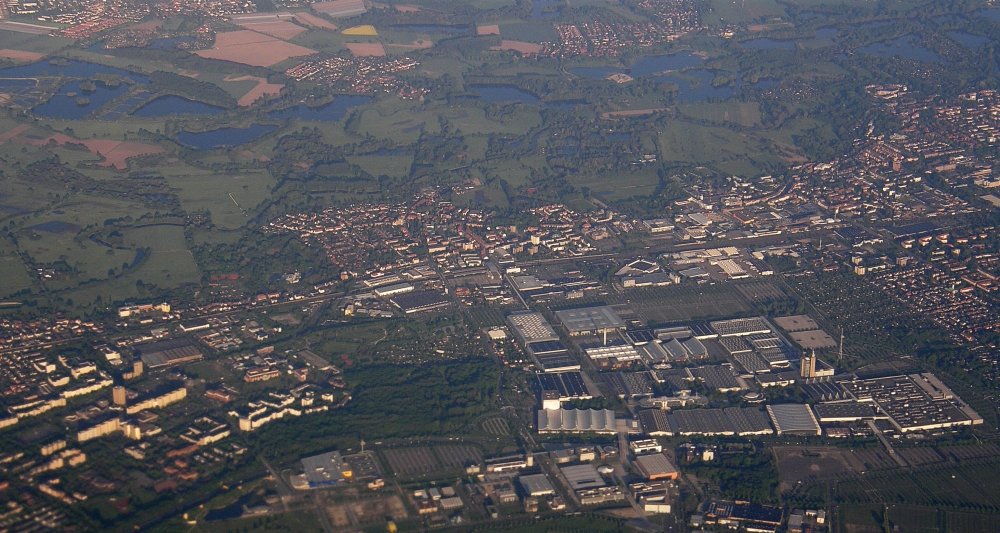
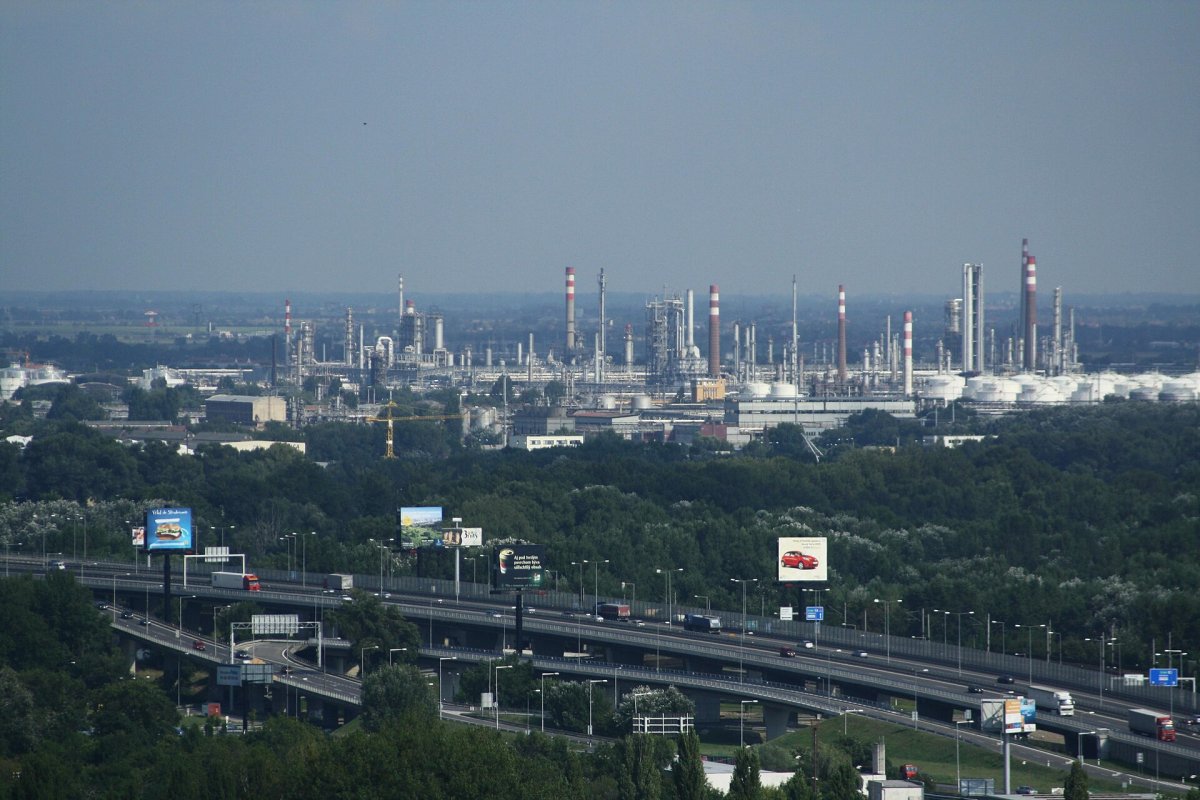
Illustrative photo: the Slovnaft refinery, viewed from the Nový most bridge lookout in Bratislava. Author Frettie, Wikimedia Commons, CC BY 3.0.