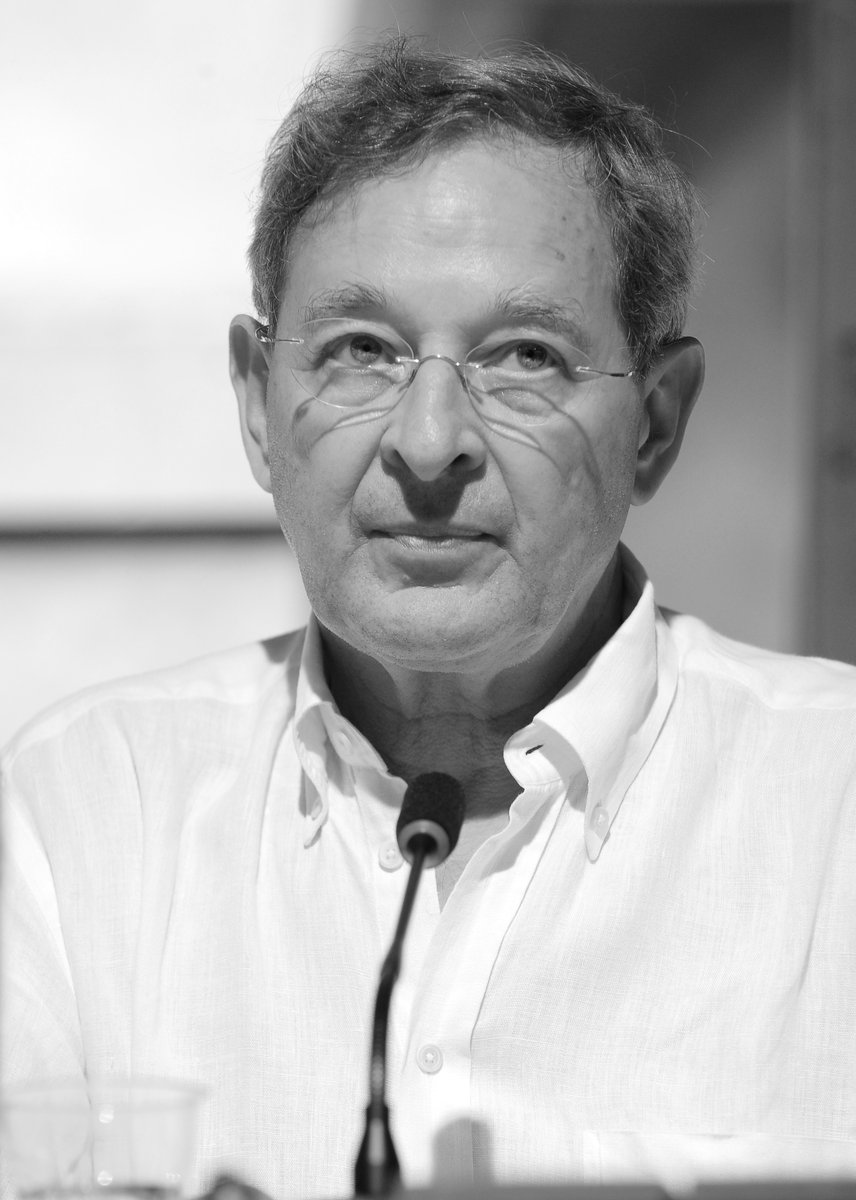

Obituaries for him appeared in thirteen countries — from the Hungarian Telex and Index through the German Spiegel, Austrian Die Presse, Swiss NZZ, French Le Monde and Italian ANSA to the Swedish Dagens Nyheter, Spanish El Mundo, Croatian Novi list, Lithuanian LRT and Romanian HotNews. In Slovakia, three brief reports about him were published: coverage from Denník N and STVR and a news agency report from TASR, which was picked up by Pravda. Yet the turning point that led him to literature took place here, among us.
Key actors — tap for context

Péter Nádas
Hungarian prose writer, essayist and photographer, author of The Book of Memory and Parallel Stories.
Why here: Died Wednesday morning in his home in Gombosszeg at age 83.
More info →
Ladislav Fuks
Czech writer, author of The Burner of the Dead and Variations for a Dark String.
Why here: Nádas dedicated a short story "The Lamb" to him in 1967 and presented his novel as a model for narration through a child's eyes.
More info →
Péter Esterházy
Hungarian writer and essayist, along with Nádas the most prominent figure in the renewal of Hungarian prose.
Why here: Friend and rival to whom Nádas dedicated one of three essays in his last book Dead Friends.
More info →
Miklós Mészöly
Hungarian writer awarded the Kossuth Prize, one of the founders of modern Hungarian prose.
Why here: Nádas considered him his teacher and portrayed him in the book Dead Friends.
More info →Alaine Polczová
Hungarian psychologist and writer, pioneer of thanatology and founder of the Hungarian hospice movement.
Why here: The third person portrayed in the book Dead Friends, wife of Miklós Mészöly.
More info →
Csaba Károlyi
Hungarian literary critic and deputy editor-in-chief of the weekly Élet és Irodalom.
Why here: He spent a year in conversation with Nádas for the book A Whole Year, and after his death explained why it was a consciously closed work.
More info →
László Krasznahorkai
Hungarian writer and screenwriter, author of Satan's Tango.
Why here: He received the Nobel Prize in Literature last October, not Nádas.
More info →
Viktor Orbán
Hungarian politician and head of Fidesz, whose party lost the elections in April 2026.
Why here: Nádas called his system autocracy and Eastern European mafia in 2022.
More info →
Franz Kafka
Prague-based writer writing in German, after whom the international literary prize awarded in Prague is named.
Why here: Nádas received this prize in the fall of 2003 at the Old Town Hall.
More info →
Attila József
Hungarian poet considered the greatest Hungarian poet of the 20th century.
Why here: Nádas received the prize bearing his name in 1985.
More info →Juliana Szolnokiová
Slovak translator from Hungarian.
Why here: Translated both of Nádas's major novels into Slovak, The Book of Memory and Parallel Stories.
Anna Valentová
Czech translator from Hungarian, recipient of the State Prize for Translation Work.
Why here: Thanks to her, three Nádas books were published in Czech, including The Book of Memory.
More info →Kalligram
Bratislava publishing house focused on Central European literature and the Hungarian-Slovak cultural bridge.
Why here: Published his two most extensive novels, The Book of Memory and the three-volume Parallel Stories.

Élet és Irodalom
Hungarian weekly on literature and politics, one of the most influential cultural periodicals in the country.
Why here: Its editor Csaba Károlyi was among Nádas's closest readers.
More info →
Kunsthaus Zug
Swiss art museum with the most important collection of Viennese modernism outside Austria.
Why here: Nádas donated his photographic work to it and exhibited there twice.
More info →
Gombosszeg
Village in Zala County in southwestern Hungary with several dozen inhabitants.
Why here: Nádas lived here from 1984 and died here on Wednesday.
More info →Eva Bonnierová
Swedish publisher who published Nádas's late books.
Why here: After his death, she said that the Nobel Prize he never won seemed very sad to her.

Plutarchos
Greek writer and historian, author of Parallel Lives, in which he placed the fates of Greeks and Romans side by side.
Why here: Nádas cited him in the foreword to The Book of Memory as a model of parallel narration.
More info →The Mirror in Which His Mother Showed Him a Jew
Nádas was born on October 14, 1942 in Budapest into a Jewish family. His mother Klára Tauberová was a worker, his father László Nádas was a telephone repairman. After the Arrow Cross came to power, his mother fled with her two-year-old son on false documents to Bačka and Novi Sad, but they returned before the siege of Budapest. They survived the siege in a relative's apartment among others in hiding, and a bomb fell on the building. Digital Literary Academy ↗When he was eight years old, he announced to his mother that he hated Jews. She put him in front of a mirror and said: "Look carefully, here is a Jew, you can hate him peacefully." In interviews he emphasized that this was one of the few incidents in his books that actually happened exactly as he described it. Die Presse ↗
After the war, his parents advanced — his father became a high official of the Reparations Office, his mother a Budapest secretary of the Democratic Union of Hungarian Women. In the 1950s they fell out of favor. His father was suspended in 1953 on suspicion of embezzlement, the charges were dropped a few months later due to lack of evidence, but he remained in a lower position. His mother died on May 15, 1955 after a long illness, Nádas was twelve. During the 1956 uprising, his father was dismissed by a workers' council and someone made threatening phone calls to him, so he left the apartment with both sons. A labor court ultimately cleared him of all charges, and several days after the decision was delivered, on April 15, 1958, he committed suicide. Digital Literary Academy ↗
The Zurich daily NZZ recalled in its obituary what the brothers Péter and younger Pál learned from their father's farewell letter: that they were supposed to die with him before he finally decided to go alone. Nádas was fifteen at the time, and he later called the childhood trauma raw material from which he builds. NZZ ↗
He Renounced Journalism for August 1968
In summer 1958, at sixteen, he left school and went to apprentice as a photographer. From 1961, he worked as a photojournalism apprentice in the editorial office of the magazine Nők Lapja, completed a two-year journalism school, and after military service returned first to photojournalism and then to journalism. In summer 1968, he moved to the village of Kisoroszi at the northern tip of the Danube island near Szentendre and left journalism work in 1969. His first novel The End of a Family Saga was completed in August 1972, but censorship did not release it to the world until 1977. Digital Literary Academy ↗He named the reason himself, and it was the occupation of Czechoslovakia. "In the sixties and seventies, Czech literature was not only important to me, but generally very important in Hungary. And Czech film too. In sixty-eight we tore Czech books from each other's hands; we couldn't even enter your cultural center to watch Czech films. In August 1968, thanks to that, I began learning Czech, but I had my last lesson on March 31, 1969," he recalled in an interview with MF Dnes. Seznam Zprávy ↗
The decision cost him his livelihood. "I could not continue to be a journalist, because I could not participate in what followed in any way. At the same time, it meant that from that moment on I was unemployed. My literary texts were not allowed to be published anyway, so essentially I voluntarily withdrew into complete isolation," he later told the newspaper Právo. Seznam Zprávy ↗
The Italian agency ANSA quotes a harsher version of the same decision: he turned his back on the system "to save my soul". From then on, according to his own words, he was strictly controlled. "They decided when I could publish, what, and in how many copies. They would only allow me to travel abroad if I accepted work as a secret agent, that is, if I spied and informed on my friends." ANSA ↗
The Czech influence in his life was not an episode. He dedicated the short story The Lamb in 1967 to Ladislav Fuchs, whose novel Variations for Dark Strings he cited as an example of why he too often told stories through a child's eyes. "It was a way to resist dictatorship. Under the apparent naivety of a child's perspective, many things could be hidden," he explained. In autumn 2003, he accepted the Franz Kafka Prize at the Prague Old Town Hall. Seznam Zprávy ↗
He Died Once and Wrote a Book About It
In 1990, he married Magda Salamonová, a journalist with whom he had lived since 1962. Three years later, he suffered a heart attack, survived clinical death, and doctors revived him. He processed the experience in the book My Own Death, which was published in 2004. "I love to live, but it was good to die too; I have never known such a peaceful state, such silence," he said in a television interview and added that the experience was beyond words. La Libre ↗According to literary critic Csaba Károlyi, deputy editor-in-chief of the weekly Élet és Irodalom, this very experience determined Nádas's relationship with death. Károlyi spoke with him regularly throughout a year and published a book from it. "He died once already, so they brought him back," he told the portal Index. "From his own death on, he had a cool relationship with death, his own and others'." Károlyi himself added that the news of his death shocked him; he knew of no illness. Index.hu ↗
According to him, Nádas deliberately closed his oeuvre. The last book was Dead Friends from 2025, portraits of Miklós Mészöly, Alaine Polczová, and Péter Esterházy. "He did it so that it would be. And he did it. Thus the trajectory deliberately closes, because it is a closed work," Károlyi said. Index.hu ↗
The Austrian newspaper Die Presse put a sentence from one of his last interviews with the MTI agency in the headline: "Trees die standing, I while writing. Well, that would be a fine death." Die Presse ↗
Six Books in Slovak, Five Translators
Slovak has not forgotten Nádas. According to an overview by Denník N, the novels Book of Memory and Parallel Stories, translated by Juliana Szolnokiová, were published here; The End of a Family Saga was translated by Katarína Králová; My Own Death by Eva Andrejčáková; and the essays in the books Hamlet Is Free and The State of Things were translated by Peter Kováč and Renata Deáková. Denník N ↗Both major novels were published by Bratislava's Kalligram. Book of Memory was published in Slovak in 2004; the three-volume Parallel Stories—Silent Country, In the Deepest Night, and The Breath of Freedom—in 2009, and together they have 1,280 pages. Artforum ↗
Book of Memory from 1986 is his international breakthrough. He began writing the first version in summer 1973, destroyed the manuscript in spring 1974, and started over, so he worked on the novel for over ten years. In the preface, he wrote that he wanted to write memories somewhat like Plutarch, "parallel memories of different people at different times, and those different people would all be me, without actually being that". NZZ ↗
This very book was called by American essayist Susan Sontag "the greatest novel written in our time," as the Romanian portal HotNews recalls with reference to the New York Times. HotNews ↗
Anna Valentová translated it into Czech and received the State Prize for Translation for Book of Memory. Besides her, a selection of short stories Mrs. Klára's House was published in Czech, and in 2014 the novel The End of a Saga. Seznam Zprávy ↗
Slovak media, however, remained with short formats on the day of his death. In the TASR agency report that Pravda reproduced, his main novel is listed as Parallel Short Stories, although it was published in Bratislava seventeen years ago as Parallel Stories. An obituary that would recall his Slovak translations as well as the Czechoslovak turning point of 1968 has not yet been published. Pravda ↗
The Nobel He Never Received
His Swedish publisher Eva Bonnierová said to the newspaper Dagens Nyheter: "He was one of Europe's great writers. The Nobel Prize was often mentioned in his case, and he never received it, and personally I find that very sad." Swedish translator of Book of Memory Ervin Rosenberg called it an almost perfect book. Dagens Nyheter ↗The Nobel Prize for Literature was won last October by another Hungarian, László Krasznahorkai. Nobelprize.org ↗
Nádas had a full shelf of other awards: the Attila József Prize (1985), the Kossuth Prize (1992), the Austrian State Prize, the French prize for best foreign book of the year (1998), and the Prague Franz Kafka Prize (2003). In 2006 he was elected a member of the Berlin Academy of Arts, and in 2010 he became an honorary citizen of Budapest. Pravda ↗
He never abandoned photography. He donated his photographic work to the Swiss museum Kunsthaus Zug and exhibited there twice, most recently in 2018 under the title Author on the Road, where he combined older photographs with images taken on a mobile phone. SRF ↗ Digital Literary Academy ↗
He commented on politics judiciously, but not evasively. On Viktor Orbán in 2022, he said that "it's autocracy, he is the party," and he described his system as a kind of Eastern European mafia. La Libre also recalls his statement to the portal Litera: "Literature is a personal matter, not a communal or national one. But if no one cultivates it, the population will certainly grow dumb." La Libre ↗
In an interview with Dagens Nyheter in 2022, shortly after the Russian invasion of Ukraine, he summed up his own life like this: "I was born in dictatorship. Then came a short democratic pause after the war. Those four years of my childhood marked me. Then dictatorship again. Then twenty years of democracy. Wonderful. Then authoritarian rule once more." Dagens Nyheter ↗
Orbán lost the election on April 12 of this year. Nádas lived to see it four months later. According to NZZ, "he was part of it, did much to make it happen, and experienced it firsthand." NZZ ↗
What hotinfo is watching for
- A Slovak or Czech publisher announced a new Nádas translation, above all of his last book, Dead Friends, from 2025.
- The Hungarian government or the city of Budapest announced the form of the farewell, the funeral or a public commemoration.
- Kunsthaus Zug or another institution opened a posthumous exhibition of Nádas's photographs.
- A Slovak outlet or literary journal published its own obituary or essay on Nádas, rather than a wire report.
- Kalligram announced a reissue of A Book of Memories or Parallel Stories.