
On Monday, the negotiations broke down: Tehran declared the sixty-day deadline invalid and announced a "full offensive", Trump called on Iran to capitulate and threatened bombing Oman — that is, the country co-negotiating the corridor. Turkey has meanwhile entered the game, and a ship in the strait has been hit by an unknown projectile.
Iran and Oman Redraw the Map Without Washington
- Trump threatened to bomb Oman if it gets in the way of the strait agreement. "If they do that, we will bomb them," he was quoted as saying according to Fox News by most European newsrooms — that is, the threat is aimed at the country co-negotiating the corridor. Le Monde ↗El País ↗De Standaard ↗Tagesspiegel ↗
- Trump has meanwhile returned to the idea that the strait should belong to America: "I like to declare it as American territory." Balkanweb ↗
- Turkey has entered the game. Erdoğan called Trump, offered help, and asked him to continue negotiations with Iran; Ankara and Tehran are meanwhile negotiating directly on opening the strait. Index.hr ↗RTP ↗Naftemporiki ↗
- Guterres urged Washington and Tehran to return to negotiations. RTP ↗
- Traffic through the Hormuz Strait has fallen to nearly zero — on Sunday they recorded no passage at all. This is so far the hardest number of the entire crisis: bypasses are being drawn precisely because no one is actually using the main route anymore Protothema ↗
- The framework agreement between the USA and Iran has meanwhile expired. German n-tv asks what it actually brought. CBS writes about the same thing differently — about a dead point just before the deadline expires n-tv ↗CBS News ↗
- Persian Gulf countries according to Bloomberg already have their own bypass — they are secretly exporting oil through Hormuz despite Iranian attacks. This is the fourth way the strait is being bypassed without Washington deciding about it Censor.NET ↗Ukrayinska Pravda ↗.
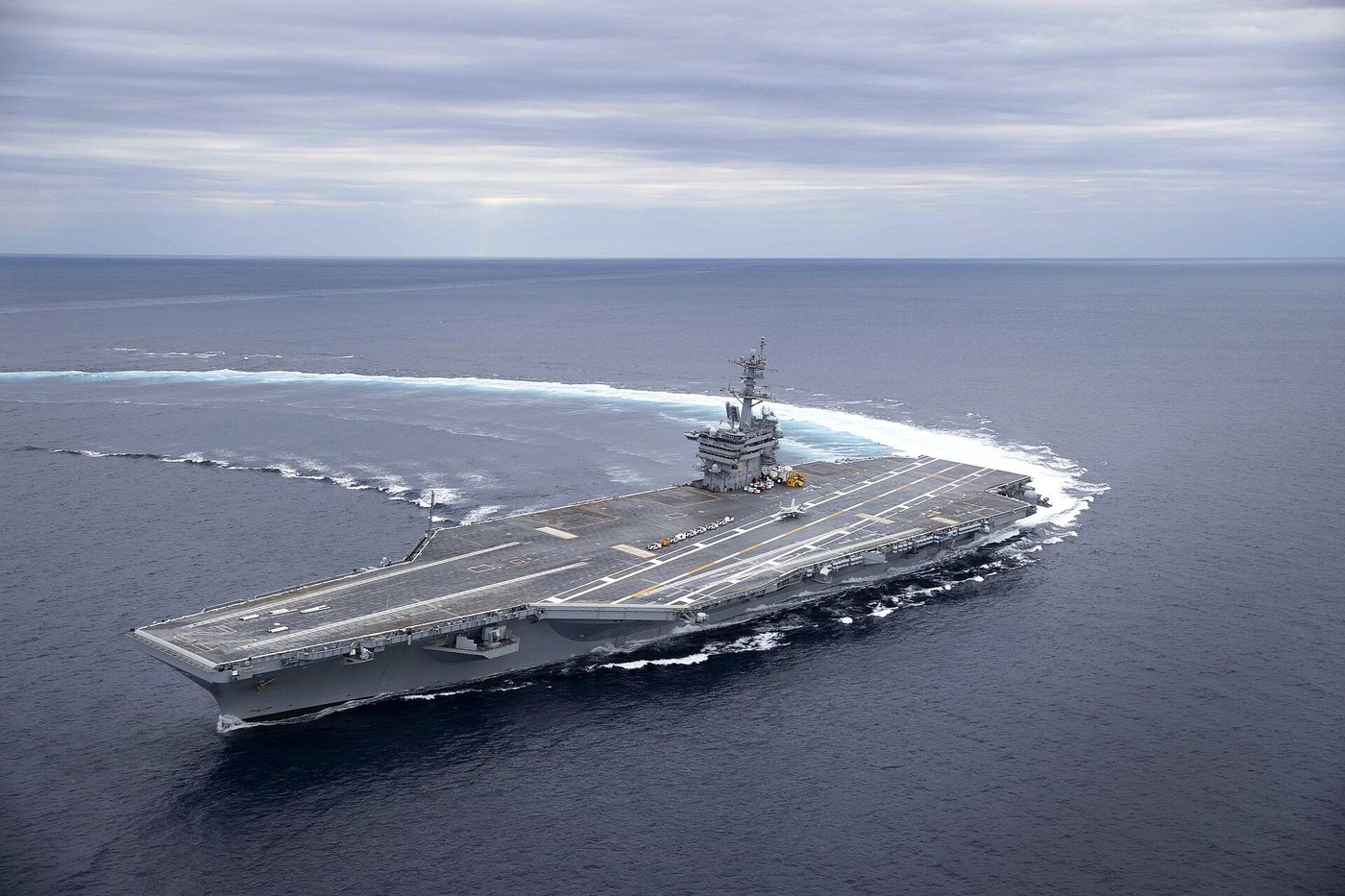
- The USA are moving the last aircraft carrier from the Pacific to the Middle East. Romanian Adevărul notes that China can take advantage of precisely that Ukrayinska Pravda ↗Adevărul ↗.
Iran claims that it is close to an agreement with Oman on a new, temporary maritime route through the Hormuz Strait. According to French France 24, both countries agreed on the general course of the corridor, a large part of which would run through Iranian territorial waters France 24 ↗.
Madrid's El Mundo drew a sharper conclusion from this: Iran and Oman are redrawing the map of Hormuz without Washington, and it is not improvisation — it stems from years of cooperation between Tehran and Muscat El Mundo ↗.
That is a different logic than blockade. If the corridor runs through territorial waters, the legal regime of passage becomes disputed: international law in straits prohibits impeding transit passage, so any toll would clash with this principle. Portuguese Observador named it precisely: Iran's priority is not closing the strait, but its financial control — and its guest adds that the USA should not allow it, because passage must not become a tradeable item Observador ↗.
Tehran Has Tightened Conditions in the Meantime
- Words gave way to rockets: The Emirates announced that Iran fired two ballistic missiles at their territory — the first such attack in months. Residents were called to take shelter; according to Abu Dhabi, both missiles fell into the sea. Le Monde ↗Die Presse ↗ANSA ↗Libération ↗
- Washington Post: The Pentagon is considering reducing American military presence in the Persian Gulf after the war ends. This is the first signal that Washington is counting on a scenario in which it withdraws from the region — rather than strengthens its presence there. G4Media ↗TRT Haber ↗n-tv ↗
- The shift we described in the first wave now has a result: The Pacific is left without a single American aircraft carrier. Le Figaro adds to this that due to Iran, the other end of the world is exposed. Le Figaro ↗
- France will expel two Iranian diplomats 'in the coming days'. Paris thus took recourse to diplomatic retaliation for the first time in this crisis. Le Figaro ↗Libération ↗
- According to Polish and Latvian media, the Kremlin is no longer waiting for Trump and is supporting Iran with its own weapons — Russia was supposed to start supplying Tehran with ammunition for war against the USA. Rzeczpospolita ↗LSM ↗
- Oil prices are rising due to uncertainty around the Strait of Hormuz — and France, against this background, is borrowing at its most expensive since 2008. Politika ↗France 24 ↗
- Iranian parliament speaker Kalibaf sent word to Washington that 'they have ventured into something far beyond their capacity'. Cumhuriyet ↗
- Idea became reality: Trump released a map on which the Strait of Hormuz is marked as 'new U.S. territory'. Media picked it up in two dozen countries — from Lisbon to Vilnius. The Hill ↗El País ↗LRT ↗
- Trump at the same time hardened his formulation about negotiations: not only are they not taking place, but nor are they planned. The sixty-day period expired without replacement. CBS News ↗Die Zeit ↗NPR ↗
- That same Trump claims that mines are 'removed or neutralized' and the strait is 'functional'. This is in direct contradiction to Iran's position as well as shipping figures. BFM TV ↗
- Iran's chief negotiator laid down the condition openly: the strait will remain closed until Washington meets the conditions of the interim agreement. Le Figaro ↗LSM ↗Ziarul de Gardă ↗
- Tehran responded to the map mockingly: 'We will correct his illusions. Washington is begging us to negotiate.' Protothema ↗
- The White House at the same time insists that the naval blockade 'remains fully in effect and effective'. La Libre ↗
- Austrian Die Presse reports that Iran is threatening an invasion of Persian Gulf states and 'strategic surprises'. Die Presse ↗
- Dutch De Telegraaf summed it up as a transition 'from defense to full offense'. De Telegraaf ↗
- Former French ambassador Éric Danon turns the reading around: 'Stuck in Iran, Trump threatens, but won't bomb Oman.' Swiss Tages-Anzeiger named it even more harshly — 'Trump barks because he cannot bite'. Le Figaro ↗Tages-Anzeiger ↗
- Swiss SRF offers a broader frame: 'A superpower is being pushed out by a regional power.' SRF ↗
- Tehran declared the sixty-day negotiation period void and warned that it is moving to 'full offense'. Spanish El Español meanwhile writes that Iran used those sixty days for rearming. France 24 ↗Protothema ↗El Español ↗
- Trump called on Iran to raise the 'white flag' of surrender, and his son-in-law Kushner at the same time admits that negotiations are in a desperate state and the president will have to be 'very patient'. Ukrajinská pravda ↗Daily Mail ↗
- Iran is threatening escalation directly in the Strait of Hormuz, reports Austrian ORF. ORF ↗
- Wall Street Journal described a secret Iranian plan: According to it, Tehran used the 60-day ceasefire to prepare for a new war. The report was picked up by Greeks and Finns To Vima ↗Naftemporiki ↗Ilta-Sanomat ↗
- Iran confirms it openly as well — saying that its 'defensive' stance will change to 'offensive', and promising 'surprises'. El Confidencial ↗
- The head of Iran's Guards explained the strategy in one sentence: 'As long as Trump is in power, there will be no peace in Hormuz.' Novi list ↗
- Trump has the opposite reading of those same 60 days: 'Their army is defeated.' BFM TV ↗
- German Welt warns of a third possibility: if America continues to hesitate, Iran will win. Welt ↗
- An Iranian general, after Trump's statement that Hormuz will be U.S. territory, told the president: 'We will break your legs.' Protothema ↗
- According to Romanian media, Iran has issued a bounty of 30,000 dollars for each killed or captured American soldier. French Ouest-France mentions it in its overview as a 'bonus in Iran' Libertatea ↗Ouest-France ↗.
- The framework agreement between the USA and Iran expires and Tagesspiegel asks what it actually brought during its validity. Tagesspiegel ↗
- Adevărul describes Trump's secret channel to Iran's Revolutionary Guards. Adevărul ↗
- G4Media analyzes that Republicans want to have peace in Iran by the November elections — and asks whether Trump will listen to them. G4Media ↗
Tehran has released new conditions for opening. According to Madrid's El País, it is demanding that the USA "correct its behavior" and compensate it; it is holding on to most of the demands from the June memorandum El País ↗. Swedish Dagens Nyheter called it an ultimatum Dagens Nyheter ↗, American station CBS speaks of "new conditions" CBS News ↗ and Romanian HotNews calculated what specific concessions Iran wants HotNews ↗.
Trump responded in two ways. Verbally he hardened — according to BFM TV, he announced that the USA will also demand 'compensation' from Iran for its actions in recent years BFM TV ↗. And practically he backed down: on Monday, he extended for another three months the exemption that allows shipping between American ports by vessels under foreign flags, to ease pressure on fuel prices BFM TV ↗. At the same time, according to El País, he claims that Iran will ultimately back down because the American naval blockade has ruined it.
China Is Going Around — Through the Arctic
- The Arctic is not the only place where the commodity map is being redrawn right now. Handelsblatt writes that the dispute over Greenlandic oil with an American corporation is intensifying. (Handelsblatt ↗)The second bypass is not diplomatic, but logistical. According to La Repubblica, Beijing has revived the polar Silk Road: with a new route it transports goods to Europe, shortens sailing time and bypasses the most dangerous choke points of world maritime traffic La Repubblica ↗. Turin's La Stampa adds that China has launched the first regular Arctic container line La Stampa ↗.
The Arctic route is seasonal, expensive and politically sensitive. And the line is presented as a bypass of global choke points in general — the connection to Hormuz is an interpretation, not a declared reason.
Syria Wants to Be an Energy Player
- Saudi Arabia is changing its oil route and Egypt is becoming its alternative gateway to Asia. It is the fifth bypass and the first drawn by the largest exporter in the region (Protothema ↗)The third bypass is the most surprising. According to Swedish Svenska Dagbladet, Syria hopes to open a pipeline from Iraq to the Mediterranean and thus become a force on the energy market; it is a bilateral Iraqi-Syrian plan that the Iraqi side has already approved — though there are many challenges Svenska Dagbladet ↗.
This idea makes sense only in the context of a second news story from the same day: Damascus and Moscow signed an agreement on the future of Russian bases, and German taz summed it up with the sentence that "the Russian era in Syria is ending" — this is, however, an editorial interpretation, not an official statement taz ↗. Polish Do Rzeczy reports that Syria is taking over Russian military bases; according to available information, these are Hmeimim and part of Tartus, which are to become joint training centers Do Rzeczy ↗. A country that is just taking over its own infrastructure is looking for how to pay — and oil transit is the fastest answer.
The Markets Are Footing the Bill for Now
- Saudi Aramco is loading oil at the Strait of Hormuz again. After weeks when shipping fell to nearly zero, this is the first concrete counter-move — and it comes from the region's largest exporter. Handelsblatt ↗
- Lula offers Brazil as a replacement: "Brazilian oil can supply the world if Hormuz closes." ANSA ↗
- Following Trump's threats, the price of oil moved up, reports Hungarian HVG. HVG ↗
- An unidentified projectile hit a ship in the strait, one casualty reported. Le Figaro ↗DR ↗Portfolio ↗
- Since resuming the blockade of Iranian ports, the USA has detained more than sixty ships. RTP ↗LRT ↗
- The ended ceasefire has translated into prices: oil is rising and bond yields are breaking records, writes Estonian Postimees. Postimees ↗
- Oil prices are rising because peace negotiations between the USA and Iran have stalled. Censor.NET ↗
- WTI nevertheless opened at $81.94 per barrel with a loss of 0.55 percent, gas rose to €62.20 per megawatt-hour. The market thus reacts to both at once — to risk and to the fact that workarounds are working ANSA ↗ANSA ↗
- Moldovan BANI.md described a scheme through which oil passes through Hormuz "in the dark" and prices haven't exploded. BANI.md ↗
- Austrian media raised the question of why the Emirates are secretly supplying Iran with two tons of gold. Die Presse frames it with the question of whether Abu Dhabi is buying peace before attacks — gold is a currency that sanctions channels don't catch Kleine Zeitung ↗Die Presse ↗.
- Heat waves are weakening Europe's power grid according to El Español — less water, less nuclear, and gas made expensive by Hormuz. El Español ↗
- Cybercriminals, according to Spanish sources, intensified DDoS attacks during the Iranian war. El Español ↗
While routes are still being drawn, prices are moving now.
Oil in New York jumped on Monday — WTI by 4.26% to $81.51, Brent by 4.24% to $87.09 ANSA ↗. Gas prices in Europe rose, according to N1 Bosna, by about eight percent, close to €60 per megawatt-hour (other sources reported a smaller increase of around six percent) N1 Bosna ↗. Italian ANSA reports that the "Hormuz effect" spread to gas and slowed European exchanges ANSA ↗, Belgian La Libre saw it already at the opening of trading La Libre ↗.
And an indicator that cannot be explained by seasonality: US strategic oil reserves fell below 300 million barrels, the lowest since 1983 Naftemporiki ↗.
Greek Protothema brought a figure showing how shipping is really adapting: 55 commercial vessels were diverted in the strait — from 35 by August 2 — and there are more than 20 warships in the area. Greek ship owners are on high alert Protothema ↗.
Why This Is a Story for a Slovak Reader
Slovak and Czech media have covered Hormuz intensively over the last three days — Tehran's demands, oil prices, statements from the new Iranian security chief. What is not in that coverage: the Omani corridor, the polar route, the Syrian pipeline, or 55 diverted vessels. Yet these four things precisely determine whether the crisis will be an episode or a permanent change in trade routes.For Slovakia, the last point is relevant. Gas prices, which rose by eight percent on Monday, do not depend on how the dispute over transit fees ends — but on how long goods will travel the longer route.
Limits of This View
- This is the fifth and last update to this article. The story has since moved from bypasses around the strait to direct exchange of blows in the Persian Gulf — we will therefore follow further developments in a separate text, not another round here.- According to Index, Trump and Vice President Vance disagree even on the main goal of the war with Iran — which is reason to take individual statements about the corridor with caution. (Index.hr ↗)
The agreement between Iran and Oman is not signed. France 24 speaks of agreement on the "general course" of the corridor, which is diplomatic language for a state where everything can still be cancelled. El Mundo's assessment that it is a redrawing of the map "without Washington" is an interpretation by the Spanish editorial board, not an Iranian or Omani statement.
The Syrian pipeline is an intention, not a project: SvD itself writes that there are many challenges. For a country just dealing with the transition after Russian military presence, the time horizon is completely open.
The polar route is seasonal and its capacity is negligible compared to Hormuz — it is not a replacement, but a signal that alternatives are being sought.
And the figures on diverted vessels come from a single Greek source; we do not have independent confirmation.
What hotinfo is Watching
- Whether the Iranian-Omani corridor moves from "the general outline" to a signed text — and whether it includes a fee. Iran's foreign ministry says so far that transit fees are not being negotiated at this stage.
- Whether Trump extends the shipping exemption again after three months, which would mean he is not counting on the strait reopening soon. And whether the Arctic route disappears once the season ends, or Beijing keeps it going.