





However, the zero number of votes against does not mean consensus across the chamber. According to HVG, the overwhelming majority of Fidesz MPs abstained, while the law was supported by MPs of the governing Tisza party and the far-right Mi Hazánk movement, and the KDNP caucus split between those who voted in favor and those who abstained. The majority of the chamber rejected amendments proposed by Mi Hazánk and KDNP. HVG ↗
Prime Minister Péter Magyar commented on the vote on Facebook. "With a 36-year delay, on Tisza's proposal, the Hungarian parliament today voted to disclose the agent files. Fidesz did not support the proposal. I wonder why," he wrote. Telex ↗
What will be released on October 20
The first batch of data is to go onto the archive's website on October 20, three days before the 70th anniversary of the outbreak of the 1956 revolution. It will consist of already-processed data from the so-called "6" index cards, from the B-diaries, and from the database marked H. They are to be published on the archive's website free of charge, without login, and in searchable form. 24.hu ↗The personal files of network persons — in Hungarian terminology, B-dossiers — will be released on an ongoing basis, with a final deadline of February 25, 2027. That date, too, was chosen symbolically; it is Hungary's Day of Remembrance for the Victims of Communism. 24.hu ↗
It commemorates the day in 1947 when Soviet occupying authorities unlawfully arrested Béla Kovács, secretary-general of the Independent Smallholders' Party, and deported him to the Soviet Union, where he spent eight years in prisons and camps. The Hungarian parliament established the memorial day in 2000, and it was first observed in 2001. Government of Hungary ↗
This represents a shift from the original plan. In April, Magyar announced that on October 22 the agent files and the so-called magnetic tapes would be released and made fully searchable. The first sets of data will indeed arrive two days earlier, but the processing of the B-dossiers is not set to be completed until February 2027. 24.hu ↗
Anonymization remains the main rule
The law does not turn the entire archive into an open database of names. Under it, anyone may access and publish documents held in the archive, but generally only in anonymized form. People who were under surveillance can still find out who filed reports on them and which professional state security officers ran their case. Affected persons have priority and receive copies free of charge. 24.hu ↗The scope of automatic disclosure was narrowed during the parliamentary debate. The original government bill envisaged that the non-classified descriptive data from all databases on the magnetic tapes would be automatically published. The parliamentary amendment restricted this, for the tapes, to database H, which records members of the state security network. This narrowing does not apply to the "6" index cards or the B-diaries, which are also being released on October 20. The content of the other tape databases will therefore not automatically appear online in full, although individual documents may be accessible under other rules. 24.hu ↗
Even documents that are currently classified are not automatically declassified. They are to be reviewed at least once every two years and may remain classified, for example on grounds of national security, foreign policy, obligations under international treaties, or personal safety. A thirteen-member advisory commission assists with the review; ten of its members are nominated by the ministers responsible for national security and culture, and two may be proposed by opposition caucuses. The commission may inspect classified files and initiate declassification, but cannot lift classification itself. This commission was set up by a separate law, which parliament passed on July 7 with 188 votes and not a single vote against. 24.hu ↗ Telex ↗
The law also changes the general rules of archival research. For archival documents containing personal data, the previous thirty-year protection period, counted from the death of the person concerned, is being shortened to five years. Anyone who unlawfully holds state security documents or copies of them will have six months from October 20 to hand them over to the archive. Anyone who does so within the deadline will not face consequences for the unlawful possession, including criminal ones. 24.hu ↗
What an index card proves and what it does not
It is precisely in the order of the phases that what historians say diverges from the political message of the law. A "6" index card is a registration card that state security drew up upon recruitment. Its existence means that the person in question was carried as a recruited network person. However, it says nothing about what that person actually did.The archive's director general, Gergő Bendegúz Cseh, explained this back in 2021. According to him, the law does not regard the index card as evidence "because it does not bear the signature of the person concerned," and "in itself it reveals nothing about what activity the person actually carried out." The agent's actual work is documented only in the work dossiers containing their reports. Válasz Online ↗
The distinction also matters for the second batch. The B-dossiers, which are to be processed by February 2027, contain the names of people who came into contact with the network, their recruitment files, and the assessments state security drew up about them. The agents' actual reports are stored elsewhere, in the work dossiers. Telex ↗
HVG notes that the difference between being registered and actually engaging in activity became apparent in Hungarian politics as early as the beginning of the 1990s, when politicians accused each other over their pasts. The recruitment of József Torgyán and István Csurka, and later also of Alajos Dornbach, quickly came to light, but it also emerged that none of them had actually carried out any real activity. The opposite case is Zoltán Szokolay, who was a member of the parliamentary committee on national security elected in 1990. Nothing was found on him at the time, but it later emerged, from materials subsequently handed over to the archive, that he had been a diligent author of reports. If only the network registry goes online in October, this distinction will not be apparent from it at first glance. HVG ↗
A case that shows how this plays out
How this looks in practice was demonstrated by Hungary in May 2021, in the case of Katalin Karikó, the biochemist who two years later received the Nobel Prize in Medicine for research that led to mRNA vaccines.According to documents, state security recruited her in 1978 and ran her under the cover name Lengyel Zsolt. The pressure was based on her family and career; her father had been punished for taking part in the 1956 revolution. Karikó herself said she signed out of fear. "I knew the system worked, I was afraid, that's why I signed," she said, adding that she never filed any written report and never harmed anyone. Telex ↗
The archive stated at the time that nothing contradicted her account. According to Cseh, the index card does not even show the number of a work dossier, and there is no trace of one in the archive either. "According to our current knowledge, Katalin Karikó has no work dossier at all," he said, adding that there is no archival evidence that would disprove her claim. The absence of a work dossier is not in itself proof that she never filed a report, just as the index card is not proof of the opposite. Nevertheless, she was written about as an agent at the time. Válasz Online ↗
Most of the material is missing
The scope of what even exists is a second limitation. As of December 31, 2023, the archive held 4,611.87 running meters of documents and can provide data free of charge on nearly one million people who appear in the materials in various roles. However, there is considerably less material about network persons specifically. The archive itself states that precisely about them — that is, about agents, informants, and secret operatives — it holds, compared to the original volume, relatively little data. Historical Archives of the Hungarian State Security ↗The missing material has two main causes. Part of the documents burned or were lost during the 1956 revolution; another wave of destruction came in 1989, on the basis of a central order and without any record being kept of it. The fact-checking portal Lakmusz adds that the total number of agents is estimated at around 160,000, while the archive holds around nine thousand recruitment dossiers and approximately 24,000 index-card records of recruitment. Lakmusz ↗
According to 24.hu, the archive itself points out that a significant portion of the documents has already been researchable up to now. The real change is a unified online database accessible to everyone. 24.hu ↗
Third attempt in 36 years
Hungary has attempted to come to terms with this part of its past twice before. In 1994, under the MDF government, it passed a vetting law for people in high office; in 2003, under the MSZP–SZDSZ governing coalition, a law followed on making the state security archives accessible. According to 444, neither of them led to any real consequence. 444 ↗Two prime ministers illustrate this. Gyula Horn, who led the government from 1994 to 1998, was, according to 444, recruited in 1962 under the cover name Harcos. Historian Krisztián Ungváry, in his case, speaks of a period before 1962. Péter Medgyessy, prime minister from 2002 to 2004, worked as a counterintelligence officer from 1977 to 1982. Neither of these facts stood in the way of their reaching office. Ungváry notes on this point that what matters is not what happened decades ago, but why those concerned are lying about it today. 444 ↗ Index ↗
What Slovakia already knows from this
The Slovak reader has more than a twenty-year head start on this step, as well as experience of how it develops further. The Nation's Memory Institute began publishing the registration protocols of the agent and operational files of the State Security and military counterintelligence gradually. According to its annual report, the Košice registers were added in November 2004, the central Slovak ones in February 2005, and the western Slovak ones in March 2005. The database today contains 172,131 records. Nation's Memory Institute ↗ Nation's Memory Institute ↗The limitation of the Slovak registration protocols is, moreover, the same as with the Hungarian index cards. The institute itself describes them as proper registration aids that served to record the creation and movement of case files. They thus document the administrative procedure, not the actual content of the file, which is a separate record. Moreover, they have survived only in fragments, more systematically only from 1958 onward. Nation's Memory Institute ↗
Court disputes followed. For publishing the lists of registered secret collaborators from 2003 and 2004, the institute faced a series of lawsuits in which the plaintiffs sought damages totaling more than €1.3 million. The institute lost several of the disputes, but according to a news agency overview from February 2015, the court had, up to that point, not awarded damages to anyone. Among the plaintiffs was, for example, a member of the Police Corps who claimed that the StB had wrongly listed him in the files and that the entry had prevented him from applying for the position of head of a traffic inspectorate. TASR ↗
Same day, opposite picture
Tuesday's vote on the archive was not the only item on the agenda. On the same day, parliament elected five new constitutional judges, and given the balance of power, candidates from Tisza were the ones who joined the court. Fidesz and KDNP boycotted the vote. When the speaker of the chamber, Ágnes Forsthoffer, welcomed the candidates into the hall, Tisza's MPs gave them a standing ovation, while the Fidesz and KDNP caucuses walked out of the chamber. Index ↗Also read: Hungarian public media outlets filed a criminal complaint. The new leadership claims they were run by the "fifth floor"
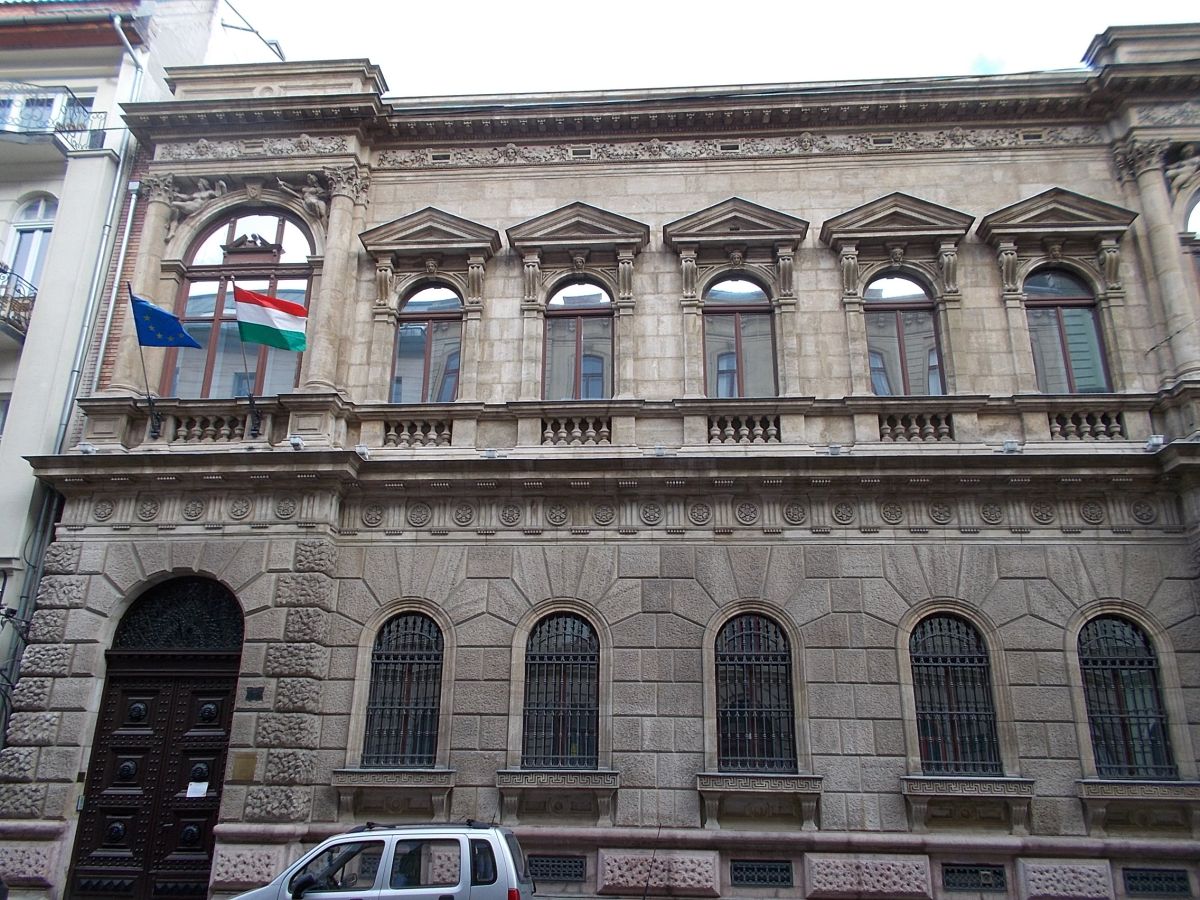
Photo: The headquarters of the Historical Archives of the Hungarian State Security Services on Eötvös Street in Budapest. Author: Globetrotter19 / Wikimedia Commons, CC BY-SA 3.0.