

Key actors — tap for context

Hengelo
A town in eastern Netherlands in the province of Overijssel, with about 80,000 inhabitants.
Why here: The court convicted it of an environmental offense related to the artificial turf of two clubs.
More info →
Algemeen Dagblad
A national Dutch daily newspaper.
Why here: It reported on the ruling and raised the question of what it means for 2,400 amateur clubs.
More info →
RIVM
The Dutch National Institute for Public Health and the Environment, the equivalent of our Public Health Authority.
Why here: Its measurements separate two things: players' health and pollution of the area around the pitches.
More info →
Raad van State
The Netherlands' highest administrative court.
Why here: In 2023 it confirmed the granulate's harm to the environment and ordered four municipalities to decide the matter again.
More info →Sportaal
An organization that manages sports facilities in Enschede.
Why here: In 2019 the same court convicted it in a similar case, but it defended itself through an appeal.

European Chemicals Agency
An EU agency headquartered in Helsinki that oversees the REACH regulation.
Why here: The ban on selling rubber infill from October 2031 falls under its regime.
More info →SBR granulate
Crumb from worn-out tires, a common flexible infill for artificial turf.
Why here: According to measurements, it is precisely this that releases zinc, cobalt, and mineral oils.
The Court Assessed the Soil, Not the Children on the Pitch
The ruling rests on soil protection, not the health of athletes. The Dutch national institute RIVM examined the two questions separately, with different results.On health, it already concluded back in 2016 that the risk for those who play on such a pitch is practically negligible. According to the institute, harmful substances are present in the granulate, but they remain firmly bound within the rubber particles. As a result, only a negligible amount is released through inhalation, skin contact, or ingestion. At the time, the institute's calculations even accounted for a four-year-old child and a seven-year-old goalkeeper — those who are in the most contact with the granulate. RIVM ↗
The environment came out differently. RIVM explicitly notes that it did not measure the soil directly beneath the pitches — it took measurements in the soil and groundwater next to them, in the verges, and in the drainage water flowing into ditches. Several verges near the pitches were heavily contaminated with zinc and mineral oil, and moderately with cobalt. Other substances drained off into ditches and settled in sediment. According to the institute, zinc is not harmful to humans, but it does have consequences for organisms living in the soil and water. RIVM ↗
Not the First Such Ruling
The Rotterdam court had already dealt with rubber granulate back in December 2019. At that time it convicted Sportaal, an organization that manages sports facilities in neighboring Enschede, over the pitch of the Vogido club, and imposed a fine of ten thousand euros, half of it suspended. The complaint was filed by the environmental organization Recycling Netwerk Benelux. Rechtbank Rotterdam ↗ Zembla ↗However, that was a first-instance ruling, and the convicted party did not accept it. Sportaal's lawyer, Rob Oude Breuil, said at the time that in his view the reasoning was too brief and that an appeals court should weigh in on the matter. He also predicted that more lawsuits would follow and that the prosecution had chosen the easiest case to start with. Oost ↗
Meanwhile, the matter also reached the highest administrative court. In April 2023, the Raad van State confirmed that the granulate harms the environment and ordered four municipalities to decide again on requests to enforce soil protection. This does not amount to a blanket ban — the court acknowledges that the granulate may still be used if the operator takes adequate protective measures. Fieldmanager ↗
What is new about the September ruling is who stood before the court. In 2019 it was an organization managing sports facilities; now it is a municipal government as such — which is precisely why Dutch media are asking how many other municipalities are in a similar situation. Algemeen Dagblad ↗
The European Rule Also Applies Here, But It Addresses Something Different
Rubber crumb from worn-out tires, known as SBR granulate, is a common infill for artificial turf on Slovak and Czech pitches as well. The Dutch ruling does not apply here and is based on the Dutch obligation to protect soil. Separately, however, there is a European rule: in 2023 the EU placed intentionally added microplastics under a restriction in the REACH regulation, and artificial turf infill falls under it. Official Journal of the EU ↗For this specific item, the Commission set a transition period of eight years, so placing such infill on the market will not be banned until October 17, 2031. The reason was practical — so that as many existing pitches as possible could reach the natural end of their service life. At the same time, the regulation does not require pitches already laid to be dismantled or taken out of use. Official Journal of the EU ↗
This is precisely the gap that the Dutch case reveals. Selling the infill is legal until 2031, but that in itself says nothing about whether the operator is liable for granulate that spreads from the pitch into the surrounding area. In the Netherlands, the court answered that it is.
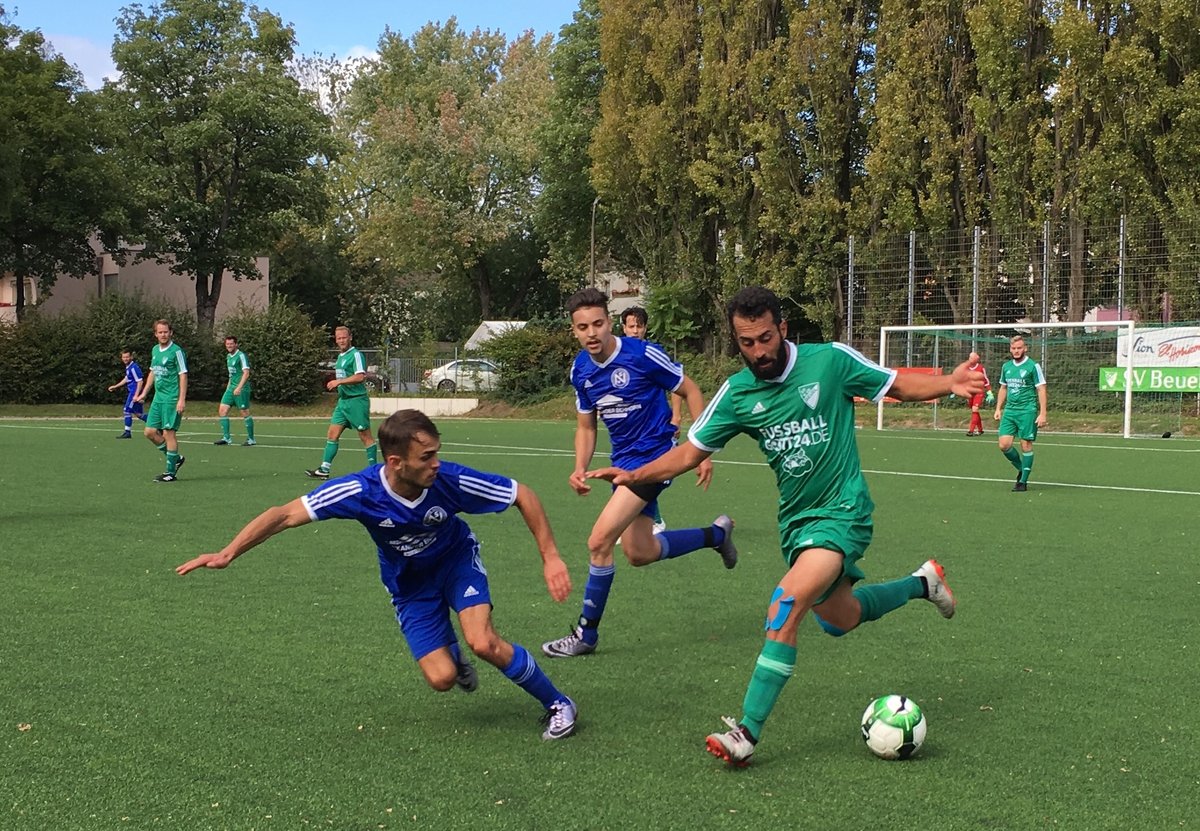
*Illustrative photo: A match between German amateur clubs SV Beuel 06 and SV Heimerzheim on the artificial turf of the Elbernstadion in Bonn. Author: Sir James / Wikimedia Commons, CC BY-SA 3.0.*