








"I am pleased to announce that, given the fact that the European Union is not living up to our fully negotiated Trade Deal, we will be, next week, raising the Tariffs on Automobiles and Trucks coming into the United States from the European Union," Trump wrote. Vehicles manufactured in American plants by EU companies are to be exempt from the new tariff — Trump mentioned in the same post ongoing investments "at a record $100 Billion Dollars" in American factories. AP / Star-Advertiser ↗
Slovakia on the front line
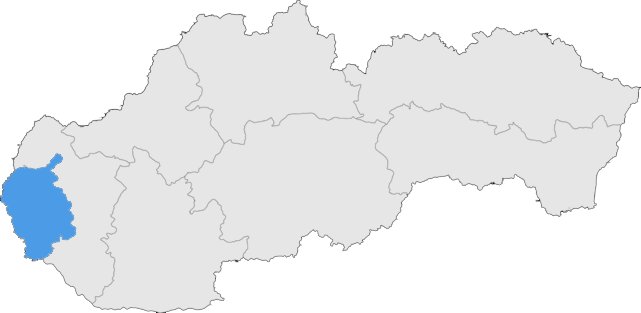
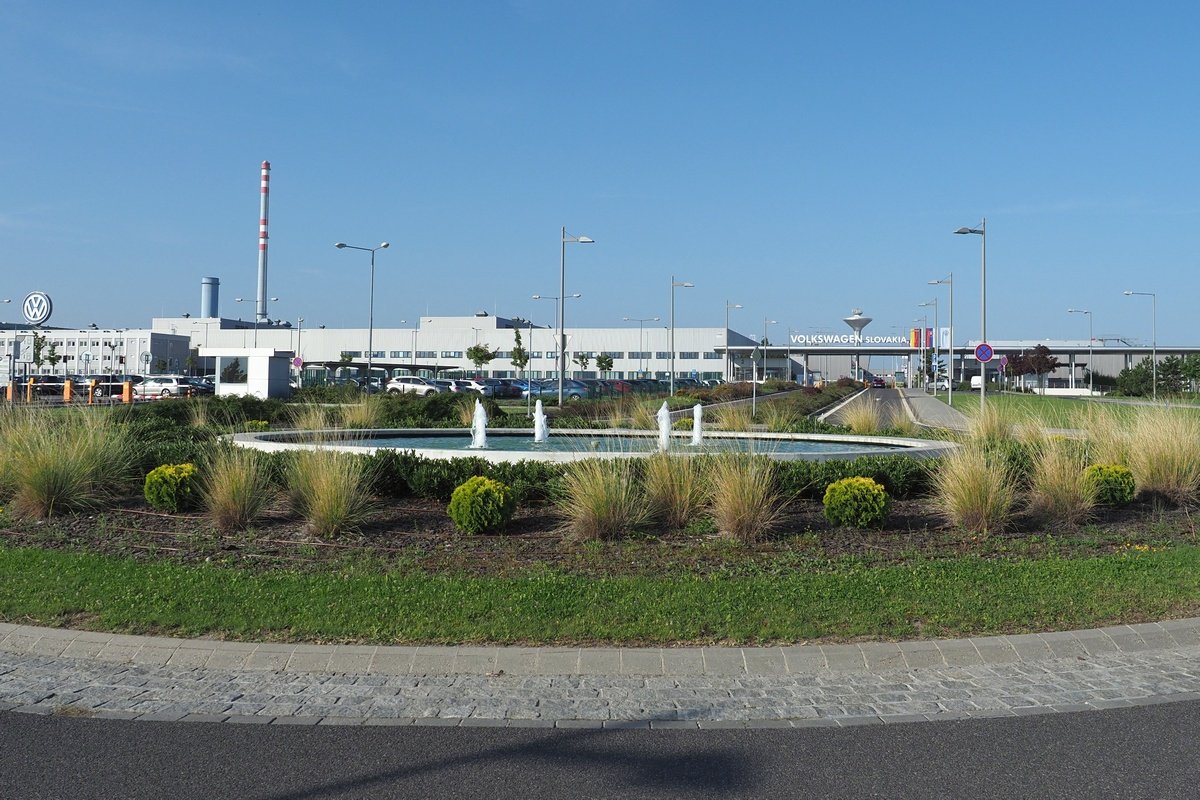
The automotive industry is one of the largest pillars of the Slovak economy; according to the Automotive Industry Association (ZAP SR), it accounts for approximately 52 percent of industrial production. The country produced 1.07 million cars in 2025 according to ZAP, and remains the world's largest per-capita car producer. STVR / ZAP ↗ Exports to the US make up approximately four percent of total Slovak exports, of which about 80 percent are vehicles. OilPrice ↗ The most direct exposure is therefore concentrated in two factories; secondary risk is also borne by their Slovak suppliers.Volkswagen Bratislava produced 341,111 vehicles in 2024 according to its annual report, with 99 percent of production destined for export. Sixteen percent of that went to the US — roughly 54,000 cars. The plant assembles the Volkswagen Touareg, Audi Q7 and Q8, Porsche Cayenne and Cayenne Coupé, Volkswagen Passat, and Škoda Superb. The large premium SUVs from Audi and Porsche are especially important for the American market — neither the Touareg nor the Superb is normally sold in the US, but the Q7, Q8, and Cayenne models are among the best-selling SUVs of their respective brands there. Volkswagen Newsroom ↗
Jaguar Land Rover Nitra produces the Defender and Discovery 5. The Defender has in recent years been one of the British brand's most successful models specifically in the US, but unlike vehicles made at British plants (which since the end of June 2025 have benefited from a special US–UK agreement with an annual quota of 100,000 units at a 10-percent tariff), Slovak-made Defenders are subject to the full EU rate. JLR has already halted deliveries to the US once in recent months due to tariff uncertainty, and according to its own projections will see margins in fiscal year 2026 fall from a planned 10 percent to 5–7 percent. Automotive News ↗
Stellantis Trnava today relies mainly on the Citroën C3, Citroën C3 Aircross, and the new Opel Frontera; production of the Peugeot 208 there ended in 2024. Kia Žilina assembled approximately 300,000 cars in 2025 — alongside the Sportage and the Ceed/XCeed family, series production of the electric EV2 model also started in March 2026. electrive.com ↗ Both plants target mainly the European and Asian markets, and their exposure to the new US tariff is an order of magnitude lower than that of Bratislava and Nitra. Volvo Košice, Slovakia's fifth car plant, is still under construction; large-scale production is scheduled to begin in early 2027. Wikipedia ↗
What preceded this: Turnberry, 50 percent, and 15 percent
Last July, at his Scottish golf resort, Trump announced a framework trade agreement with Ursula von der Leyen that reduced the originally proposed 50-percent tariff on European cars to 15 percent. The European Parliament voted in March 2026 to proceed with ratification, but the formal so-called trilogue between the Commission, the Council, and the Parliament has not yet been concluded. Trump described precisely this slow process as "not living up to the deal." Al Jazeera ↗The chair of the European Parliament's trade committee, German MEP Bernd Lange, reacted sharply: "This latest move shows how unreliable the American side is." The European Commission did not comment on the specific figure — it stated only that it remains committed to the agreement from last summer and has "options open to protect the EU's interests." According to the Guardian, diplomats in Brussels are preparing a diplomatic campaign to save the deal from collapse. France 24 ↗
Pressure in a broader context
Trump's targeting of European cars does not stand alone. On Friday, the Pentagon announced the withdrawal of 5,000 American troops from Germany — a move that came after tension between Trump and German Chancellor Friedrich Merz over the American conflict with Iran. Recent weeks have also brought expanded sanctions on Cuba and pressure on other trading partners. Germany's Spiegel frames the situation as another phase of the transatlantic tariff dispute, and identified the Volkswagen Group, which owns Volkswagen Slovakia in Bratislava, as one of the most exposed. Der Spiegel ↗For Slovak suppliers, this is a further source of pressure after Volkswagen Group announced a decline in group-level profits in late April. Slovak production of large SUVs had been among the parts of the portfolio propping up the group's results.
Also read: Volkswagen cuts profits, Škoda moves forward. The group enters arms production
What hotinfo is watching
- The exact effective date. Trump said "next week" — what will matter is the official executive order setting the effective date and the tariff line items.
- The EU's response. The Commission says it is keeping its options open to protect EU interests; it will be key whether it reaches for retaliatory tariffs or prioritizes negotiations.
- The Slovak government and ZAP SR. Prime Minister Robert Fico has not yet commented on the matter. Reactions from the Ministry of Economy, ZAP SR, and the leadership of VW Bratislava and JLR Nitra will emerge early in the week.
- The trilogue. If Brussels speeds up ratification, could it still avert escalation? Or is Trump raising the bar such that the deal is already a thing of the past?
- The price for the American consumer. For models like the Audi Q7 and Porsche Cayenne, what will matter is how much of the tariff automakers pass on to prices for American customers — inflationary pressure in a pre-election year.