



In early July, the social division of the court in Bayonne recognized the breast cancer of a former Air France flight attendant as an occupational disease. According to her lawyer, this is the first such case in French aviation, as far as she knows. Sophie Lainault is 59, is in remission and flew for Air France from 1989 to 2019, first as a flight attendant and later as chief purser on long-haul routes. She logged more than 12,600 flight hours, including more than 6,500 at night. She was diagnosed with cancer in 2019, the same year she stopped flying. Le Figaro ↗ Ouest-France ↗ La Croix ↗
The court relied on three exposures at once: night work, ionizing radiation and passive smoking, since smoking was permitted on Air France aircraft until 2000. At the same time, it stated that no other genetic or lifestyle factor had been found in Sophie Lainault’s case that would explain her illness. No one appealed the decision, so it is final and will allow her to retire early. Le Figaro ↗
She pursued recognition for two and a half years, and two regional commissions for recognizing occupational diseases had previously concluded that the link had not been proven. The French system has two paths. The simpler one is based on tables listing conditions, and anyone who meets them does not have to prove anything. Breast cancer is not included in these tables, so the patient has to build the case themselves, starting with a medical assessment. If the applicant challenges a negative conclusion, the case goes to court, where it is decided by a social division composed of a professional judge and two lay judges, one representing employees and one representing employers. Jean-Luc Rué of the CFDT adds that proceedings open very painful wounds, and many people therefore prefer to avoid them. France Info ↗
Lainault is not the only one. In early March, the administrative court in Marseille recognized a “direct relationship” between the breast cancer of nurse Sylvie Pioli and her night work. She worked shifts from 8:30 p.m. to 6:30 a.m., roughly 140 nights a year, and her proceedings lasted seven years. The CFDT trade union, which accompanied her, speaks of almost 25 years of night work and is calling for a separate table to be created for breast cancer. The exact date of the decision differs between sources: CFDT gives March 3, while France Info gives March 4. France Info ↗ CFDT ↗
The scientific picture, however, is more cautious than the rulings might suggest. The International Agency for Research on Cancer has classified night work as a probable carcinogen, in Group 2A, noting that evidence in humans is limited for breast, prostate and colorectal cancer, and stronger in experimental animals. A 2018 Harvard cross-sectional study compared 5,366 flight attendants with the general population and found a higher prevalence of self-reported diagnoses for every type of cancer monitored, with a standardized ratio of 1.51 for breast cancer. The authors themselves note that participants reported the diagnoses themselves and that the study captures one moment, not development over time. However, a U.S. cohort of 6,093 former flight attendants found that the increased incidence may also be explained by the fact that flight attendants had fewer children and gave birth later, and the association with exposure itself appeared only in women with three or more children. IARC ↗ Environmental Health ↗ American Journal of Industrial Medicine ↗
Air France told AFP that it was not a party to the proceedings and does not know the reasoning behind the decision. It described occupational health and safety as an absolute priority, adding that every employee receives monitoring beyond regulatory minimums. Trade unionists, meanwhile, are pushing further. Monique Rabussier, an elected employee representative at Air France, conducted a survey among the company’s flight attendants, receiving 500 responses, and the risk factors identified from it were precisely night work and ionizing radiation. François Dosso of the CFDT says the trade union is handling another 30 to 40 recognition applications in cases involving caregivers and nurses. Le Figaro ↗ CFDT Île-de-France ↗
In Slovakia, such an application would face a similar obstacle. The list of occupational diseases is an annex to the Social Insurance Act and does not recognize night work as a risk factor for tumors at all. Under number 19 is illness caused by ionizing radiation, under number 21 skin cancer, and under number 23 lung cancer caused by radioactive substances. There are two open doors. Number 46 covers tumors in organs not included in the list, but only in cases of proven chemical carcinogens, and number 47 is intended for other work-related health damage. Both are decided by the National Commission for the Assessment of Occupational Diseases, which is the equivalent of the French commissions that rejected Lainault twice. Yet the state itself considers crew exposure to radiation a risk. The Radiation Protection Act requires air operators whose crew member’s annual dose may exceed one millisievert to measure it every quarter, adjust rosters so that it does not exceed five millisieverts, demonstrably inform the worker about it, report the results annually to the Ministry of Transport and separately regulate the conditions of a pregnant crew member. Failure to comply can result in a fine. The state therefore measures, limits and records crew radiation exposure, but when a tumor arises from it, the injured person must work toward recognition individually. Zákon č. 87/2018 Z. z., § 126 ↗ In one respect, the Slovak reader is even better off than the French one. A ruling like the one from Bayonne could be read here directly, because the Act on Courts requires final decisions on the merits to be published in anonymized form on the ministry’s website, and that database is running. France is still catching up on making civil decisions of first-instance courts available. The deadline was the end of September 2025, but the Ministry of Justice and the Court of Cassation still describe it as a gradual rollout that began with nine courts. Zákon č. 461/2003 Z. z., príloha č. 1 ↗ Úrad verejného zdravotníctva SR ↗ Ministerstvo spravodlivosti SR ↗ Ministère de la justice ↗
Finally, it should be said what does not yet follow from the case. Only the AFP agency has seen the decision itself. Within a day, it was picked up by at least eleven newsrooms, from BFM TV and 20 Minutes through Le Figaro, Le Monde and Libération to the investigative outlet Mediapart, and all cite it as their source. Only one daily, La Croix, wrote its own text on the matter, does not refer to the agency, and was the only one to add the year when Lainault fell ill. But a second independent description of the decision itself is not available. The claim that this is the first such case in aviation comes from lawyer Elisabeth Leroux, and she herself qualifies it by saying that this is so to her knowledge. Above all, the court did not decide whether night flights cause breast cancer in general. It decided on one file in which no other explanation was found. A more convincing answer is expected only from a study by the French agency for health security Anses, whose results are expected in autumn 2027. Ouest-France ↗ BFM TV ↗ La Croix ↗ Mediapart ↗
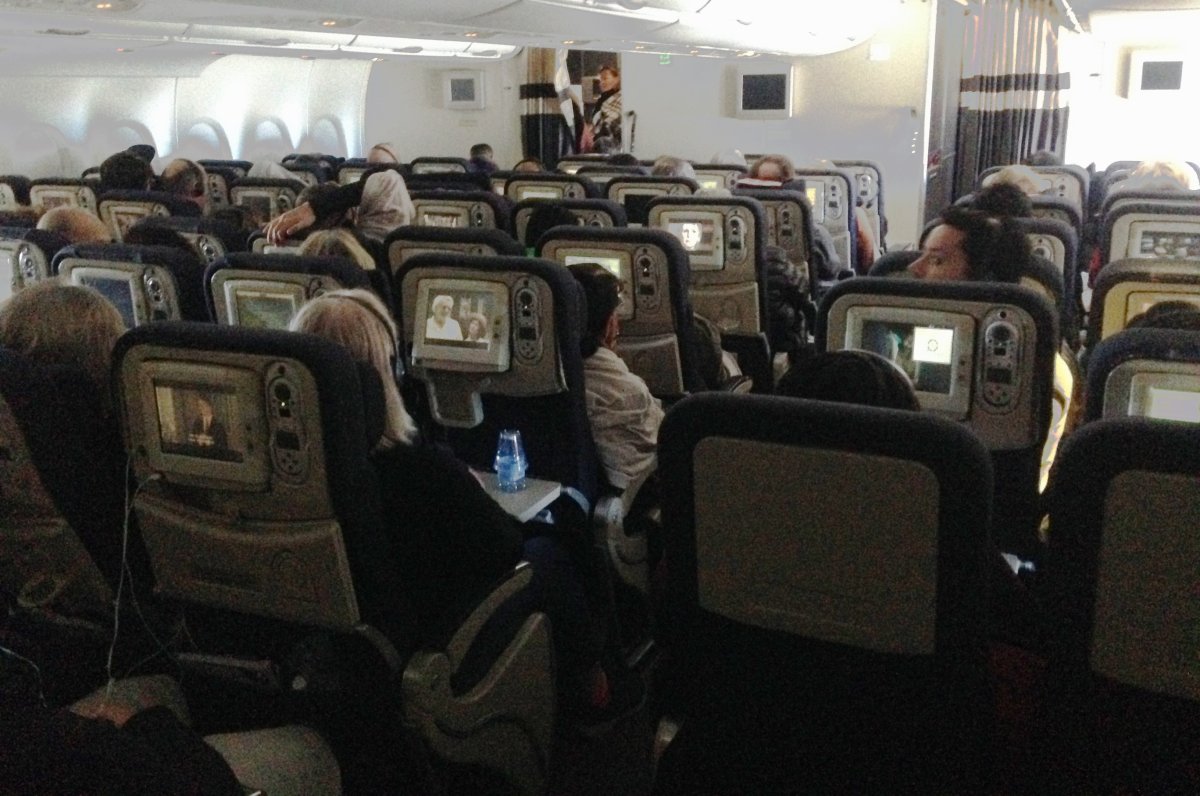
Illustrative photo: interior of economy class on the lower deck of an Air France Airbus A380. Author: Beyond My Ken / Wikimedia Commons / CC BY-SA 4.0. The image has been reduced.
Court Recognized a Flight Attendant’s Breast Cancer as an Occupational Disease. It Pointed to Night Flights, Radiation and Smoke on Board
🔥 You might also like

European Union
What Europe is writing about: EU fails to agree on lifting sanctions against Russian oligarchs, White House boycott expands to include Fox and CBS, Berlin addresses antisemitism dispute
The EU again failed to agree on lifting sanctions against Russian oligarchs, the White House boycott has expanded to include Fox and CBS, Berlin addresses an an …
World
French freezers at 50 °C and Dutch empty shelves: no evidence of a joint attack yet
Hackers heated up freezers in hundreds of French supermarkets, Albert Heijn has no fresh food. The Dutch NCSC, however, does not link the two incidents.

Music
Feu! Chatterton: the song Ce qu'on devient chosen by Soft Power and Rolling Stone
The Parisian band shows a more pop side with it, the album Labyrinthe is gold, and two concerts at the Accor Arena await in February.
Geographic locations





From our newsroom original
All →
US elections bring a shift in mood in politics and markets
SNS proposes criminal liability from age 13

Paraguayan President Santiago Peña resigns following banking crisis
Hungary corrected Orbán's troop numbers for NATO. Slovakia lowered its estimates in the same table even more sharply
Mecca Pact Countries Held Their First Joint Talks in Tehran. They Agreed Only to Keep Talking

Cruise ship with over 3,300 people on board collided with two container ships in Bremerhaven

Swiss court convicts Belarusian over disappearance of Lukashenko opponent in 1999
International Criminal Court may use American software even under US sanctions