
Key actors — tap for context

Tojohiro Akijama
Japanese television journalist who became the first Japanese in space in December 1990 and the first reporter to broadcast from orbit. Before the flight, he headed the Washington bureau of television TBS, after which he went to farm.
Why here: Died on August 26 at the age of 84.
More info →
Tokyo Broadcasting System
Japanese commercial television, abbreviated TBS, one of the main nationwide stations in the country. Akijama worked for it from 1966.
Why here: Paid for the flight as a project for its 40th anniversary under the name space correspondent plan.
More info →
Mir
Soviet and later Russian orbital station that orbited Earth from 1986 to 2001.
Why here: Target of Akijama's flight. He spent approximately six days on it, with the entire mission lasting less than eight days.
More info →Ryoko Kikucheva
Camera operator for television TBS, 26 years old at the time of selection, mountaineer and skier. She was the second finalist in the selection and as a backup candidate underwent the same Soviet training as Akijama.
Why here: Less than a week before launch, she was operated on for appendicitis and did not fly.

Mamoru Móri
Japanese scientist selected in 1985 by the Japanese space agency as the country's first professional astronaut. He reached space in September 1992 aboard the Endeavour Space Shuttle.
Why here: He was supposed to be the first Japanese in space, but was preceded by Akijama's commercial flight.
More info →
Dennis Tito
American businessman and former engineer who in 2001 paid for a flight to the International Space Station himself and is known as the first space tourist.
Why here: Flew eleven years after Akijama, unlike him from private funds.
More info →Fukushima
Prefecture in northeastern Japan and its namesake main city. In March 2011, the Fukushima Daiichi nuclear power plant had an accident here after an earthquake and tsunami wave.
Why here: Akijama farmed in this prefecture from 1996. After the accident, he had to evacuate and lost his farm.
More info →However, someone else was supposed to be the first Japanese in space. The scientist Mamoru Móri was selected by the Japanese space agency as early as 1985 and was preparing for a Space Shuttle flight. The Challenger disaster in January 1986 delayed the Japanese experimental flight, and after flight resumption, according to the agency, a technical problem with the Space Shuttle pushed it back further, so Móri reached orbit only in September 1992. The television reporter without technical education thus overtook him by a year and three quarters, although the professional had been waiting seven years for it. Wikipedia ↗ Japanese Wikipedia ↗
How much exactly the television paid for a seat on Soyuz is reported differently to this day. The most frequent mentions are ten to twelve million dollars, roughly one and a half billion yen, with sponsors covering part of it. The Soviet side spoke of fourteen million and the television's total costs including broadcasting are estimated at more than twenty million. The Soviet Union, a year before its collapse, urgently needed foreign currency and sold a place in a spacecraft for the first time in history. Dennis Tito, whom most people remember as the first space tourist, flew only in 2001, thus eleven years later, with the difference that he paid for the flight himself. IFLScience ↗ Novinky ↗
He lifted off on December 2, 1990 aboard the Soyuz TM-11 spacecraft along with Viktor Afanasyev and Musa Manarov, and spent seven days, twenty-one hours and fifty-four minutes in space, approximately six days directly on the Mir station. News agency reports typically round the total time to eight days, while Japanese profiles sometimes count nine calendar days from launch to landing. His first words from orbit went down in history. Instead of a prepared phrase, he said "Kore, honban desu ka?" – "Is this for real?" – a question a reporter would ask before turning on the camera. He then prepared two radio and one television program for the station daily. Mainichi ↗ Japanese Wikipedia ↗
However, the broadcast did not go as the station had imagined. Akijama was ill throughout his stay, and according to later accounts, his Russian colleagues said they had never seen a person vomit so much. Before the flight, he had to stop smoking four packs of cigarettes a day, and after landing he asked for alcohol and a cigarette. Among the experiments he was in charge of were Japanese killifish, in which the effect of weightlessness on the secretion of neuropeptides was studied. Viewership declined after the first few days back to normal levels, so viewing expectations were only partially fulfilled. IFLScience ↗ Japanese Wikipedia ↗
However, the second half of his life is more interesting. He still managed to head the international news center at the television station, but left it in 1995. It is attributed to disgust at how much the television had commercialized itself, and also to the fact that after the flight he lost interest in career advancement. He later spoke of how in space he began thinking about what has kept humanity alive for centuries, and he realized he knew practically nothing about cooking and growing crops. According to his own words, he did not even know how to grow rice, and felt that without mastering these basics he could not die. Mainichi ↗ IFLScience ↗
From 1996 onwards, he therefore farmed in the mountainous village of Takine, now part of the city of Tamura in Fukushima Prefecture, devoted himself to ecological agriculture and growing shiitake mushrooms on wooden logs. It ended in March 2011 when, after an earthquake and tsunami wave, the Fukushima Daiichi power plant had an accident. Akijama had to evacuate, lost his farm and called himself a nuclear refugee. With this experience, he then lectured throughout Japan and spoke out against nuclear energy. Mainichi ↗ Japanese Wikipedia ↗
From November 2011 to March 2018, he taught at Kyoto University of Art and Design, now Kyoto University of the Arts, where he focused on the environment and agriculture. He eventually returned to farming and from April 2017 farmed in the village of Ódai in Mie Prefecture. It was there that the Mainichi newspaper photographed him in March 2023 holding the clothing in which he once flew at the Mir station. According to the Jiji agency, he also died there in his home. Mainichi ↗ Jiji/Nippon.com ↗
In the Slovak and Czech reports we reviewed, the agency version ending in 1990 dominated. The most detailed of them also brought his first words from orbit or Akijama's craving for a cigarette after landing, but mentions nothing about farming, Fukushima or his reasons for leaving television. None of them also stated the date of death, so from their wording a reader could conclude that Akijama died only on Tuesday. Novinky ↗ HN ↗
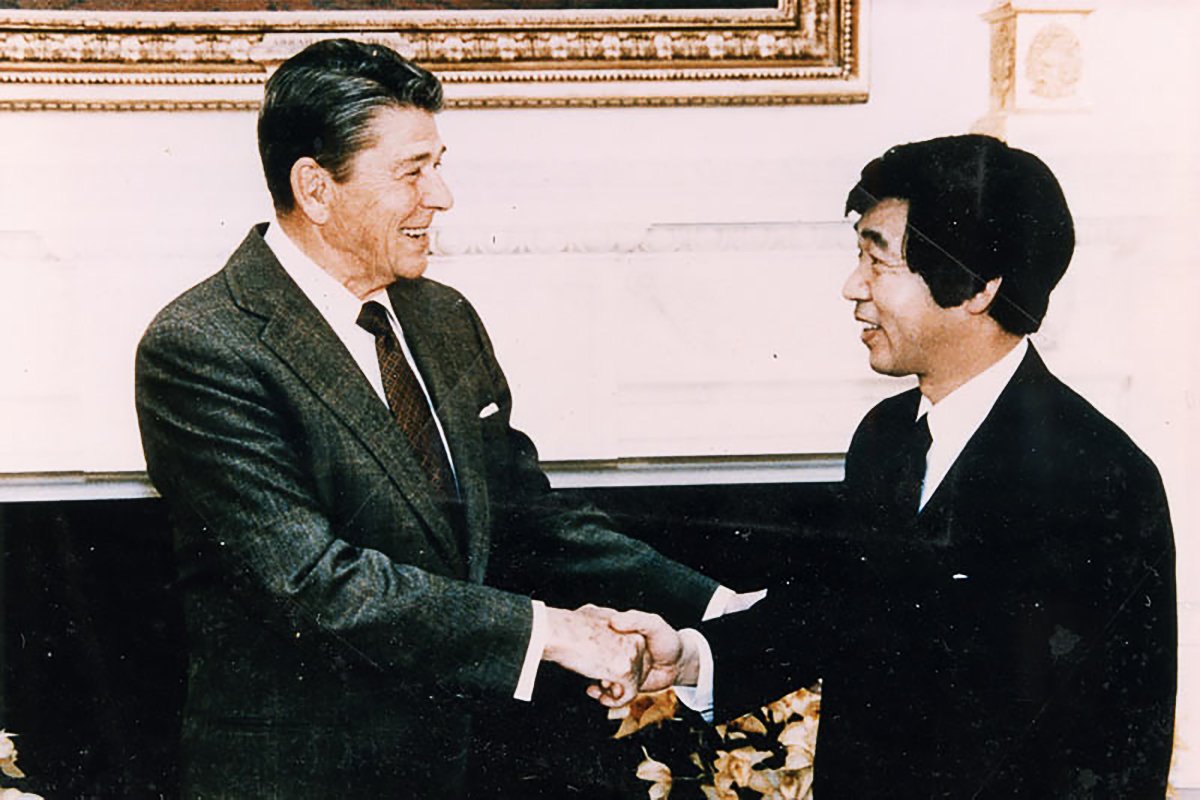
Photo: Tojohiro Akijama as head of the Tokyo Broadcasting System's Washington bureau meeting with President Ronald Reagan at the White House on April 29, 1985. Author: Terry Arthur, White House / Ronald Reagan Library / Public domain.