

Eighty Years in the Washington Archive
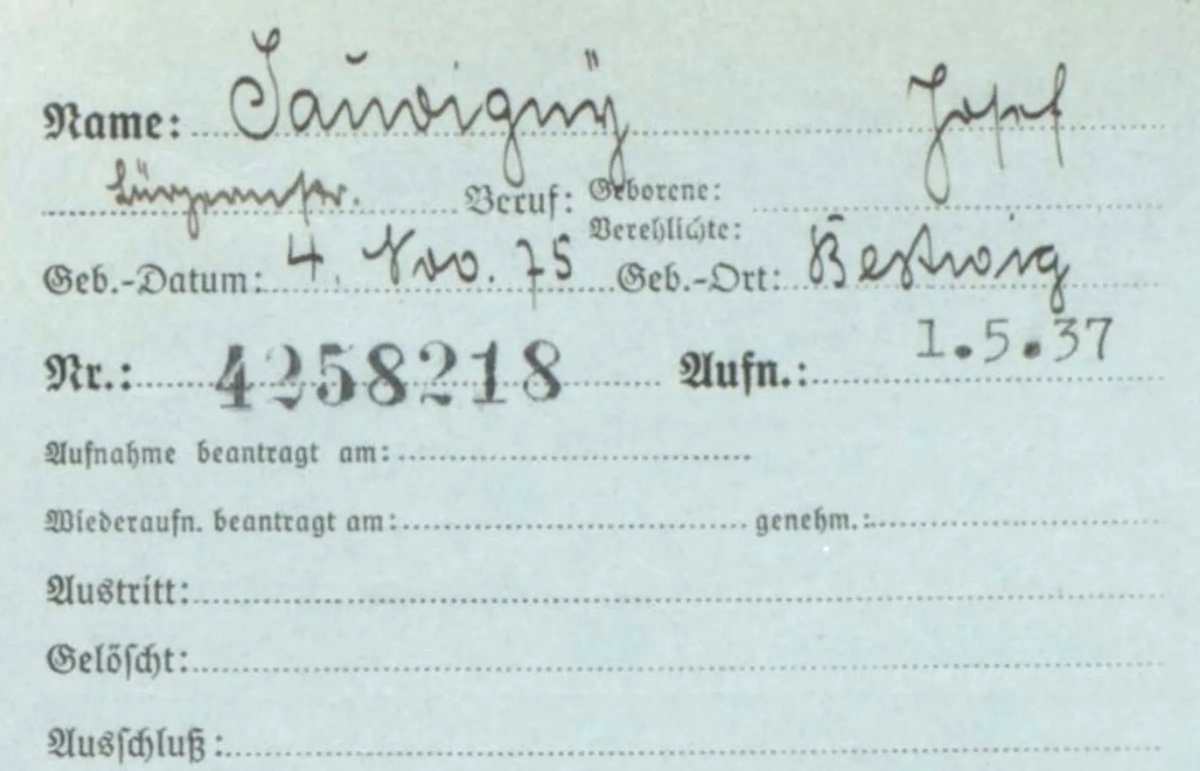
American troops seized the records in 1945. For more than eighty years they sat in the National Archives' facilities in Washington — anyone wishing to search them had to fly to the US. In March 2026, NARA made the digitized records available online. Each card contains a name, date of birth, address, member number, date of entry, and local group. The NSDAP had nearly nine million registered members. Spiegel ↗Renate Künast entered her father's name and date of birth, and a record immediately appeared: Willy Künast joined the party on May 1, 1933, a few weeks after Hitler's seizure of power. "It hit me, and it's occupied my thoughts ever since," she said. She also discovered that her father's older brother had joined in 1937. "After the war it was, as in so many other families, a Schweigekartell" — a conspiracy of silence. Tagesspiegel ↗
Author Matthias Lohre went even further. His grandfather joined the NSDAP on March 1, 1932 — even before the Nazi seizure of power. The family lived for decades in a house that its previous Jewish family had been forced to sell under duress in 1938. "My grandfather profited from the suffering of his Jewish neighbors," Tagesspiegel quoted him as saying. Spiegel reports similar discoveries from dozens of German politicians. Bundestag Vice President Bodo Ramelow (Linke) already knew about his grandfather's early membership beforehand. Former Health Minister Karl Lauterbach (SPD) found a great-uncle, but not his grandparents. Spiegel ↗
The Polish View: What a Country Nazism Decimated Sees
Gazeta Wyborcza, Poland's largest liberal daily, is paying special attention to these developments. For Poland, which lost six million of its own citizens — including three million Jews — Germany's confrontation with its own past is not merely academic. It is a commitment that Germany also makes toward its neighboring nations.Slovak media have barely covered this story. Yet Slovakia has its own archival layer from the years 1939–1945: records of Hlinka's Slovak People's Party officials, members of the Hlinka Guard, and officials involved in organizing transports. The Slovak wartime state deported more than 57,000 Slovak Jews in 1942 — organizationally the largest mass deportation of Jews from a single country in that year. Those records still are not digitally accessible from a living room today. iROZHLAS ↗
Sociologist Harald Welzer, who has long studied German family narratives about the Nazi era, emphasizes that the phenomenon of silence (Schweigekartell) was not exclusively German — it was European. Spiegel ↗
What a Card Shows — and What It Doesn't
Historians point to the database's limits. Historian Johannes Spohr, in an interview with Spiegel in March, noted that "no one was forced to join" the NSDAP — yet many joined out of career pressure, social pressure, or fear for their family. Membership alone does not automatically mean participation in atrocities. A card will show the date of entry, address, and local group — context must be supplied by historians and family conversations."Transparency is important — not for belated judgments, but for confronting the historical fault lines within one's own family," is how Bundestag Vice President Ramelow put it. Tagesspiegel ↗
What hotinfo Is Watching
- SK archival parallel: No deadline has been set for digitizing Slovak archival collections of the HSĽS and the Hlinka Guard. The German model could accelerate the domestic debate
- Historical debate: Where is the line between career opportunism (the wave of entries in 1933) and moral responsibility — historiography differs on this
- Other European countries: What archival records from the 1938–1945 period are still not digitally accessible in other Central European countries