



Saturday's arrests and the official version
The Bahrain News Agency on Saturday quoted a statement from the Ministry of Interior, according to which "security forces uncovered a group linked to Iran's Revolutionary Guards" — according to the ministry, investigators are documenting cases of "sympathy with the Iranian attacks" as well as the gathering of intelligence on sensitive locations. Reuters cez WHBL ↗Reuters journalists Ahmed Elimam and Eman Abuhassira specified that those detained had been monitoring "strategic sites" — Manama specifically mentions military facilities, energy infrastructure, and commercial ports. The ministry did not disclose the names or nationalities of the detainees. Reuters cez WHBL ↗
Two months since the first missiles
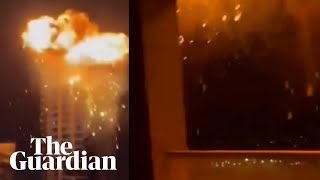
Iran's campaign against Bahrain began on February 28, just hours after the United States and Israel launched a large-scale military operation against Iran's nuclear program. Tehran fired missiles and drones at all six Gulf Cooperation Council states hosting American bases. The National ↗Bahrain intercepted 194 Iranian missiles and 523 drones, but the attacks nevertheless struck the port of Mina Salman, Isa Air Base, an oil refinery, a desalination plant, the Bahrain Aluminium plant, telecommunications networks, and Amazon Web Services data centers. At least two people died — a Bangladeshi worker at a shipyard and a Bahraini woman in a strike on office buildings — and more than 50 people were injured. A ceasefire took effect on April 9. The National ↗
Trials, life sentences, and revoked citizenship
Manama followed up the arrests with swift trials and a wave of administrative measures. On April 27, Bahrain's Ministry of Interior announced that King Hamad bin Isa Al Khalifa had stripped 69 individuals of their citizenship for alleged "sympathy with Iran" and "cooperation with foreign entities." The directive states that all 69 were of "non-Bahraini origin" — a criterion that the London-based Bahrain Institute for Rights and Democracy called "dangerous" and in violation of international law. Al Jazeera ↗Shortly afterward, a court sentenced five defendants to life in prison for preparing "terrorist and hostile acts in cooperation with Iran." Another 25 people received up to ten years for supporting the Iranian attacks. In early May, a verdict was added against 14 people in seven cases — according to the ministry, they were detained directly "in the act of committing crimes" at the sites of the attacks and will now serve up to three years in prison for violence and sabotage concurrent with the Iranian missiles. The National ↗
Criticism from HRW: wave of arrests also caught peaceful critics
Human Rights Watch stated in a March report that Bahraini police detained dozens of people over social media posts or participation in peaceful marches. At least 40 people ended up in pretrial detention for online content, and five Pakistanis and one Bangladeshi were arrested for sharing a video. The details of the cases are troubling: one detained woman was held by police for five days without contact with her family, a sixteen-year-old boy was taken away after a phone search without a warrant, and "thirty plainclothes police officers" arrived at three in the morning at the home of Munir Mirza Mushaima, a local activist. Human Rights Watch ↗In March, Bahrain's public prosecution asked the court for the death penalty for some of those accused of alleged espionage — a step HRW urges be rejected as disproportionate and in violation of international standards. Manama justifies the severity of the measures by citing "public safety in a time of outrageous Iranian aggression." However, human rights defenders point out that in a kingdom with a majority Shia population and a Sunni government, political and sectarian tensions have been escalating since the 2011 Arab Spring, and according to them, the current crisis may give the government a tool to suppress opposition without a direct link to Tehran. Human Rights Watch ↗
GCC closes ranks, defensive architecture takes new shape
Gulf Cooperation Council Secretary-General Jasem Mohamed Albudaiwi declared "full solidarity" with Manama on May 3, emphasizing that "Bahrain's security is an integral part" of the region's collective defense. The leaders of the six-member bloc, at a summit in Jeddah, agreed to accelerate the building of a joint air and missile defense system — an intention that had failed to gain traction for years before the February attacks. The National ↗Bahrain's King Hamad accused Tehran of "outrageous aggression" against the kingdom's stability and called the cooperation of domestic actors with Iran "an unforgivable betrayal." For Manama, this represents a lasting shift — the kingdom, which for years accused Iran of "stirring up" Shia unrest, now has documented direct missile strikes and claims to have also uncovered domestic links to Iran. It is using this combination to justify an extraordinarily harsh wave of citizenship revocations. The National ↗
Context: the 14-point MoU and Iran's response
Saturday's arrests come at a moment when the Trump administration is awaiting Tehran's response to a 14-point memorandum on the Strait of Hormuz — the deadline for submitting Iran's position expired on Thursday evening, May 8. Negotiators Steve Witkoff and Jared Kushner want to stabilize the Lebanese ceasefire and restore Project Freedom in Saudi and Kuwaiti airspace. Manama, meanwhile, is handling its domestic equation independently.Also read: Khamenei's advisor compared control over the Strait of Hormuz to an atomic bomb
For Slovakia and Czechia, Bahrain is a distant state in the Gulf, but its tremors are reflected in oil prices and global shipping routes. The kingdom lies about 30 kilometers from the Saudi Ras Tanura refinery, and Juffair hosts the headquarters of the 5th Fleet, whose task is to secure the passage of tankers through the Strait of Hormuz. Any further strike on Bahraini energy infrastructure or escalation involving domestic cells linked to the IRGC could add pressure to the price of Brent and complicate Slovak discussions about Russian oil via the Druzhba pipeline.
What hotinfo is watching
- Iran's answer to the 14-point MoU (the weekend of May 9–10) — Saturday's arrests in Bahrain may enter Iran's rhetoric around the talks
- HRW versus Manama — the UN, the EU or Washington goes beyond a polite statement in public
- Gulf states' joint defence — the Jeddah commitment turns into a concrete step (treaties, linked radars)
- The Trump–Xi summit in Beijing on May 14–15 — Beijing presses Tehran to accept the MoU
- The Slovak and Czech response to the EU's 21st sanctions package — Slovnaft's comment on Urals prices
- Another wave of citizenship revocations in Bahrain (more than 50 people) — a further step in consolidation
- Who the 41 detainees are — Manama says whether they are Bahraini Shias, foreigners or a mix→ Za spoluprácu s Iránom vyniesli v Bahrajne tri doživotné trestySúd vyniesol 3 doživotné tresty za spoluprácu s Iránom (TASR, 11.5.) — Bahrajn vs Revolučné gardy, casework profil