


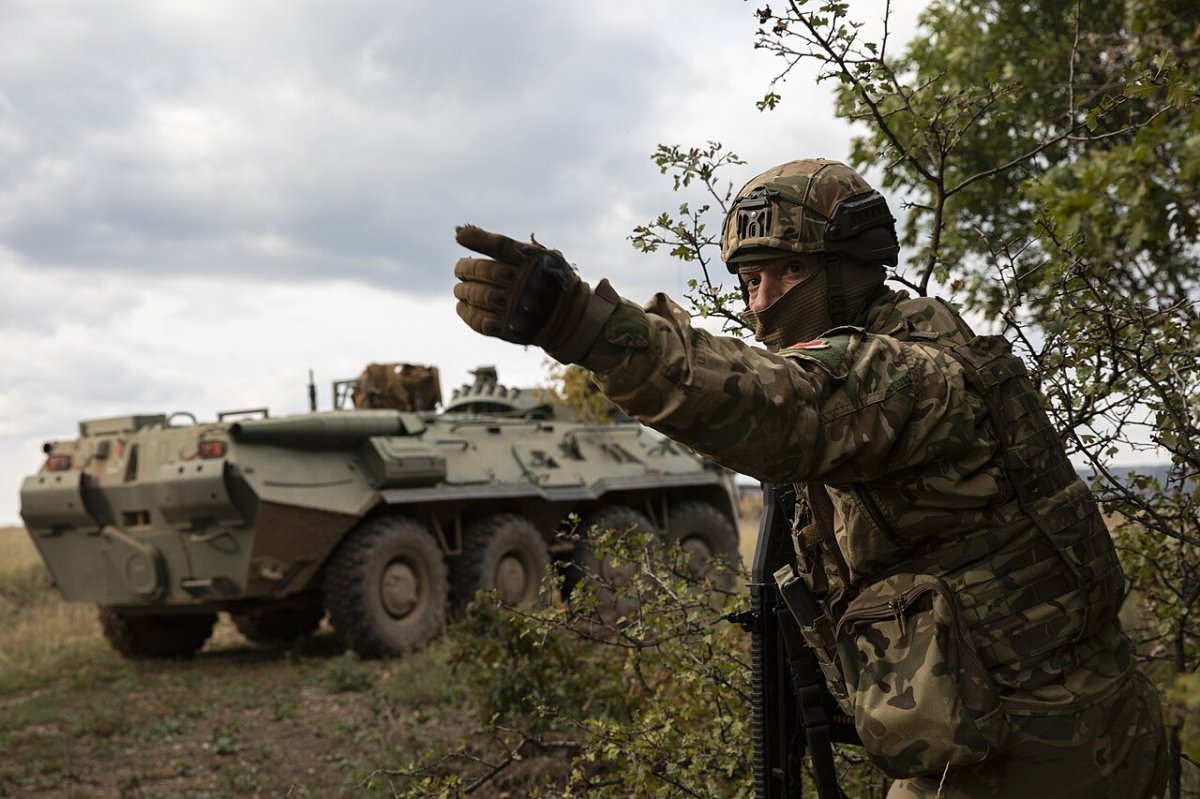


Slovakia has received the first battery of the Israeli Barak MX air defense system. Defense Minister Robert Kaliňák (Smer-SD) announced this on April 16, 2026, stating that the battery is deployed "at the intersection between our nuclear power plants" and has already been in the country for about ten days. According to the plan, Slovakia is to receive all six batteries by 2030. SITA ↗
The contract, signed in December 2024, is worth 560 million euros (583 million dollars) and represents, according to the Israeli Ministry of Defense, the largest defense deal between the two countries in history. The agreement includes six batteries, training, simulators, spare parts, and a two-year warranty. Breaking Defense ↗
In the Slovak tender, Barak MX received a 95 percent rating, compared to the Spyder system from the Israeli company Rafael (84%), the IRIS-T SLM from Germany's Diehl Defence (72%), and the VL MICA from the French-British MBDA (65%). The American-Norwegian NASAMS and the French-Italian SAMP/T NG were also invited to the competition. Defense News ↗ While the Slovak Ministry of Defense evaluated Barak MX as the most advantageous offer, the Danish Defence Command rejected the same system in October 2025, citing that it wanted to use the funds for initiatives "with higher immediate combat value." However, the two countries assessed the system in a different budgetary and strategic context. Breaking Defense ↗
Barak MX is a modular system made by Israel Aerospace Industries (IAI), introduced in 2016. It consists of three types of missiles with active radar guidance: MRAD with a range of up to 35 kilometers, LRAD up to 70 kilometers, and ER up to 150 kilometers with an intercept altitude of 30 kilometers. According to the manufacturer, the AESA-type radar (ELTA ELM-2084 or ELM-2138) has the ability to track targets with a low radar signature in a saturated airspace. According to the manufacturer, the system can engage fighter jets, helicopters, unmanned aircraft, guided missiles, and tactical ballistic missiles. Breaking Defense ↗
Combat deployment of the ground variant was first publicly confirmed on June 20, 2025, when the Israeli armed forces announced the downing of an Iranian unmanned aircraft using this system. During the twelve-day war between Israel and Iran in June 2025, the naval version Barak Magen shot down eight drones from a single attack. According to the IDF, Israel's overall drone interception rate reached 99%, a figure that has not yet been independently verified. Janes ↗ Breaking Defense ↗
Effectiveness against cheap drones remains an open question. Kaliňák himself admitted in September 2025 that the system has "a problem" with them. Pravda ↗ However, this is not a unique weakness of Barak — an analysis by the Center for Strategic and International Studies (CSIS) points out that defensive missiles are inherently an order of magnitude more expensive than offensive ones. Iran sells the Shahed-type drone for 20,000 to 50,000 dollars, while a Patriot PAC-3 system missile costs over 3 million dollars. Against Russian Shaheds, Ukraine deploys interceptors costing 1,000 to 2,500 dollars, which have a success rate of around 60 percent. CSIS ↗ CSIS ↗
Delivery to Slovakia was delayed by several months. In March 2026, Kaliňák said the country had been "about 48 hours" away from receiving the first components when the aircraft transporting the parts "suddenly lost landing clearance" — the reason being the operational situation in the Middle East region following the Israeli-Iranian war. SITA ↗
The contract contains a clause on the local production of some components. According to foreign sources, "two Slovak companies — one state-owned and one private — were approached in the area of radars and missile production." Defense News ↗ The Ministry of Defense has not publicly stated which companies are involved, in what volume, or whether it will involve an actual technology transfer or merely assembly. The scope of the declared offset thus cannot yet be independently assessed.
Slovakia is replacing Soviet 2K12 KUB systems, which, according to the Slovak Ministry of Defense, had only 33 percent operational availability, and by 2027 the country would have lost the remainder of its medium-range air defense. The final contract price per battery comes out lower than the original tender's unit calculation, suggesting significant negotiation of terms. However, without full disclosure of the delivery configuration, it is not possible to determine how much of the difference stems from negotiation and how much from a change in scope. Janes ↗ The real value of the contract will therefore only be assessable once the exact system configuration, the extent of domestic production, and the first years of operational service have been disclosed.

The first Barak MX in Slovakia: 560 million euros, six batteries and questions surrounding two Slovak suppliers
Videos
🔥 You might also like

European Union
Israel won't give Greece the source code for its weapons. Who writes the shield's control software, Tel Aviv hasn't explained
Dendias said in July the army wouldn't get the system without source code. Israel's missile defense chief said no. Slovakia bought the same layer.
World Politics
Romanian counter-drone systems failed acceptance tests. A day later a drone fell near Suceava, and F-16 fighter jets did not shoot it down
Two of the four Oerlikon systems Rheinmetall was to convert for counter-drone use failed tests, a ministry document says. They were due April 15.

European Union
Greece will buy an Israeli missile shield for three billion euros. It will also integrate Patriots, whose missiles Ukraine is requesting
Israel and Greece signed an agreement on Achilles Shield for three billion euros. The next day, the Commission was to ask Athens for missiles for the Patriots, …


From our newsroom original
All →
Zelensky: Russian Army Suffered Record Losses in October

Trump pushes for return of Russian gas to Europe

Mecca Pact Countries Held Their First Joint Talks in Tehran. They Agreed Only to Keep Talking

Cruise ship with over 3,300 people on board collided with two container ships in Bremerhaven

Swiss court convicts Belarusian over disappearance of Lukashenko opponent in 1999

Orbán for UN Secretary-General? WSJ Editorial Says Washington Is Pushing Him, Moscow Points to Latin America

International Criminal Court may use American software even under US sanctions
What Europe is writing about: Witkoff met with Putin, a PHP bug knocked out government websites, Iran reports fires on tankers
