



A Slovak reader may find this pattern familiar. In the case of the murder of Ján Kuciak and Martina Kušnírová, Slovakia stood exactly at this point — with the difference that in our case, the acquitting verdict did not hold up and the trial returned to the beginning.
Key actors — tap for context
Yorgen Fenech
Maltese businessman, head of the Tumas group and co-owner of the Electrogas power consortium.
Why here: A jury acquitted him on September 2, 2026 on both counts of the murder indictment, he still faces charges of corruption.
More info →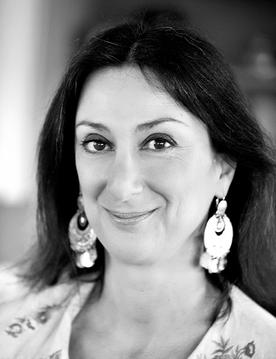
Daphne Caruana Galizia
Maltese investigative journalist and blogger who wrote about government corruption for years.
Why here: She was killed in 2017 by a car bomb, after nine years no one has been convicted of ordering the murder.
More info →Keith Schembri
Former head of the office of Maltese Prime Minister Joseph Muscat, accused in the corruption branch of the case.
Why here: Fenech identified him before the jury as the architect of the plan, Schembri denied it and police told the court he was never a suspect.
More info →
Konrad Mizzi
Former Maltese energy minister linked to secret Panama companies revealed in the Panama Papers.
Why here: Along with Fenech and Schembri, he faces charges of corruption around the Electrogas project.
More info →Melvin Theuma
Maltese taxi driver who admitted to the role of intermediary in preparing the murder.
Why here: He received a presidential pardon in 2019 in exchange for testimony, Fenech claimed in court that he was blackmailing him.

Marian Kočner
Slovak businessman convicted in the promissory note case, accused of ordering the murder of Ján Kuciak.
Why here: The Specialized Criminal Court acquitted him in May 2023, the Supreme Court annulled the verdict in May 2025 and the trial is ongoing again.
More info →
Ján Kuciak
Slovak investigative journalist who wrote about tax fraud and connections between business and politics.
Why here: He was murdered in 2018 along with his fiancée Martina Kušnírová, the trial over who ordered it continues.
More info →Alena Zsuzsová
Slovak woman accused in the Ján Kuciak murder case, sentenced to 25 years in the first verdict.
Why here: The Supreme Court also annulled her part of the verdict, citing inconsistencies including her watch.
Who is Already Serving Time for the Murder
Fenech was the last of six accused who went to trial. The others have already been convicted: Vincent Muscat confessed and received 15 years in 2021, brothers Alfred and George Degiorgiovci confessed to placing and detonating the bomb and received 40 years each in 2022, Robert Agius and Jamie Vella received life sentences in 2025 for procuring and delivering explosives, which was confirmed by the appeals court in January 2026. OCCRP ↗ Taxi driver Melvin Theuma, who admitted to the role of intermediary, already received a presidential pardon in 2019 in exchange for testimony. Nový Čas ↗The prosecution identified Fenech as the main organizer and indicted him in 2021. The jury did not believe them on any count. In courtroom number 22, cheers erupted from the defense bench after the verdict was read, the journalist's family wept. Newsbook ↗
A Name the Jury Should Not Have Considered
Fenech took the witness stand during the trial and said that Keith Schembri, the then head of the prime minister's office, developed the plan to murder the journalist in front of him. He claimed he paid Theuma 50,000 euros to stop the murder, and later gave him approximately another 400,000. He portrayed himself as a victim of loyalty to Schembri, of Theuma's blackmail, and of his own cocaine addiction. Schembri denied the allegations and police told the court he was never a suspect. The Shift News ↗What matters is what the judge did about it. Judge Edwina Grima warned the jury before they retired to deliberate not to be distracted by references to third parties including Schembri — she characterized them as part of Fenech's defense. The jury was thus deciding whether Fenech was guilty, not who ordered the murder if it was not him. That question was not posed as a question to be answered in the proceedings. The Shift News ↗
On Thursday, however, the same judge took a step that reopens that question in another way. As part of the written verdict, the judge ordered the police commissioner and investigators to examine the testimony from the entire 55-day trial and assess whether it suggests possible criminal activity by third parties. The jury thus should not have and did not decide about Schembri — but the material that arose in the process is now going to the police. (Lovin Malta ↗, Newsbook ↗)
The case is not over. Fenech, his Electrogas colleague Paul Apap Bologna, former energy minister Konrad Mizzi, and Schembri face charges of bribery and corruption around the Electrogas project. Fenech is separately indicted for bribing a police inspector who was responsible for investigating his 17 Black company. All accused in this branch deny guilt. The journalist's family claims that 17 Black was precisely what Caruana Galizia was investigating when she died. The Shift News ↗
Reporters Without Borders expressed "extraordinary indignation." The director of the Prague office of the organization, Pavol Szalai, summed it up by saying that almost nine years after the murder, Maltese authorities failed to identify and convict the main organizer. The European Centre for Press and Media Freedom warned that failing to hold anyone accountable sends a "troubling message" to those who attack journalists. TASR ↗
On Thursday, two people for whom the case is most politically significant also spoke. President of the European Parliament Roberta Metsola wrote directly to the murdered journalist that the promise from October 2017 stands: "We will not give up and will not back down." The response to the verdict should not, according to her, turn into helplessness or fatigue, but into renewed determination. Former Prime Minister Joseph Muscat, on the other hand, called for respecting the verdict and announced that after six years of restraint he wants to speak in the coming days and "shake the gravel out of his shoe" — a phrase he was already asked about by the investigative commission in December 2020 and which he then refused to explain. Opposition MP Alex Borg meanwhile filed a formal request for an urgent parliamentary debate. (Lovin Malta ↗, Lovin Malta ↗, Newsbook ↗)
In the afternoon, the response came from Castille. Prime Minister Robert Abela announced that he is ready to debate the verdict already on Friday, which means that the House of Representatives will open in the middle of summer holidays. At the same time, he asked for the debate not to be partisan: parliament should ensure that justice is served without hindering police investigation — "I appeal to responsibility and maturity." He refused to comment on the verdict itself, saying that the jurors decided with final authority. (Newsbook ↗, Lovin Malta ↗)
Abela also distanced himself from a wave of hateful comments toward the murdered journalist and her family, which according to Newsbook intensified in recent days and was being pushed by several bloggers. "I completely distance myself from those comments," he said and added that he spoke with Peter Caruana Galizia that day: "I understand the great pain they are now experiencing. Pain almost as great as when she was killed." (Newsbook ↗, Lovin Malta ↗)
Opposition leader Alex Borg called a second press conference of the day and posed the question that has been in the background of this case all along: "What will the Maltese state do to really get to who is behind the murder?" He recalled that three judges in a public inquiry said the government bears responsibility for the murder, and added that his party has faith in justice — but not in the government. (Newsbook ↗)
Slovakia Went Through This and It Ended Differently
The Specialized Criminal Court on May 19, 2023 acquitted Marian Kočner of charges of ordering the murder of Ján Kuciak and Martina Kušnírová. Alena Zsuzsová received 25 years in the same verdict. STVR ↗ Here too, then, sentences were passed for the murder, but the man designated as the person who ordered it was not legally convicted. Pravda ↗The difference came two years later. On May 20, 2025, the Supreme Court by a vote of 2:1 annulled the acquitting verdict and returned the matter to the Specialized Criminal Court, moreover to a different panel. The reasons were errors in the verdict: unclear factual findings, unperformed evidence, and circumstances the court did not address. Hospodárske noviny ↗
When the Supreme Court published the reasoning in July 2025, it specified what was missing — Alena Zsuzsová's watch, the testimony of Peter Tóth, contradictions from Zoltán Andruskó, and the fact that the alleged motive for the murder did not fit. SME ↗
The trial continues. At the September main hearing, a telephone conversation between Kuciak and Kočner is to be played. STVR ↗
In Slovakia, then, the acquittal of a person whom the prosecution designated as the person who ordered the murder was not the end of the case, but one of its phases. Malta today faces a similar public question, although the legal path to the answer may be completely different.
Limits of This Comparison
Both proceedings are similar in pattern, not in law. In Malta, a lay jury decided on guilt, in Slovakia a professional panel — and the appellate mechanisms differ to such an extent that the Slovak proceedings say nothing about how it will end in Malta. Maltese law, moreover, knows appeals against acquittal — according to the EU e-Justice portal, both the accused and the prosecutor general have the right to appeal to the Criminal Court of Appeal. Whether the prosecution will do so in this case is not yet clear. e-Justice EU ↗ Le Monde ↗Nor does it follow that these are the same people in the same position. Fenech is innocent in the murder question after Wednesday's verdict and Kočner is accused in the Kuciak case, so the presumption of innocence also applies to him. What is common is something else and institutional: in both countries, those who carried out the murder were convicted, and in both, there is still no legally binding conviction of the person designated as the person who ordered it. Caruana Galizia's family named it after the verdict by saying that even after nine years, the systemic failures that contributed to the murder have not been removed, and that justice will not be served until the state ensures it cannot happen again. Nový Čas ↗
What hotinfo Follows
- The Maltese prosecution has appealed the acquittal, or the deadline to appeal has passed without one being filed
- A court has ruled in the corruption branch around the Electrogas project and the 17 Black company, involving Fenech, Schembri, Mizzi and Apap Bologna
- The Maltese government has submitted the announced reform to protect journalists
- The retrial of Marian Kočner before a new panel of the Slovak Specialized Criminal Court has reached a verdict
Illustration photo: memorial to Daphne Caruana Galizia at the Great Siege Monument in Valletta, August 2023. Author Ethan Doyle White, Wikimedia Commons, CC BY-SA 4.0.