



Key actors — tap for context
Eurostat
The statistical office of the European Union.
Why here: Compiles the healthy life years indicator, whose database already includes 2024.
More info →
TASR
The press agency of the Slovak Republic.
Why here: Its dispatch from September 9 is the only original Slovak text about these numbers that we found in the archive.
More info →Zuzana Katreniaková
Chair of the Slovak Public Health Association and a member of the governing board of the European Public Health Association.
Why here: In the dispatch, she talks about prevention, about better use of data, and about the fact that proven practices are failing to make it into practice.
SAVEZ
The Slovak Public Health Association.
Why here: Co-organizer of the conference at which the figures were presented.

OECD
The Organisation for Economic Co-operation and Development.
Why here: Its Slovakia health profile from December 2025 states a life expectancy of 78.6 years, the same value carried by the dispatch.
More info →
Vysoké Tatry (High Tatras)
The highest mountain range in Slovakia.
Why here: The location where the conference takes place from September 9 to 11.
More info →What the Dispatch Said
The dispatch reports on the sixth public health conference of the V4 countries and the seventh SAVEZ conference, taking place in the High Tatras from Wednesday, September 9, to Friday, September 11, with the participation of experts from Europe, Canada, and Australia. The event was organized by SAVEZ, the Ministry of Health, the World Health Organization, the European Public Health Association, and the EuroHealthNet organization. TASR ↗Alongside the description of the conference, the dispatch carries three numerical claims. The first states that the average life expectancy in Slovakia is 78.6 years. The second, that Slovak men will live 56.8 healthy years compared with the European average of 62.8, and that this is the third-lowest value in the Union. The third claims that Slovak healthcare faces the second-fastest population aging in the Union, after Poland. The dispatch was picked up by the regional outlet Korzár and, in abbreviated form, by other websites as well. Korzár ↗
The indicator in question is called healthy life years in Eurostat. It is not a forecast for any specific individual, nor a doctor's assessment, but a population-level estimate of how many years of life, on average, fall within a period without limitation in usual activities. This is essential for everything that follows. Eurostat, metodika ↗
The Values Correspond to 2023, the Database Has 2024
The figures 56.8 and 62.8 match exactly with 2023. Eurostat's database already includes 2024 as well, in which the Slovak value for men is 56.0 years and the average of the Union's twenty-seven countries is 64.8. The gap for 2024 is thus 8.8 years, while for 2023 it was six. The dispatch does not state the year, so we are inferring its source based on the match of the values, not on what the text itself says. Eurostat, hlth_hlye ↗The ranking also changed. In 2023, below Slovakia were Latvia with 51.2 years and Estonia with 56.5, so the third-lowest value held true. For 2024, the value for Estonian men rose to 56.8, the Slovak value fell to 56.0, and the two countries swapped places. Only Latvia, with 51.1 years, now remains below Slovakia. Eurostat, hlth_hlye ↗
The dispatch speaks only of men. The value for Slovak women in 2024 is 58.2 years compared with the Union average of 65.5, a gap of more than seven years, and within the Union this is, together with the Netherlands, the third-lowest value. The values for women thus come out somewhat better than for men, but not enough to change the overall picture. Eurostat, hlth_hlye ↗
Where the 78.6 Years Comes From
The dispatch's first claim, namely a life expectancy of 78.6 years, does not match the values currently given by Eurostat. It has a value of 78.4 years for 2024 and 78.1 years for 2023. The Statistical Office of the Slovak Republic gives a value of 78.45 years for 2024. Eurostat, demo_mlexpec ↗However, the figure from the dispatch does have a published source. The Slovakia Health Profile, published in December 2025 by the OECD together with the European Commission, states verbatim that life expectancy in Slovakia "reached 78.6 years in 2024," and cites Eurostat itself as the source. The same document gives, for 2023, 81.9 years for women and 75.2 years for men, whereas today's Eurostat database has 81.5 and 74.9. The profile thus worked with the version of the data available at the time, which Eurostat has since revised downward. OECD, Zdravotný profil Slovenska 2025 ↗
The difference of two-tenths of a year is thus not an error in the dispatch, but a trace of the revision. For the reader, the takeaway is rather that even a basic demographic figure keeps shifting for months after the year has ended.
The Older the Person, the Greater the Relative Gap
The figure at birth is the most frequently cited. It expresses the estimated years without limitation at birth, assuming that the mortality and health conditions of the given year remained unchanged. Eurostat calculates the same indicator for fifty-year-olds and for people aged 65 as well, and there the Slovak gap from the Union average changes. In absolute terms it decreases, from 8.8 years at birth to 7.5 years at fifty and to 5.5 years at 65. The relative gap, however, grows: the Slovak value is about 14 percent lower than the Union average at birth, 38 percent lower at fifty, and 55 percent lower at 65. Eurostat, hlth_hlye ↗In absolute figures, this is how it looks for 2024. Slovak men aged 65 have, on average, 16.3 more years of life ahead of them, of which 4.5 years are without limitation in usual activities, compared with a Union average of 10.0 years. Only Latvia, with 3.9 years, has a lower value in the entire Union. Czechia has 7.8 years, Poland 8.8, Austria 9.1. At the opposite end stand Sweden with 14.3 years and Italy with 12.9. Eurostat, hlth_hlye ↗
This is also the period close to the standard retirement age. A man with no children raised, born between September and December 1962, reaches retirement age in 2026 at 63 years and four months, and for the 1968 cohort it is set, from July 2026, at 64 years and two months. Retirement and actually ceasing to work are not the same thing, though, so this is a proximity, not a match. Sociálna poisťovňa ↗
Years Were Added, Healthy Ones Were Not
Between 2023 and 2024, the estimated life expectancy of Slovak men rose from 74.9 to 75.2 years, and for women from 81.5 to 81.7. Meanwhile, the estimate of years without limitation fell for men from 56.8 to 56.0 and stayed at 58.2 for women. The difference between the two estimates, that is, the number of years falling within a period with limitation, thus increased year-on-year. This concerns two adjacent years, not a long-term trend. Eurostat, hlth_hlye ↗For 2024, a Slovak man has 19.2 years falling within a period with some limitation. Among the countries that Eurostat covers for this indicator, only Switzerland with 23.0 years, Finland with 21.2, Latvia with 20.3, the Netherlands with 19.7, and Austria with 19.6 have a higher value. The Union average is 14.1 years, Czechia has 15.4. Eurostat, hlth_hlye ↗
Switzerland and the Netherlands, meanwhile, are among the wealthiest and longest-living countries in Europe. A longer life can in itself mean more years with limitation, so their ranking is not proof of anything. It is worth looking, however, at how this indicator is constructed.
Why this ranking can't be read like a thermometer
The indicator isn't built from medical records. It combines mortality tables with answers to a single question from the European Union survey on income and living conditions, which asks whether a person has been limited for at least six months in activities people usually do. In technical language that question is called GALI, and its result is a self-assessment, not a diagnosis. Eurostat, metodika ↗Eurostat itself flags this directly in its own methodology. It states that the way member states incorporated the question into the survey can hinder comparison between countries, and that not all of them followed the recommended wording. As examples, it cites cases where six months was understood as the reference period instead of the minimum duration of the limitation, where the question asked about one's own daily activities instead of those people usually do, or where two response options were used instead of three. Eurostat, metodika ↗
How this plays out in the data can be seen in three countries. Bulgarian men have the shortest lifespan in the entire union, 72.2 years, and at the same time the highest share of years lived without limitation, 92.5 percent. Swiss men have the longest lifespan at 82.4 years and the lowest share of years without limitation, 72.1 percent. Romanian men live to 72.8 years and live 64.0 of those without limitation, eight years more than Slovaks, even though Slovaks live to a higher age. Eurostat, hlth_hlye ↗
Differences between countries are therefore shaped not only by health status but also by how the survey is conducted and by what people in a given country consider a limitation. This doesn't help Slovakia's figure, but the ranking stops being a ranking by health and becomes a ranking by health and manner of answering at once.
Part of the year-on-year jump has a technical cause
The fact that the gap from the average grew from six years to 8.8 is driven more by the two-year rise in the European average than by Slovakia's eight-tenths decline. Such a year-on-year shift is unusual for an aggregate of twenty-seven countries, and one of its components is Romania, whose figure changed from 59.4 to 64.0 years. Eurostat marks it with a break-in-series and estimate flag, so the Romanian increase cannot be read entirely as an improvement in health. Eurostat does not quantify the contribution of individual countries to the movement of the aggregate. Eurostat, hlth_hlye ↗The figure cited in the dispatch also carries flags. The European average for 2023 is marked in the database simultaneously as a break in series, an estimate, and a provisional figure. For 2024, Denmark, Spain, France, Italy, Lithuania, Portugal, and Romania carry a break-in-series or provisional flag. Eurostat, hlth_hlye ↗
Slovak values from 2019 to 2024 carry no break flag. However, the mere absence of a flag doesn't say whether the year-on-year decline of eight-tenths of a year is larger than the uncertainty of the sample survey it rests on. So the uncertainty concerns the Slovak estimate itself as well. Eurostat, hlth_hlye ↗
Aging behind only Poland holds up for the 80-and-over group
The dispatch's third claim, that Slovakia faces the second-fastest population aging in the union after Poland, states neither the indicator nor the time horizon, so it cannot be verified in the form in which it's written. Under the most common reading, it doesn't hold up. According to the demographic projection that Eurostat last updated in May 2026, the number of people aged 65 and over in Slovakia will rise from 29.0 to 49.7 per hundred people aged 15 to 64, that is, by 20.7 percentage points between 2026 and 2050. That is the fifth-fastest increase in the union, behind Greece, Spain, Portugal, and Italy. Poland, with an increase of 18.4 points, ranks ninth. Eurostat, EUROPOP2023 ↗For the oldest age group, though, it does hold up. The share of residents aged 80 and over in Slovakia is projected to rise from 3.7 percent in 2026 to 7.2 percent in 2040, nearly doubling. Only Poland grows faster in the union, where the share is projected to rise from 4.2 to 8.6 percent. In terms of the relative growth of this group's share over this horizon, Slovakia ranks second after Poland, exactly as the dispatch states. Eurostat, EUROPOP2023 ↗
The difference between the two readings isn't a formality. The group aged 80 and over draws on long-term care the most, so this is a relevant figure for planning beds and care services. But a reader hearing the phrase "fastest aging" is more likely to picture the age of the population as a whole, and there Slovakia isn't second.
What remains of it
The dispatch stated nothing untrue about years lived in health. It used figures that belong to 2023, even though the database already has 2024, and it didn't add what makes this indicator a softer number than it appears. The value of 78.6 years has a published source, and the claim about aging is confirmed for one age group.Two conclusions remain from the newer figures, and each carries different weight. The first is international: for 2024, Slovak men rank second from last in the union in years lived without limitation, and at age 65 the Slovak value reaches 45 percent of the European average. For women, it's the third-lowest value in the union. It is precisely to this comparison that Eurostat's methodological reservations apply, so the ranking should be taken as indicative only.
The second compares Slovakia with itself over time, and the reservations about cross-country comparison don't apply to it. Between 2023 and 2024, the estimated life expectancy of Slovak men rose while the estimated years without limitation fell, so the gap between the two figures widened. This is a comparison of two adjacent years, and the estimate of years without limitation also depends on a sample survey. It is a signal to watch, not a confirmed trend.
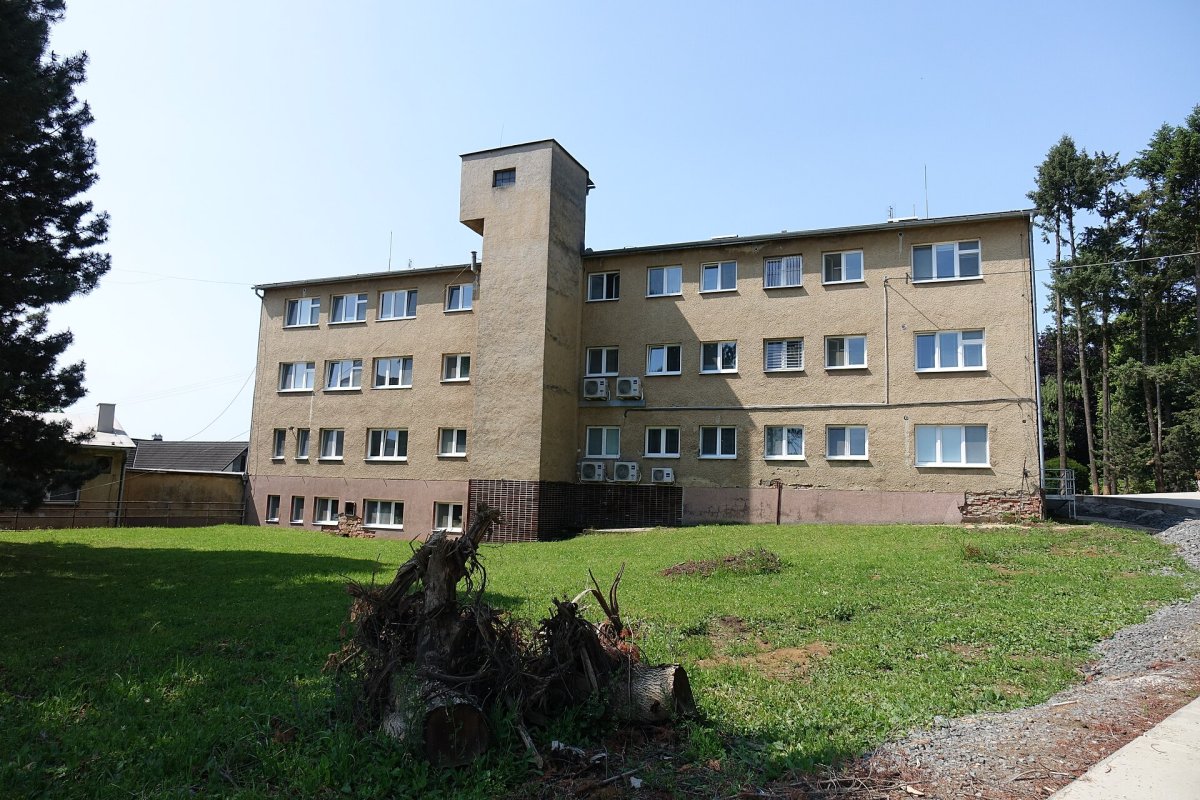
Illustrative photo: Pavilion 8 of the J. A. Reiman Faculty Hospital with Polyclinic on Hollého Street in Prešov, June 2025. Author Jozef Kotulič, Wikimedia Commons, CC BY 4.0.