
Key actors — tap for context

Transnistria
An unrecognized separatist entity on the left bank of the Dniester, which broke away from Moldova after the 1992 war; it is not internationally recognized even by Russia, which nevertheless keeps troops there.
Why here: Both schools discussed in this article operate here.
More info →Promo-LEX
A Moldovan human rights NGO that has long monitored the situation on the left bank of the Dniester.
Why here: It is the source of all the figures in this article.

Tiraspol
The largest city in Transnistria and the seat of its self-proclaimed authorities.
Why here: It is home to the Suvorov Military School, subordinate to the so-called ministry of defense.
More info →Bender
A city on the right bank of the Dniester that Transnistria effectively controls, even though it lies outside its declared territory.
Why here: It has a cadet school subordinate to the so-called ministry of internal affairs.

Moldova
A European Union candidate country between Romania and Ukraine that has no effective control over Transnistria.
Why here: Promo-LEX is calling precisely on its government to act.
More info →
Alexandr Suvorov
An 18th-century Russian generalissimo who founded Tiraspol and is a central figure in the Russian military cult.
Why here: The Tiraspol military school is named after him.
More info →Who are these children
Sixty-five children enrolled in the Suvorov Military School in Tiraspol, which is subordinate to the so-called ministry of defense. Another sixty-two enrolled in the cadet school in Bender under the so-called ministry of internal affairs — and there, roughly half of the new students are girls. NewsMaker ↗According to Promo-LEX, some of the children come from vulnerable families and boarding schools. That is a significant detail for this type of institution: a child who has nowhere else to go also has no real possibility of leaving.
What such a school looks like from the inside
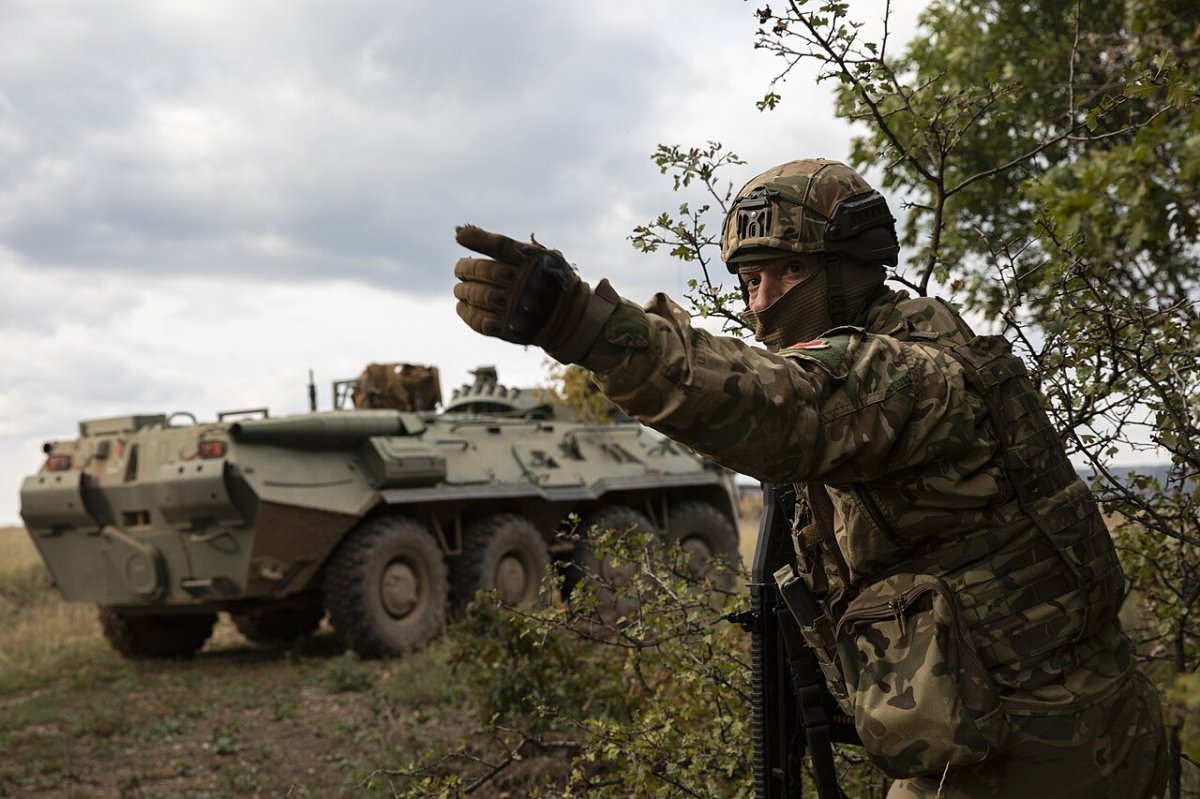
"The educational process is organized to reproduce, as closely as possible, the conditions and discipline of military life. From the age of eleven, children wear military camouflage uniforms, live under barracks discipline, and are under the constant supervision of military personnel," Promo-LEX writes. Ziarul de Gardă ↗Alongside regular subjects, they undergo military training, including training with firearms and with combat and reconnaissance drones, plus tactical training. The drone component is a newer layer — it's a skill with direct value on today's front line, just a few dozen kilometers away. NewsMaker ↗
When the schools were founded, and why it's not a coincidence
The cadet school in Bender was founded in 2002 and was the first educational institution with a military profile for minors in the region. The Suvorov school in Tiraspol is much younger — it was established with the support of the Russian Federation three years after the annexation of Crimea and the start of the war against Ukraine, at a time when Russian authorities were expanding their own system of military-patriotic education for children and youth, including new cadet classes. Ziarul de Gardă ↗According to Promo-LEX, both institutions prepare children for later incorporation into the regime's security and law-enforcement structures. The organization also claims that graduates are forced to sign long-term military service contracts, and that refusal exposes young people and their families to repression and persecution by the Tiraspol secret services. NewsMaker ↗
Why Chișinău won't stop it
Moldova has no effective control over the left bank of the Dniester, so its options are diplomatic rather than executive. And relations with Tiraspol are tense right now: the separatist authorities accused Chișinău of "new information attacks," and parliament speaker Igor Grosu responded by inviting them to come shopping in Moldova more often. NewsMaker ↗At the same time, the war around Moldova has palpably intensified. Infrastructure Minister Vladimir Bolea publicly acknowledged this week that Russia could attack the port of Giurgiulești, which Romania recently purchased. "The war has come too close to us," he said. Digi24 ↗
Read also: Moscow is escalating interference in Moldova, according to NYT
This is not the only way the war is affecting Moldovan citizens personally. This week, Moldovan media discussed the case of a thirty-seven-year-old man who was traveling by bus to visit his grandmother when border officials discovered he also held Ukrainian citizenship — obtained for him by his grandparents, without his parents' consent, when he was a minor living in Ukraine. He was taken away by staff from a territorial recruitment center and has been undergoing military training for more than three weeks now. NewsMaker ↗
Limits of this account
All the figures and descriptions of the schools' regime come from a single source — Promo-LEX. It is an established and respected Moldovan human rights organization, but it is also an advocacy one: its mission is to draw attention to these issues, and its materials are shaped accordingly. Independent verification directly in Tiraspol is practically inaccessible to journalists outside the regime.The claim about forced contracts and repression against families who refuse is also the most serious and the least substantiated one. Promo-LEX presents it as a risk and as its own finding, not as a documented individual case with a name.
It should also be said what this story is not: schools with a military focus for minors exist in NATO countries too, including military high schools and cadet programs. The difference Promo-LEX points to is not the existence of such a school as such, but the age, the barracks discipline, the weapons training, and the fact that a graduate has nowhere to go.
What hotinfo is watching
- Chisinau or the EU officially responded to the Promo-LEX findings
- Promo-LEX documented a specific case of pressure on a graduate or their family
- Enrolment in both schools rose again the following school year
- Another militarised school for minors opened in Transnistria
- Moldova raised the issue at an international forum, such as UN child-rights bodies