


The Irish government has for years warned against sanctions on the plant, and Prime Minister Micheál Martin calls them counterproductive. The Irish Times has just published documents showing how the company negotiated its Russian ties with ministers as far back as 2023.
Key actors — tap for context

Oleg Deripaska
Russian billionaire and oligarch, founder of the aluminum conglomerate Rusal, subject to sanctions by both the European Union and the United States.
Why here: According to the Swedish tax authority, he retained control of Rusal through the holding company En+ despite a formal change of ownership.
More info →
Micheál Martin
Prime Minister of Ireland.
Why here: He has called sanctions on the plant counterproductive, citing roughly a thousand jobs.
More info →
Simon Coveney
Former Irish Minister for Enterprise, Trade and Employment.
Why here: The plant's management told him in May 2023 that the invasion had created a difficult environment for the plant.
More info →
Volodymyr Zelenskyy
President of Ukraine.
Why here: In August he imposed sanctions on four Russian smelters that source raw material from the Irish plant.
More info →
Vladyslav Vlasiuk
Commissioner of the Ukrainian president for sanctions policy.
Why here: He claims that Irish raw material ends up in Russian missiles, though the Irish investigation neither confirmed nor refuted this.
More info →
Rusal
Russian aluminum conglomerate, one of the largest aluminum producers in the world.
Why here: It owns the Irish plant as well as the smelters that source raw material from it.
More info →
Aughinish Alumina
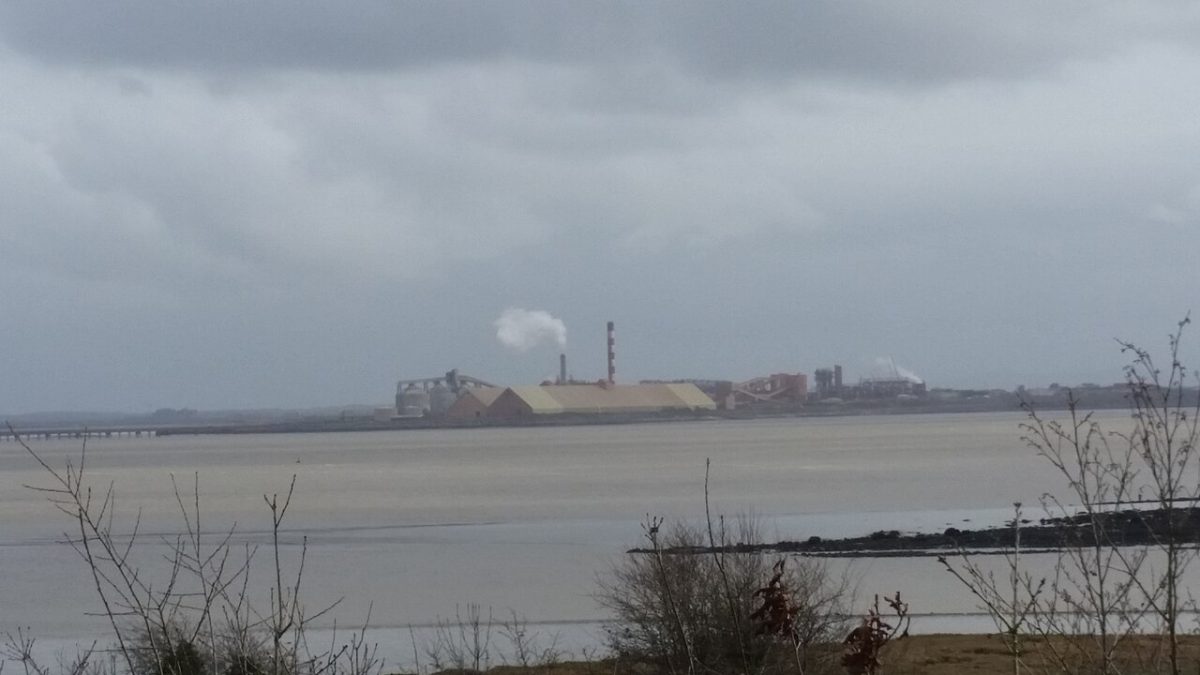
Alumina refinery at the mouth of the River Shannon in western Ireland, the largest of its kind in Europe, under Russian ownership since 2007.
Why here: In the first half of 2026, nearly 49 percent of its exports went to Russia.
More info →
European Commission
Executive body of the European Union that proposes sanctions packages.
Why here: It had not proposed a ban on alumina exports to Russia as of July.
More info →
European Parliament
Legislative body of the European Union.
Why here: In July it adopted a non-binding call for an export ban, though it cannot set sanctions itself.
More info →
Slovalco
Aluminum plant in Žiar nad Hronom, the only Slovak producer of primary aluminum.
Why here: It is the counterpart to the Irish case, having halted production due to electricity prices and now restarting it.
More info →What the documents obtained by The Irish Times showed
The newspaper requested records of the plant management's negotiations with Irish ministers and officials under the Freedom of Information Act. The Department of Enterprise initially refused to release them. At a meeting on May 10, 2023, the company told then-Minister Simon Coveney that the Russian invasion of Ukraine had created a "challenging environment" for the plant precisely because of the ownership structure through Rusal and Deripaska. The Irish Times ↗The same records also reveal what the company thanked the government for. It praised the "ongoing dialogue with and support from" the department in the years when it faced American sanctions. Washington placed Rusal itself and its parent company En+ on the sanctions list in April 2018, because of Deripaska's control. The companies came off the list at the end of January 2019, and the U.S. Treasury Department stated at the time that they had already reduced his stake and removed his control. Deripaska himself remained sanctioned. The Irish government lobbied in Washington on the plant's behalf at the time. The Irish Times ↗
It was precisely this mechanism that the Swedish tax authority called into question in July. In a seventy-three-page ruling, it stated that a Russian presidential decree excludes shareholders from "hostile states" from voting, and once they are subtracted, Deripaska's controlling stake in the parent company En+ rises to fifty-three percent and his voting power on the board to seventy percent. Control over Rusal runs precisely through En+, so, according to Sweden, the formal separation of the oligarch from the company does not work. The ruling directly affected the Swedish aluminum plant Kubal, which belongs to Rusal and whose tax account the authority froze in the amount of 56.8 million Swedish kronor, about 5.1 million euros. Kubal has appealed and warns of serious consequences for the region. The Irish Times ↗
The dispute over whether the raw material ends up in Russian missiles
In August, Ukraine imposed sanctions on five Rusal companies, including four smelters that source alumina from Aughinish, namely plants in Krasnoyarsk, Sayanogorsk, Bratsk, and in the Urals. Zelenskyy's sanctions commissioner Vladyslav Vlasiuk stated that, in Kyiv's view, there is no other explanation than that the Irish raw material is being used in Russian missiles. According to the newspaper, Krasnoyarsk alone took in about half a million tons in 2024, worth approximately 170 million euros. The Irish Times ↗The newspaper's own investigation mapped one link in the chain. It found that the sanctioned smelters sell a large part of their production to the trading company ASK, which supplies dozens of Russian arms manufacturers and is already on the Ukrainian sanctions list. Both Rusal and the Irish plant deny that their material is used in weapons, and according to the newspaper, the Irish government investigation produced no tangible evidence directly linking Aughinish to the Russian military or arms manufacturers. Meanwhile, exports are growing. For the whole of 2025, 775,985 tons went to Russia, averaging 64,665 tons per month and forty-three percent of the plant's exports. In the first half of 2026, it was 422,474 tons, 70,412 tons per month, and nearly 49 percent. The Irish Times ↗
In July, the European Parliament adopted a non-binding call for a ban on alumina exports to Russia; the entire resolution on Ukraine passed by a vote of 460 in favor, 136 against, and 59 abstentions. However, Parliament cannot set sanctions itself. The European Commission had not proposed a ban as of July, since, in its view, it would harm European industry. The Irish Times ↗ OCCRP ↗
The Irish argument rests on what the plant means both domestically and for the rest of the Union. Martin speaks of roughly a thousand jobs including suppliers, of which about 470 are direct, and of the refinery supplying critical raw material to smelters in France and Sweden. He described the negotiations with the Union as communication, not lobbying. The Irish Times ↗
Why read this from Slovakia
The Slovak reader has fresh domestic experience with the same metal, just from the opposite end of the chain. Aughinish produces alumina, an intermediate stage between bauxite and finished metal. The Slovalco plant in Žiar nad Hronom uses such raw material to produce primary aluminum and completely halted production in January 2023, when it stopped being profitable at the electricity prices of the time. TREND ↗At the end of August, it began restarting production. In the first phase, one hundred of 226 electrolyzers are being brought online, about 43 to 45 percent of capacity; the ramp-up is expected to run until the end of February 2027, and the restart costs over one hundred million euros. According to the weekly TREND, this is a test of the model by which Europe wants to keep energy-intensive industry alive, namely a combination of long-term electricity contracts, compensation for emission allowances, and private capital. TREND ↗
Also read: Slovalco is resuming aluminum production in Žiar nad Hronom
Thus stand side by side two European stories about the same metal. One plant keeps running, and its government fights for it in a sanctions dispute; the other fell silent for three and a half years due to electricity prices and is now resuming production with both public and private support. These are two different stages of production, and nothing suggests they are commercially connected. In both cases, however, the plant's fate was decided by politics — sanctions policy in one case, energy policy in the other.
Limits of this account
The factual record on Aughinish rests almost entirely on a single editorial line. The Irish Times has worked on this topic for a long time and in cooperation with other media outlets, so other outlets citing its figures is not independent confirmation but the same source in a different wrapper. It is also an Irish newspaper writing about the Irish government.The boundary of the evidence lies elsewhere than it might first appear. The newspaper documented that the buyer smelters sell aluminum to a trader that supplies arms manufacturers. What remains undocumented is the path of a specific batch of Irish raw material into a specific weapon, and that is precisely what the Irish investigation did not confirm. Kyiv, moreover, is a party to the war and has an interest in the sanctions.
The economic argument itself is also open. Whether sanctions would harm Europe more than Russia is a prediction, not a fact, and it is made by a government that has a direct interest in preserving the plant. And the comparison with Slovalco is only structural, not causal.
What hotinfo is watching
- Európska komisia zaradila zákaz vývozu oxidu hlinitého do Ruska do sankčného balíka, alebo ho zamietla
- Írska vláda zverejnila celú správu zo svojho vyšetrovania o možnom vojenskom využití suroviny
- Sú známe údaje o vývoze z Írska do Ruska za druhý polrok 2026 a porovnanie s 422 474 tonami
- Členský štát navrhol sankcie voči Rusalu na základe švédskeho zistenia o Deripaskovej kontrole
- Slovalco dosiahlo ohlásených sto elektrolyzérov a 43 až 45 percent kapacity