







Czechs and Slovaks know the legend by the same name. Folklorist Petr Janeček documented it with a police record from Pilsen dating from November 1988, and since then it has returned in new vehicles, on new networks and with new suspects. This first part of the HotInfo series traces where it came from, what the figures tell us about it, and why it has not been silenced by almost forty years of debunking. Seznam Zprávy ↗
Key actors — tap for context
Petr Janeček
Czech folklorist and ethnologist, author of the book series Černá sanitka
Why here: described the Pilsen police record of a black ambulance from 1988–1989 held in the Security Services Archive
More info →Zuzana Panczová
folklorist from the Institute of Ethnology and Social Anthropology of the Slovak Academy of Sciences
Why here: described how rumours about black vans in Slovakia were revived after the migration crisis

Verejná bezpečnosť
the uniformed branch of the National Security Corps that served as the police in Czechoslovakia
Why here: its Pilsen patrol inspected the place where a black ambulance was allegedly driving in November 1988
More info →
Škoda 1203
a Czechoslovak van from Vrchlabí, the most widespread ambulance of its time
Why here: according to Janeček, its black hearse version may have influenced the form of the legend
More info →
Edgar Morin
French sociologist and philosopher
Why here: in 1969 analysed the antisemitic Orléans rumour about women being abducted
More info →Aurore Van de Winkel
Belgian researcher of contemporary legends
Why here: describes how similar legends differ from country to country only in the type of car

Plzeň
a regional city in western Czechia
Why here: in November 1988, Verejná bezpečnosť investigated a report of a black ambulance here
More info →
Orléans
a city in France on the Loire
Why here: the setting of the 1969 rumour, a classic case in the study of legends
More info →Recea-Cristur
a village in Romanian Transylvania
Why here: in August 2026, a group of people attacked an ambulance crew here
Acatlán
a small town in the Mexican state of Puebla
Why here: in August 2018, a mob burned alive two farmers whom it falsely accused of abducting children

Ministerstvo vnútra SR
the central state administration body responsible for policing and internal security
Why here: in 2022 it stated that no child abduction had occurred in Slovakia in recent years
More info →
Policajný zbor
the police force of the Slovak Republic
Why here: repeatedly debunks reports of children being abducted by vans and advises people to call 158
More info →Centrum pre medzinárodnoprávnu ochranu detí a mládeže
a Slovak office dealing with cross-border child disputes
Why here: in 2024 it registered 41 new cases of parental abduction

WhatsApp
a communications app owned by Meta
Why here: rumours spread through it in India, after which mobs lynched innocent people
More info →
TikTok
a social network for short videos
Why here: in Romania, a claim that ambulances abduct children spread there
More info →Pilsen 1988: police searched for tracks in the snow
At half past nine in the evening on 24 November 1988, a nineteen-year-old girl arrived at the railway division of Verejná bezpečnosť at Pilsen’s main station. She said that as she walked along a country lane from Skvrňany to Křimice, she had been followed by a dark Škoda 1203 van, from which she had fled. The record says that, in her view, it might have been a black ambulance driving around Pilsen and picking up girls. The patrol inspected the site and recorded that the fresh dusting of snow contained no tracks showing that any car had left the road, and that at the bend every car would have had to shine its headlights in the direction in which the girl was walking. Seznam Zprávy ↗On 12 December, the City Administration of the National Security Corps issued a statement that the rumour about a black ambulance “has so far had no basis”. The only other lead was the alleged pursuit of apprentice girls in Křimice, which police learned about ten days later: three men were said to have jumped out of a dark car and the girls had run to a bus stop. Officers did not investigate the circumstances with the girls any further and linked the report to the Roma origin of two of them. Janeček calls the wording of the report racist. On 16 January 1989, the case was officially closed with the conclusion that no criminal activity was involved. Seznam Zprávy ↗
The rumour was not a Pilsen curiosity at the time. In the run-up to Christmas, the East Bohemian daily Pochodeň, the press organ of the regional KSČ committee, wrote about “incredible rumours” that a black ambulance was collecting children and removing their organs, with blue-eyed blondes supposedly most at risk. According to the newspaper, some schools urged children not to go outside after dark. The daily also noted that nobody had reported a murder or abduction to the security forces and that none of those spreading the rumour knew a specific victim. The regime labelled it whispering and did not rule out that someone was spreading it deliberately. Seznam Zprávy ↗
Black Volga, funeral “one-two-oh-three” and the film Fleisch
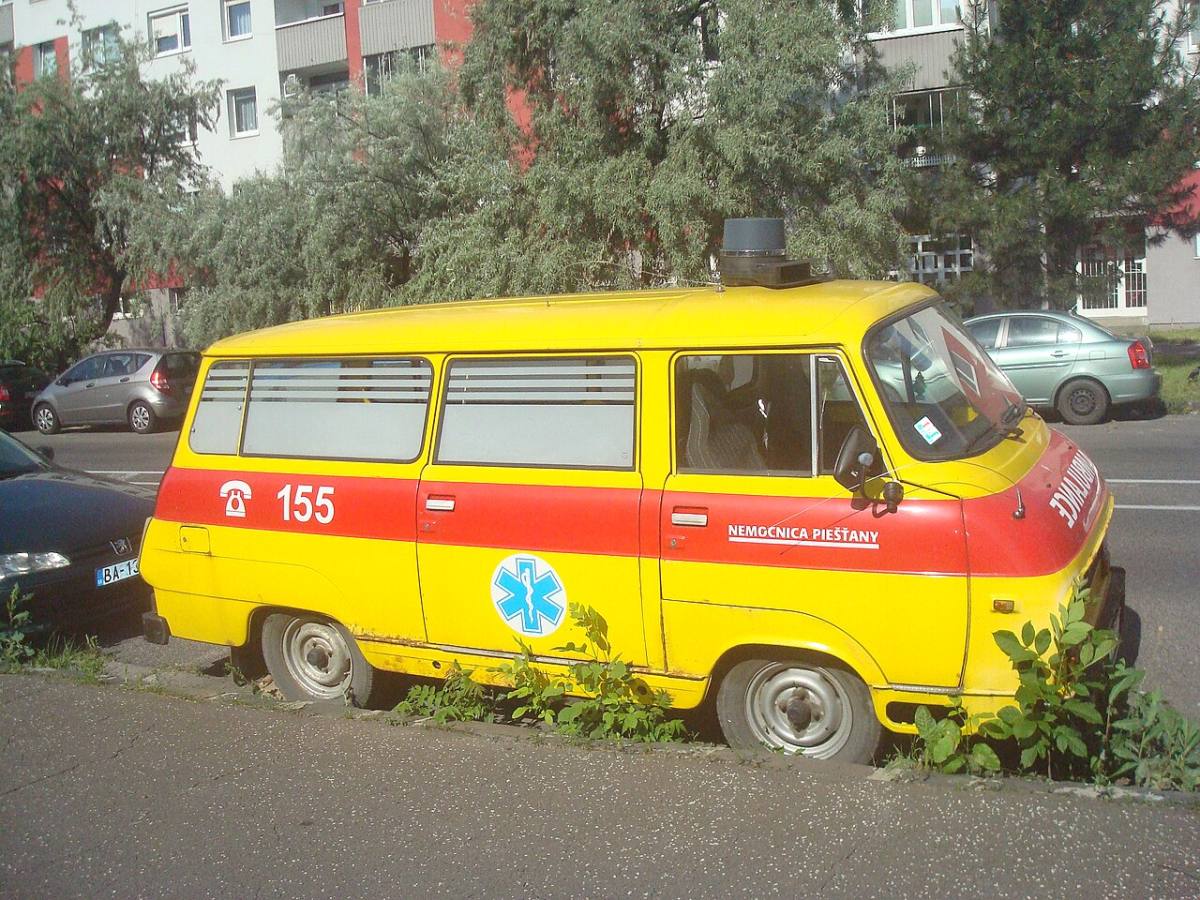
Czechoslovakia did not invent the legend. According to Janeček, it spread most widely in the Soviet bloc in Poland, where a mysterious black Volga supposedly drove around for nearly two decades abducting children. The antisemitic version blamed Jews for the abductions; other versions blamed priests and nuns. At the end of the 1980s, the rumour crossed the border and the Volga turned into an ambulance. Seznam Zprávy ↗Janeček sees two reasons for this change. The most widespread ambulance of the period was the Škoda 1203, which funeral services also used in black, and which people commonly called a “black ambulance”. The second was the 1979 West German thriller Fleisch, released here as Kandidáti života a smrti, whose plot revolves around an ambulance abducting people to remove their organs. Seznam Zprávy ↗ Wikipédia ↗
The legend was so widespread in the 1980s that, according to Czech Radio, Czechoslovak Television had to debunk it officially. In the Prague version described by the daily Právo, an ambulance slowly drives through the city at night and its crew looks for young, healthy people. According to Právo, it reflects a fear of the violation of one’s bodily integrity. Radio Prague International ↗ Novinky.cz ↗
The same skeleton, a different car
In the West, the same skeleton had different scenery. In May 1969, an antisemitic rumour spread in the French city of Orléans claiming that women were being abducted in the changing rooms of fashion boutiques and forced into prostitution. All the shops accused belonged to Jewish owners, and angry crowds gathered outside their windows. Police publicly announced that they had found no missing persons. In an essay from November 1969, sociologist Edgar Morin concluded that the rumour was not driven by any conspiracy but by a collective unconscious steeped in antisemitism. La Libre Belgique ↗According to Janeček, the 1980s and 1990s were the golden age of stories about cars abducting people for their organs. Vans were the most common vehicles, but ambulances, fire engines and police cars also appeared, and the stories spread across almost every continent. The alleged organ buyer was most often the United States. The rumour even reached the European Parliament, which adopted a resolution in 1988 repeating claims about an alleged organ trade. Seznam Zprávy ↗
Belgian researcher of contemporary legends Aurore Van de Winkel sums it up by saying that the story remains the same and only the detail changes according to local culture. French and Belgian versions feature a white van, American versions more often an ice-cream truck, and Russian versions a black Volga. Public Sénat ↗
Why it keeps returning
During her research, folklorist Zuzana Panczová of the Slovak Academy of Sciences also recorded Slovak local versions of the black ambulance, or of a yellow or white van that abducts children. In her view, legends respond flexibly to the fears of their time, whether those involved the satanic panic of the 1970s and 1980s, fear of HIV infection, or fear of terrorist attacks after 2001. She links the revival of stories about black vans to the migration crisis after 2015. One version spread on Slovak social media referred to an alleged incident in Krnov. Etnologické rozpravy SAV ↗Police see the same pattern from their side. A 2022 report by the Presidium of the Police Force on disinformation, published by the Interior Ministry, says that in 2018–2020 “standard narratives” dominated Slovakia’s disinformation scene, including migrants and child abductions. As late as 2022, false child-abduction stories were among the topics on which police published explanatory posts. Ministerstvo vnútra SR ↗
Social networks made oral rumours faster and more dangerous. In India, rumours about child abductors and organ theft spread mainly through WhatsApp; at least 23 people died in mob attacks and police arrested at least 600. In the village of Rainpada in Maharashtra, a mob killed five men from the nomadic Nath Panthi Davari Gosavi community on 1 July 2018. That month, WhatsApp launched a campaign against fake news in India and announced labels for forwarded messages. Wikipédia ↗
In Acatlán, Mexico, at the end of August 2018, a mob burned two farmers alive in front of dozens of onlookers. According to the daily Expansión, in Acatlán and two other cases that week, the mob falsely accused the victims of abducting children, and the rumour originated in messages shared on social media. Authorities said the alerts were false. Expansión ↗
In France, reports about a white van abducting children spread via Snapchat and Facebook in March 2019. In Clichy-sous-Bois and Bobigny, in the Paris suburbs, groups of people subsequently attacked Roma, and police detained 20 people. Paris police said that rumours of children being abducted by a van were completely unfounded and that no abduction had been established. In mid-March, about twenty youths pulled two men from such a van in Colombes and beat them. The Local ↗ Public Sénat ↗
The Romanian case from this summer is therefore not an exception. According to DPA, cited by Noviny.sk, claims about children being abducted by ambulances had circulated in Romania before, and distrust of state institutions has persisted for a long time in some poorer communities. The legend that Czechoslovakia knew as the black ambulance thus returned to an ambulance after almost four decades—this time with an injured driver. Noviny.sk ↗
Report by Romanian public broadcaster TVR Cluj on the suspects’ detention (in Romanian, 1:42):
What the figures say
In May 2022, the Interior Ministry said that 213 children were missing in Slovakia, including 51 minors and 162 juveniles. According to the ministry, in almost every case the reason was running away from home or from re-education centres, and no child abduction had occurred in Slovakia in recent years. It added that, with a high degree of probability, none had occurred in the entire history of independent Slovakia either. That is not entirely accurate. Noviny.sk ↗In December 2004, an unknown woman took a five-month-old baby from the lobby of the children’s hospital in Bratislava’s Kramáre district, where the baby was waiting with its mother for an ambulance. Police found the child unharmed that same week and detained a woman who, according to police, had planned the act for a long time because she could not have children herself. A genuine abduction by a stranger is therefore exceptional in Slovakia, not impossible, and looks nothing like a van outside a school. Pravda ↗
When debunking reports about vans, police distinguish abductions by strangers from so-called parental abductions. In January 2019, the Presidium of the Police Force wrote that minors and juveniles were not being abducted in Slovakia, and listed running away from home, leaving with an older partner and parental abductions among the most common reasons for people going missing. Startitup ↗ Právne noviny ↗
Those do have real figures. In 2024, the Centre for International Legal Protection of Children and Youth registered a total of 41 new cases of the unlawful removal or retention of a child across borders, compared with 36 the year before. Nineteen involved the removal of a child from Slovakia abroad and 22 the removal of a child to Slovakia. CIPC ↗
The picture is similar in Czechia. Jan Rybár, head of the Czech criminal police’s search department, said in December 2022 that police launch searches for about 2,000 children a year, although most cases involve running away from home or substitute care. According to him, abductions by strangers are extremely rare—at most one every few years. In 2024, the Office for International Legal Protection of Children handled 56 international child-abduction cases, 37 from Czechia abroad and 19 in the opposite direction; the office says parental disputes are increasing. Deník ↗ Advokátní deník ↗
Why we believe it
Janeček explains the credibility of these stories by their structure. “They look real,” he told Právo. The setting is usually an ordinary place, home, car or shopping centre, and the narrator often claims that the event happened to an acquaintance of an acquaintance—someone we do not know, but whom someone close to us does. Novinky.cz ↗According to him, most contemporary legends sound like warnings. "You have a feeling that our society is endangered by someone or something and people like to warn others," he told Czech Radio. A parent may therefore forward an unverified message believing they are protecting other children. Radio Prague International ↗
Bratislava demonstrated the mechanism well in March 2023. While police were investigating reports of a white van, they also contacted several schools, whose headteachers sent mass warnings to parents. On 8 March, police announced that no abduction attempts had occurred and that “in all cases, the minors and juveniles had made up these stories”. The second part will examine specific Slovak and Czech cases. Noviny.sk ↗ Startitup ↗
Who pays the price
A legend about abductions almost always needs a culprit, and the culprit is not chosen at random. Polish versions falsely blamed Jews or members of the clergy; in Orléans, the rumour targeted Jewish shopkeepers. In the Pilsen report, prejudice appeared in the way officers wrote about two Roma girls. In Slovakia, according to Panczová, the legend became linked to fear of migrants after 2015. Seznam Zprávy ↗ Etnologické rozpravy SAV ↗When a rumour moves from words to deeds, the people who suffer are those who have nothing to do with it: Roma in a Paris suburb, five men from a nomadic community in India, two farmers in Mexico, or an ambulance crew in Romania. That is why it matters what we do when we hear about a van near a school. The Local ↗ Expansión ↗
What the police advise
Anyone who witnesses a suspicious event should, according to Slovak police, immediately call the free emergency number 158 and report as many specific details as possible: a description of the person, the type and colour of the car, and its registration number. Spreading panic on Facebook or through a municipal loudspeaker helps nobody, police say, and if children are at risk, they will inform the public immediately through the media. Startitup ↗Published searches for missing children can be viewed in the database on the Interior Ministry’s website. If your child goes missing, report it to the police immediately; you do not have to wait 24 hours, as films often suggest. SITA ↗
The second part of the series will look at what police discovered when investigating Slovak and Czech alerts in recent years, and who was sitting in the vans that were found. The third part will examine what the rumour causes when people start taking it seriously.
Photo: Škoda 1203 ambulance in Bratislava, Kelovy / Wikimedia Commons (CC BY-SA 4.0)